

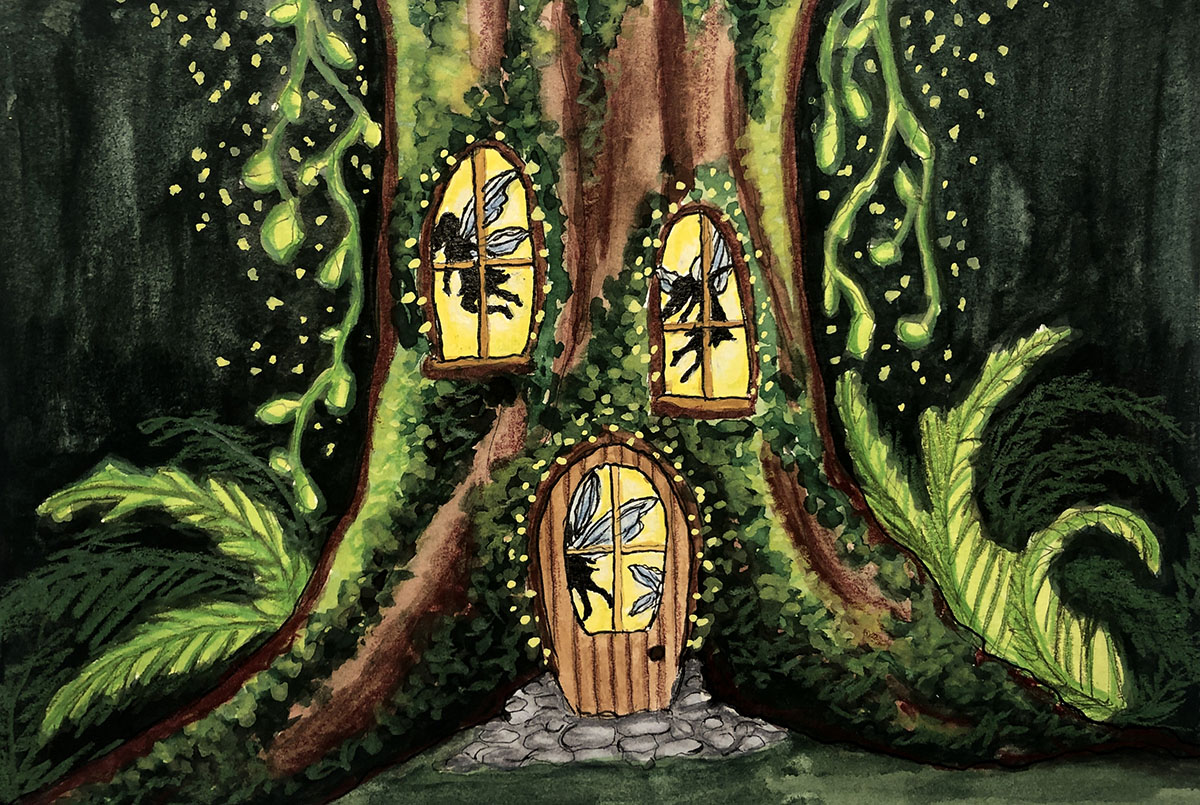

“I really want a family of choice, but I have real trouble with the metaphor of ‘family,’ it just doesn’t work for me,” I said. “So I’m trying out other metaphors. Lately I’ve been wondering if I can have a fairy court. Maybe that’s how I can conceive of my family of choice.”
“Oh!” said “Nina,” so enthusiastic it startled me. “You should have a fairy court! I love fairies! I have since I was a little girl!”
“Really?” I said. “And what’s your relationship with fairies now?”
She considered. “Thomas built a little fairy house by our house. He did it himself, I didn’t ask him, and I adore it, and it’s so sweet. If you’d told me as a little girl that someday I’d be marrying a man who would build me a fairy house on our lawn … well, I couldn’t have believed it. Not even a little. Somehow, it was easier for me to believe in fairies than to believe I’d find someone who loved me like that.”
I’d gotten together with Nina and her fiancé, “Thomas,” in the Mission for dinner. Thomas was one of my favorite creative collaborators before he moved to San Jose to buy a real house and have a real life … whatever that is … leaving his artistic community to stay behind in this strange and magical city where we never grow up. I didn’t know Nina very well, but after dinner Thomas had to go to the event that had brought him up here, and Nina asked if I wanted to grab a drink while she waited for him.
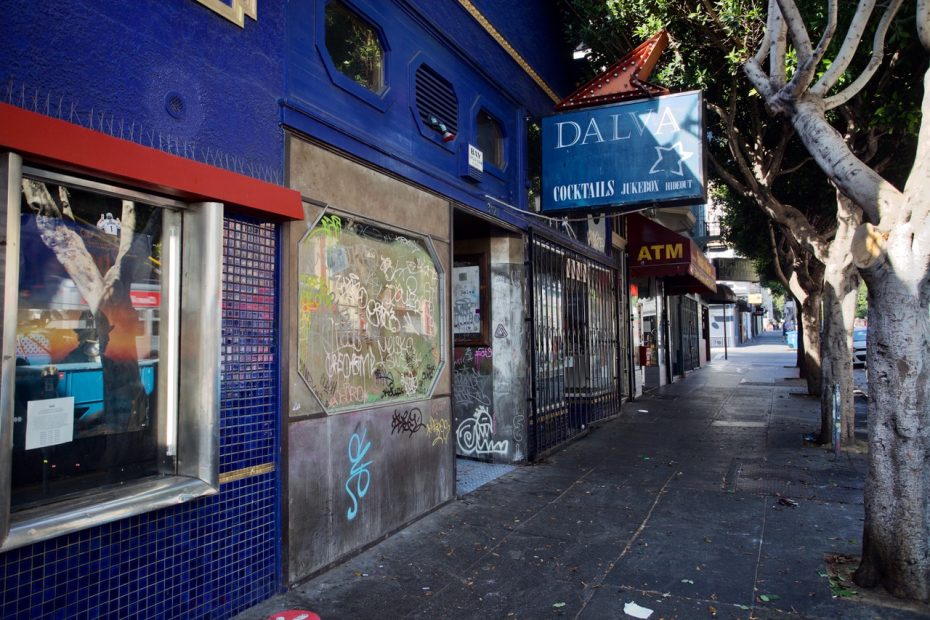
Yes, I told her, yes I did, because on the way over I’d seen that Dalva had finally re-opened, and I really wanted to go in.
It turned out she had never been to Dalva. It turned out that, even when she had lived in the Mission, just around the corner, she had never been to a bar here. “There was a lot of guilt I got from my family about drinking and extravagance, and so I never actually did,” she admitted. I considered teasing her about this, but decided not to — the kind of sincerity she was expressing was best answered with sincerity. I considered for a moment if there was another bar I wanted to take her to for her first Mission bar experience, and then decided no — Dalva works well.
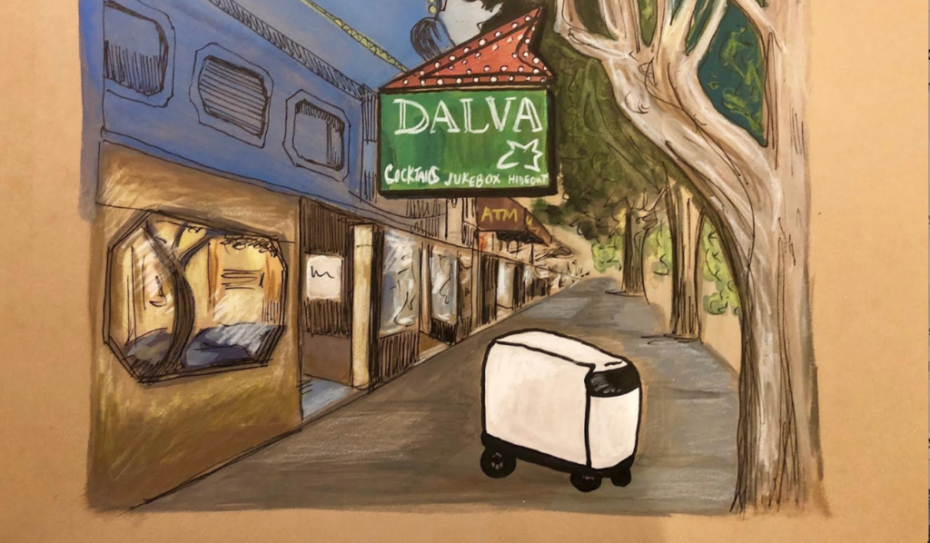
From the before times:
Distillations: Watching the weirdness at Dalva
Jon told me not long ago that he is a “paleotheist” — a fully observant Orthodox Jew. Now, sitting across from me at a window-side table at Dalva, sipping a dry martini, he tells me that he’s really more of a “periodically” observant Jew, and that the God he truly and sincerely believes in is…

I have so many good memories of Dalva, and while I noticed it was closed during the pandemic it pains me a bit that I didn’t realize it was open again. “Is this it?” she said, peering through the front window, the other side of which offers one of the best people watching perches in the Mission, and I opened the door.
Dalva was crowded but not packed; there were seats at the bar and plenty at the tables in the back, but we squeezed in to the bar. I saw there were menus behind the bar, so instead of waiting I grabbed two of them and we began looking through. The bartender came over a minute later and gave me a look — “Oh,” he said, “you’ve already got some” — and made it clear I’d committed a small foul. “Do you know what you want?” he asked.
I ordered a New Wave Fix (gin, rancio wine, lemon, pineapple, toasted coconut-chartreuse, $15), Nina ordered an Altered State (mezcal, blanc vermouth, gentian aperitif, $15). The bartender nodded, put down two glasses of water at exactly parallel spots on the bar, and took one menu and adjusted the other so that it was symmetrically arranged between the glasses. Once satisfied that the arrangement on the bar was aesthetically pleasing, he went off to make the drinks.
Sometimes this kind of attention to detail can feel overbearing (I once all but got into a fight with a bartender who simply wouldn’t let me put my bowl of peanuts where I wanted it to be on the bar). But in this case, it felt like care. I was sorry I’d grabbed the menus and gotten in the way of his flow.
While we were at dinner, Nina and Thomas had asked me if I’d officiate their wedding. I’d been floored by the request. It was such an honor.
“We both concluded independently that we wanted it to be you,” Nina had said. “So when we talked about it for the first time, we already agreed.”
“I …” I’d been reeling with pride. “I didn’t think you knew me well enough to want me to do something like that.”
Now, in Dalva, we picked up that thread again while we waited for the drinks.
“Do you know the reason I thought of you to officiate our wedding?” she asked. “I don’t think I’ve even told Thomas this … it’s because the ‘coming out of the pandemic’ ritual party you thew in Oakland was the moment I realized ‘I’m going to marry that guy.’”
“Really?” I’d had no idea.
“Yeah. I was the first person to go through the whole ritual, and Thomas was working his industrial strength bubble machine at the end of it, and while I came through and the bubbles flew all around, we gave each other a look, sort of a nod, that said ‘yeah, we’ve got this,’ and I realized we’d been through the whole pandemic, and it had been so horrible, and we were still so happy with each other … yeah, I just realized, ‘I’m marrying him.’ So since you’d created the ritual where that happened, I wanted you to help create the ritual of our wedding.”
We have no idea the kind of impact we have on each other.
The drinks took a long time to reach us; perhaps, in part, because the bar was filling up. “I’m sorry about the delay,” the bartender said as he set them down. He was sincere about it, and we were happy to wave the concern away. I decided I really liked him, in part because he seemed much more concerned with doing his job right than he did with whether or not I liked him.
The drinks were worth the wait. Dalva had always been a home for strong mixology, a cocktail bar that competes with the best (I don’t think I’ve ever had a beer here), and closing down for years hadn’t changed that. Eventually, I would order a second drink, “The Secretariat” (cap corse, pear brandy, lemon, yerba santa bitter, ginger, sparkling wine). It was a very different drink … I don’t recommend it to follow the New Wave Fix … but it was also excellent. Nina, however, would nurse her single drink all night. “I can’t really drink,” she said. “I can’t handle it.”
The tables had all filled up since we’d first sat down, but we saw an open one and decided to change positions and grab it. The candles on the tables in this area gave the space a lovely ambiance, but somehow made her eyes water and me cough. We blew the candle on our table out, which helped a bit.
The sad truth that I didn’t offer to Nina is that after three years of pandemic, I can’t hold my liquor now either. I’ve become the kind of lightweight drinker that I used to roll my eyes at. I’d had a full meal before we got here and these two drinks were still killing me.
This is changing my life. I’m probably healthier for drinking less, but I’m not who I was, and I can’t do what I used to do.
I thought about this as Nina went to look for the “secret bar” in the back, which I’d told her Dalva is famous for but which, alas, wasn’t open that night — one more mythic place that she has yet to see with her own eyes. We are all different now. But it’s not all bad: She and Thomas have gone through the intensity of living together in isolation and came out stronger. And now she’s finally been in a Mission bar. Dalva is open again, and the atmosphere is still lively and the drinks are still great. And now she believes in love more than fairies.
Once upon a time the writers and readers at Adobe Books would migrate into Dalva for more writing and reading in the secret bar.
I love Dalva! so glad its open again…During Occupy the more intellectual part of the movement would grab a table in the upstairs room and we would talk about the potential for a democratic society and we didn’t give a damn about gov’t approval. Great plans were hatched, and carried out! The revolution will be toasted!