


I was sitting with Alaric in the back patio of the Sycamore, which has been her regular spot for at least five years. Walking in with me, she narrated a complete description of its ups and downs.
“Don’t sit in the front room unless it’s not crowded, because the acoustics are weird and so it sounds weird, go to the back patio instead. Avoid the bottomless-mimosa brunch on the weekends, because it’s just way too crowded. In fact, you usually shouldn’t even try the weekends. This is a great weeknight and afternoon bar. It’s just a beer and wine bar, and it’s just, you know, beer and wine, but that’s the point. The food is really good. The french fries are killer. Do you know Paul? You know Paul, right? He did that mural back there, he comes in every few months and adds something.”
I do know Paul. And I know the Sycamore, which over the years has indeed become a hotspot for artist and bar industry types, almost a byword at times: This is their space. I don’t come here often enough because I’m a cocktail guy, but it still means I don’t come here enough.
Alaric ordered a malbec, I ordered a Fin du Monde, and we bumped into “Taylor” on the way to the patio. Taylor used to be Alaric’s friend, and they hadn’t seen each other in a while.
“Wow, you’re back in town?” he asked Alaric. “I thought you were exploring the strange outer reaches of the country!”
“No,” she said. “That stopped, like, two years ago.”
“Oh!” he said. “Okay. So, you’re back to living on the boat in Oakland?”
“No,” she said. “The boat sank.”
“It … what?”
“Sank.”
“Oh … ”
“I’m living on land now. I’m a bartender.”
“Well … You still have a dog, right?”
“Yeah, still have the dog … hey, why don’t you join us in the back when you’re ready? We can catch up then.”
So there we were in the back — squeezing into one of the fully occupied picnic tables there. Alaric had lamb sliders, I had a pulled pork sandwich, and Taylor joined us. It turned out he’s a computer security consultant, and he likes being one, but all his favorite companies to work for on the West coast are hiring people in-house now, so he’s thinking of getting a full-time gig.
“Besides,” he said, “there’s a market correction coming and when it does … all the capital is going to dry up.”

Somehow we moved on from job talk to discussing psychology and institutionalization, and the way in which many mental health issues actually manifest differently across different cultures.
It was around then that Taylor revealed that he actually had a different perspective than us on a lot of the things we’d been talking about, but hadn’t said anything because he hadn’t wanted to ruin our evening, and so we probably shouldn’t have this conversation now.
Alaric and I looked at each other, and blinked. “Wait,” she said, “do we seem like people who aren’t used to someone disagreeing with us?”
How long has he been sitting there thinking, “they’re wrong! They’re wrong!” and not saying anything, I wondered. And what is he afraid is going to happen?
“We’ve had lots of arguments,” Alaric said, indicating me. “Happens all the time.”
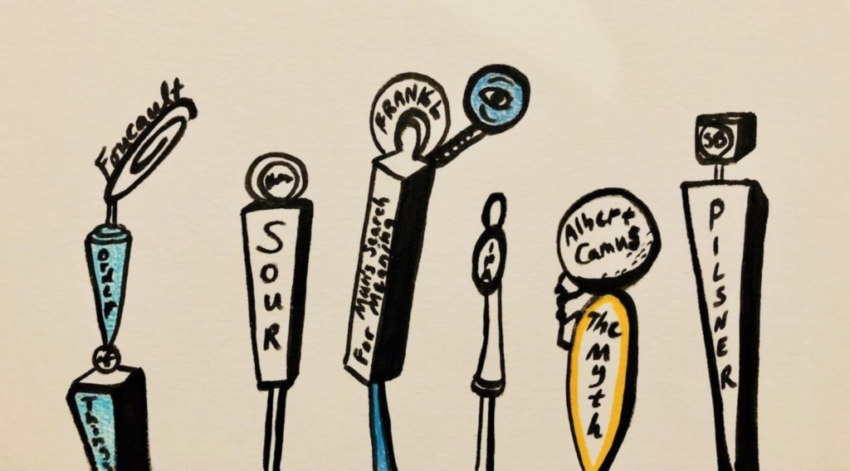
“There was knock-down drag-out about Michel Foucault, while we were playing Halo,” I said, remembering a more innocent past.
“That’s right!” she said. “Although, I don’t feel nearly as strongly about him now.” She looked back at Taylor. “And he and I are still friends,” she said. “You see?”
“Okay,” Taylor said, “okay. So … I have a different reference point than you, and I’m going to start it by saying: The first question is suicide.”
He looked at me. “I suspect you get the reference.”

I did. It’s to Camus, who wrote in The Myth of Sisyphus that “There is only one really serious philosophical question, and that is suicide.”
Taylor went on to explain that he’s an absurdist, and that none of the other thinkers or ideas we’d been referencing that night really work for him, because only existentialism makes any sense, and of the existentialists Camus was the only one who said that life is meaningless, but you can create meaning within yourself. So Camus was the only thinker that mattered here, because he gives you a reason to go on.
Alaric and I stared at each other as I stammered. “What … what are you talking about? That’s what almost all of the existentialists said! That … that was their whole project!”
“No, it wasn’t,” he said. “Really it was just Camus.”
“Okay, this is weird,” Alaric said to me, just before I pulled out my phone to look for citations. “Every time we go out now, we’ve get into some kind of argument about existentialism with strangers.”
And, goddamn it, she’s right. This is at least the third time in a row. An image flashed through my head of us as one of those couples that goes around to bars on a constant prowl for a threesome, only we just want somebody to argue about existentialism with. What the hell kind of dynamic is that?

[dropcap]“I[/dropcap] think we need another round,” Alaric said, and walked back out to the front bar. The Sycamore was packed and the bar is small, leaving a constant crush of people around it, so she was gone an uncomfortably long time, leaving me and Taylor to engage in a pointless argument over basic facts about people who essentially said you have to create your own reality anyway.
By the time she made it back with more beer and wine, Taylor was either silently evaluating the error of his ways — having had the revelatory and life-changing realization that he had not understood existentialism at all, and that what he thought was a profound moment of enlightenment was in fact just a basic premise that everybody knew — or I had beaten him into intellectual submission. It could go either way; it’s hard to tell.
With our new drinks in hand, we talked about cooking instead. I was mostly silent as Taylor and Alaric got into a heated debate over crockpots and the appropriate ways to cook large slabs of meat. Taylor was dismissive of a recipe Alaric’s mother used to make, and by the time we finished our drinks, said goodbye, and went to settle up, she was steaming like the meat in a broiler.
“What got into him?” she asked me outside as we walked towards BART. “He didn’t used to be so dismissive. Everything about that was kind of rude.” She’s never gotten that angry about existentialism.
“Maybe he’s having a market correction,” I suggested. “Psychologically speaking. A lot of us are grabbing on to whatever can stabilize us, and maybe we accidentally bumped into that. Made it feel unsteady.”
“True. It was one of those conversations,” she said, thinking, “that seemed like it was about something else.”
“Or maybe somebody who is a security consultant is always going to feel somewhat insecure?”
We’ll probably never know. People are a mystery, building up whole worlds of secret meanings and hidden connections, while you stare, and drink, and argue about cooking and philosophy, never seeing what’s really going on. But you do it together.