

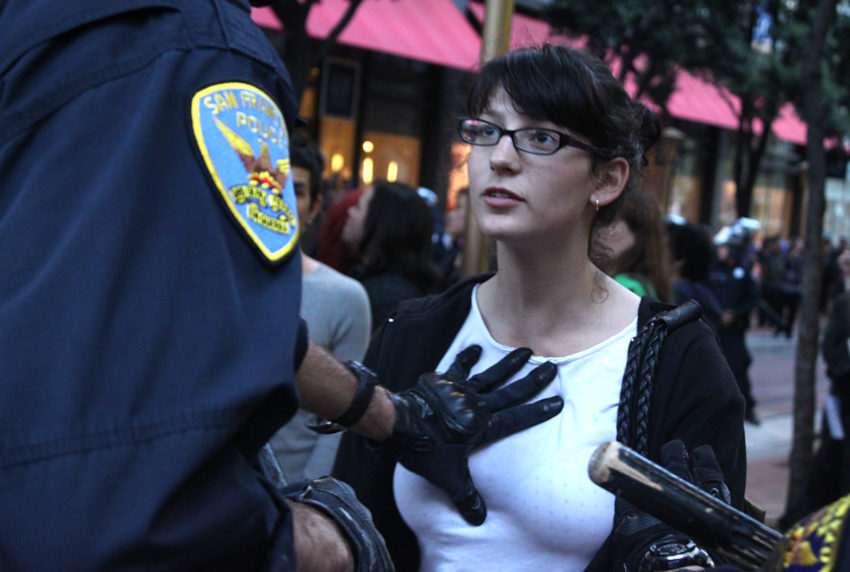
Update (11:55 a.m.): SB1421 has been passed out of committee and is now headed for a Senate floor vote. This is the farthest legislation aimed at making police misconduct records public has gone in a decades-long effort.
“We commend the Senate Appropriations Committee’s passage of SB 1421 and look forward to seeing the bill to the finish line to increase police transparency and accountability in California,” the ACLU said in a statement released this morning.
The fate of legislation aimed at strengthening trust between police departments and the community and improving police accountability will be decided this Friday in Sacramento, but it is up against the odds of history and the forces of a powerful lobby.
The legislation, SB-1421 by Sen. Nancy Skinner, D-Berkeley, seeks to loosen tight restrictions on public access to police misconduct records and police shooting investigations. Skinner introduced the bill following the fatal police shooting of Sacramento resident Stephon Clark in March that sparked protests throughout the State Capitol.
California’s law-enforcement records are some of the least accessible in the country, thanks in large part to a 1978 law signed by Jerry Brown that restricted access to information from police personnel files. California is one of only three states that specifically prohibit internal police records from public view.
On three other occasions in the last decade, state legislators tried, and failed, to pass laws that made police personnel records more open to the public. With greater access to these records, the public would have a better understanding of which officers have committed serious misconduct on the job — such as sexual assault and falsifying evidence.
Right now, that information is confidential.
The legislation would also make available details of an investigation when an officer is involved in certain use-of-force incidents such as police shootings.
In 2016, then-Sen. Mark Leno tried to pass a similar bill, but it died in the same committee where Skinner’s bill is now awaiting its fate.
Proponents of the legislation, however, are confident SB1421 will not meet the same end as its predecessors. “Things are different — Ferguson, Black Lives Matter — there’s been a change in the way people view police,” said Lizzie Buchen, a legislative advocate with the American Civil Liberties Union.
The tenor of the debate, she said, has changed, despite the grip police unions and lobbying groups have on the state’s elected officials. She pointed to statements made by some members of the Public Safety Committee, where the bill passed 5-2 on April 17 and moved on to the Appropriations Committee.
“It’s a sophomoric argument, and I think we need better,” said Sen. Holly Mitchell, responding to testimony at the Public Safety committee by law enforcement lobbyist John Lovell, who argued that allowing the public to see misconduct records, even in rare circumstances, will be “dangerous” by creating a misperception that the officer did something wrong when they might have been acting within policy.
Buchen noted, too, that Skinner’s bill is narrower than Leno’s previous iteration. Indeed, Leno’s bill would have allowed misconduct records to be made available if a police department found that an officer had committed a broad range of serious misconduct, as well as public access to citizen complaints and disciplinary proceedings against officers.
Skinner’s bill would only allow misconduct records be made available for incidents of sexual assault and incidents relating to dishonesty by an officer — if those incidents are sustained.
But, like Leno’s, Skinner’s bill allows materials involving police use of force, especially police shootings, to be available to the public.
With Skinner’s bill, for example, the public would know if officers involved in recent shooting incidents had a history of misconduct, such as sexual assault or falsifying records.
“This bill is more narrowly tailored,” she said. “We are looking specific categories that are most in need of public scrutiny.”
Despite the momentum, the legislation’s opponents have donated big to most members of the Senate and, more specifically, the members of the committee that decides whether it moves forward to the Senate floor.
“Unfortunately, there is very intense opposition that, of course, comes from all of the statewide law enforcement associations,” said Leno, who attempted similar legislation twice and is now is the heat of a mayoral campaign in San Francisco.
He said he has been able to work with those law enforcement organizations successfully on other issues. “But when it comes to this one, at least in the past, there has been little opportunity to have any kind of successful negotiation,” he said.
One of the law enforcement organizations responsible for hefty political donations is the Peace Officers Research Association of California. Over the last 21 years, the group has given some $11.7 million in state elections. That means most California legislators — including those on the committees that decide whether certain bills see the light of day — have received thousands from the association.
Everyone on the Appropriations Committee has received donations from the association.
However, Bradford and Wiener, who also sit on Public Safety Committee, both voted for the bill to move forward, despite the contributions. Sen. Mitchell, who called the law enforcement lobbyist’s argument “sophomorish,” has received $13,800 from the research association since 2012.
Most members of the Public Safety Committee, which voted in favor of the bill, have received contributions of the research association.
And even Skinner, who authored the bill, received $17,000 from the group for her successful 2016 senate bid. Over the last 21 years, the group has given roughly $11.7 million to state elections.
“I’m optimistic this thoughtfully crafted bill will reach the Senate Floor and be passed,” she said when asked about her confidence in the bill, given the failure of others in the past.
On Friday, the Senate Appropriations Committee will announce which legislation that has been placed on the so-called “suspense file” — where bills that could cost the state more than $150,000 are referred for further analysis — will move to the Senate floor for a vote.
Some have referred to the so-called suspense file as a “black box,” as it is unclear exactly how legislation that’s placed in the file is considered suitable for the Senate floor. This is where Leno’s 2016 legislation met its ultimate demise.
Leno said house leadership, specifically the committee chair and the Senate President Pro Tem — right now Sen. Lara and Sen. Toni Atkins, respectively — will decide if the bill gets to move forward.
“That subjectivity clearly allows for policy considerations and even political considerations to enter into whether the bill moves forward,” he said.
Regarding whether he thinks his former colleagues will move the bill through, Leno said, “I certainly hope that reasonable and thoughtful minds would prevail.”
