

[dropcap]It [/dropcap] was a hurricane that blew them off the island. It was hunger, hopelessness and chaos that put them on that boat out of Puerto Rico, then a train, and, finally, the solid ground of San Francisco. And then things took a turn for the worse.
San Franciscans awoke on the morning of Dec. 15, 1900, to a jarring, front-page photo in the Examiner of a tearful Puerto Rican woman having her toddler wrenched away from her by a droopy-mustached man, and being forced up the gangplank of a Hawaii-bound steamer. The woman, reads the caption “was unwilling to go” and “protested energetically until her child was taken from her arms. Then she went aboard.”
But more than 50 of the roughly 120 islanders “escaped” from their “slave-drivers,” as the papers called them. A man named Jose Morales told the Los Angeles Times that he had no desire to be “kept with the Chinese and only earn 25 cents a day.” Rather, he was optimistic “that the people of San Francisco would take care of us and we would get plenty of work and make $2 or $3 a day.”
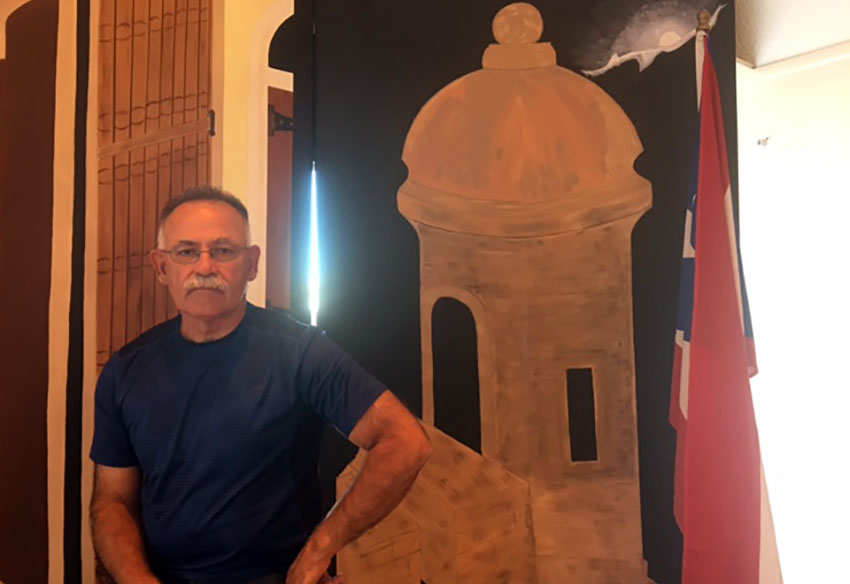
Not quite 120 years later, Al Ruiz is standing in back yard of the Club Puertorriqueño de San Francisco, of which he is president. Founded in 1912, the club bills itself as the oldest extant Latino organization in the United States. This is counter-intuitive, and especially so here in San Francisco. When those 60-odd “slaves” jumped ship in 1900, there were only seven Puerto Rico-born residents of San Francisco. Even now, there are only an estimated 4,500 Puerto Ricans living in the city.
The club, on the 3200 block of Mission, is in the heart of a vibrant neighborhood. But to be Puerto Rican in San Francisco is a unique experience. “We are a minority among a minority,” admits Ruiz. He hears plenty of Spanish around here, but very few Missionistas speak with the distinctive snap of Puerto Rico. Ruiz, who was born in Quebradillas, can quickly detect if you, like him, grew up in the countryside or in a big city like San Juan; Puerto Ricans have a way of truncating words, a tendency that is only emphasized in the rural areas. Ruiz actually lives in Salinas and drove a long way to meet me here today. But he makes this drive often. He feels a deep yearning to be around his people.
Out in the backyard, Ruiz shows me the ramp he built so older members of the club can be wheeled in. He’s 63 years old and built like an aging rugby player; it comes as little surprise he was a cop for 32 years after leaving the Army. This ramp looks like it was constructed by a contractor, but Ruiz shrugs that off. “I built my own house when I was 18 in Puerto Rico,” he says. “I was poor. But not without will or skill.”
Building that ramp was a necessity. The club “is looking for new blood.” And, it figures, new blood is on its way — to the mainland, to this and many large cities.
It was a hurricane that blew them off the island.
[dropcap]In[/dropcap] Puerto Rico, hurricanes are named after the Saints’ Days. There are many saints and almost as many hurricanes. There was San Felipe (1928), San Ciprián (1932) and Santa Clara (1956). Hurricane Hugo did a number on the island in 1989 and, of course, so has María this year. But the big one was San Ciriaco in 1899. When that monster washed over the island, killing 3,000 or more people and leaving more than 250,000 desperate and homeless, it set in motion the chain of events that would leave Puerto Rico reeling even before this year’s devastating storm.
San Ciriaco occurred during the nascent United States military occupation of the island. Now a budding colonial power, the U.S. provided aid to its subjects. But it did so in a way that made the survivors’ lives worse. Giving aid directly to the afflicted, it was reasoned, would create a nation of beggars. Instead, the relief was given to the island’s well-off planters to distribute to the needy. But only to the needy who signed work contracts — contracts “that lowered their traditional wages and made them even more dependent,” writes Stuart Schwartz, a Yale professor of Latin American history.
The U.S. compounded this by devaluing the Puerto Rican currency — instantly reducing the net worth of every islander. Usurious loans and a rash of predictable defaults soon resulted in the majority of Puerto Rican land ending up in the hands of absentee overseas owners.
In short, when faced with a humanitarian crisis, the United States instituted steps that impoverished the Puerto Rican people, enriched American banks and businesses, and led to an exodus from the island. Schwartz now worries that the initial steps from the Trump administration are an echo of that past.
The president’s first statement on the crisis — made via Twitter, of course — was a rebuking of the island for its troubled economic state prior to the disaster, and a pledge that Puerto Rico must continue to service its crippling debt.
It was a remarkably galling position for a man with a history of serial bankruptcies. It was a statement so lacking in empathy as to border on sociopathic.
Puerto Ricans, to the surprise of many Americans, are Americans (though our nation’s tepid response to this disaster belies that). The Jones Act of 1917 provided them citizenship and, just like that, 40,000 were drafted to fight in the trenches of Europe. Quite the Faustian bargain.

[clear]
[dropcap]Al [/dropcap]Ruiz has already begun funneling money to his home island. His former police colleagues have agreed to pass the hat and, Ruiz pledges, the Club Puertorriqueño will be contributing a “significant” amount. “It’ll be a drop in the bucket,” he admits. “But there are going to be many drops trickling in. Hopefully, the bucket is filled.”
In truth, however, Puerto Rico could have benefited from this money long before — or from being allowed to keep more of its own money. Even a layman like Ruiz could tell the island’s infrastructure was crumbling; rotting power poles were not replaced but, instead, braced with more poles (a poor idea in a nation that faces severe storms every year). But dollars that could have gone toward fixing this or stimulating the economy were instead spent on servicing the debt.
There’s plenty of blame to go around for Puerto Rico’s fiscal crisis. But, for more than a century, nearly every economic decision has benefitted the mainland at the island’s expense. And while the racism and classism of the 1900s is no longer overt, Schwartz notes that Puerto Rico’s most critical decisions are still made by a “fiscal board” entirely appointed out of Washington, D.C.
Like Ruiz, Schwartz knew that Puerto Rico’s electric grid, now in shambles, was a ticking time bomb. Everyone did. But the money to remedy it was, instead, sent to overseas bondholders. Also heading overseas were the nation’s professionals — and that was before the hurricane. Some 500,000 Puerto Ricans have flocked to the mainland in the last decade; many of them are doctors and lawyers and engineers, the sorts of folks the island would most want to keep. With its ablest and most well-off young residents decamping, Puerto Rico will become an island only of those who cannot leave. An island of last resort. A debtors’ prison. A downward spiral. It’s a dire future.
Al Ruiz, however, is going back. Not forever. And not until he’s sure he’s not consuming resources that are needed by others. But, once back on the island, he plans to help in any way he can — delivering goods, building houses, driving trucks, clearing roads, whatever. “I am retired,” he says. “And I am fortunate.”
He is not without will or skill.
The Club Puertorriqueño de San Francisco will on Oct. 22 hold a fund-raiser for Puerto Rico. For more information visit http://www.clubpuertorriquenosf.com/ or call (415) 920-9606.