

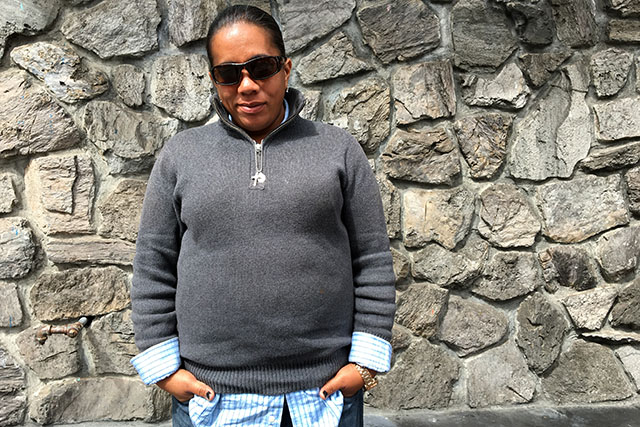

Linda Fuchs, 36, and her then-partner, Chanell Jones, were featured in a February column in the San Francisco Examiner, which detailed the loss of Jones’ job due to her homelessness. They, like many other homeless people who were surviving under the 101 freeway overpass above Division Street, were swept out of downtown for the Super Bowl, and then moved around repeatedly after a big clearing of the Division Street encampment.
The couple then settled briefly in front of the San Francisco SPCA on 16th Street, but Jones’ asthma worsened and landed her in the hospital.
“I took care of her for two weeks, and barely left the hospital,” said Fuchs, who had herself recently suffered a bout of kidney stones. “I called her family, because her condition scared me.”
Jones’ family wanted her back in Chicago and offered them both a place to stay, but the couple ended their five-year relationship before the move.
That left Fuchs on the streets and without a job. She called 311 in April, she said, and a month or two later, she got a spot at Next Door shelter on Polk street. She gives the shelter an 8 out of 10 compared to living in a tent – not as cold, she has a roof over her head, a bed and sheets. There’s a small library downstairs, she said, and some staff are helpful.
“The staff are helpful if their clients didn’t put them in a bad mood,” said Fuchs.
Unemployment is now her primary struggle and overcoming it means battling with the stigma of homelessness, the difficulty of looking one’s best when living in a shelter and just the sheer number of communication hurdles she faces without being constantly connected.
“Just think of the paperwork and stuff you have to do with getting employment,” said Kelley Cutler, who works with the Coalition on Homelessness. “And you’re living in a communal setting.”
Shelter hours, Cutler said, can be difficult with a job because clients unable to make the curfew and claim their beds must produce corroborating paperwork from the employer to get a late pass.
Without a late pass, a client’s bed must be released for those needing a one-night stay.
Those complications, however, are nothing compared to the difficulty of simply getting a job in the first place. Fuchs repeatedly states she does not use any hard drugs, but few employers are enthusiastic when they discover she is homeless.
Then, there are the little things – she has a laptop, but the charger doesn’t work and the wi-fi will not respond (though the shelter does have it) so her job hunt has been done primarily by phone.
Appearances also matter. Fuchs is as a sharp dresser even with severely limited options, pairing carefully selected ensembles of men’s clothing with earrings and mascara, hair pulled back in a precise ponytail. Still, getting ahold of hygiene products, from soap to tampons, is hit and miss, not to mention finding clothes suitable for a job interview. She is seeking donations both through the shelter and through PayPal.
“I want a job so bad. Every time I follow up it’s either ‘We’re completely staffed’ or ‘we’ll give you a call’ or ‘I’m sorry for your troubles but we’ll call you later in the month’,” she said. “I feel like somebody should give me a fair chance. This is not what I want to do, chill out on the goddamn corner. I’m smart all-around people person, I adapt to any environment.”
Kathy Treggiari, shelter director for Episcopal Community Services, which runs Next Door as well as the Navigation Center, acknowledged that if she were looking for a job herself while homeless, she wouldn’t admit to living at a shelter.
“I think there is a lot of stigma out there,” she said. “If someone is employable there are ways to maneuver around [admitting to] staying in a shelter, and not letting a future employer know that you’re in shelter.”
Without a steady job, Fuchs has turned to gig work – even landing a spot as an extra on the forthcoming ABC miniseries “When We Rise.” The work netted her $98 for a day of shooting.
But Fuchs feels a steady place to live would help her find a permanent job.
“I just need a place,” she said. “I feel a place is gonna push me to get better.”
That’s the logic behind the “housing first” approach that advocates for the homeless promote. But it takes resources and housing to get the homeless off the street.
At Next Door, more than 300 people could be in the building, with nine service coordinators, a facilities person, and a supervisor on duty. In the evening some case managers are available, and a 10-person behavioral health team moves around the shelters and may stop by. The exact ratio is hard to get at, Treggiari says, though with all of the shelters during all operating hours it works out to something like one staff member per nine clients. At the Navigation Center, it’s closer to one staff for every 2.7 clients.
“One to nine doesn’t sound bad, but it is,” Treggiari said. “The smaller you get at a shelter the more welcoming you can be, the looser you can be, because it’s not crowd control, it’s not people 40 inches apart from one another. It’s easier to facilitate.”
But Fuchs and Jones were not among those offered a coveted spot at the center, so Fuchs is trying to make it work at Next Door.
Single or no, it’s not just herself Fuchs is trying to rebuild her life for. Her two children, 8 and 6 years old, are with Child Protective Services. Their violent alcoholic father being released from prison was the threat that drove her out of San Diego. He was also the one who pulled her out of college courses when she started nursing school.
Fuchs wants her kids back, badly.
“I want to make my children to be proud to come back to me. I want them on Career Day to say, ‘this is what my mommy does,” she said.
This story previously misstated the name of the nonprofit that runs Next Door shelter and the Navigation center – it is Episcopal Community Services, not Episcopal Family Services. The story has been updated to reflect this.
This article is on myself. All is true. However please note I AM SEEKING EMPLOYMENT IM NOT A DEAD BEAT DRUGGIE OF ANY TYPE. I do have plans and goals that i am attempting to accomplish during my stay in this shelter. I’d appreciate that I’d not be judged,hanged,criticized, made fun and/or called out a liar. If there are people that would like to help or ask questions contact me at (415) 609-4492 cell/
Mr. Pickles is hiring 20th and South Van Ness
This doesn’t pass the sniff test. I see help wanted signs everywhere. Places are understaffed with huge lines.
And to reply to Mr.Ricardo , I’m the lady Laura done a story on and I do job search as well as being part of the jobs program. I just happen to need a little help. The shelter I reside in can speak on my behalf. I also volunteer at glide and help serve food. I have resumes and cover letter I make efforts sir. I’m not a bum. I handle my business. I have a lot of applications out as well, wanna list with numbers I’ll be more then happy to show you. I’m obligated to get my kids back and live a successful, prosperous and productive life so ease up on me.
Hi Linda……Judging by most of Ruiz’s previous comments he appears to be extremely negative. He adds nothing to any discussion but simply complains, blames and criticizes everyone and everything. You are under no obligation to justify your words and actions or prove anything to him. Just keep moving forward with your eye on the prize, reuniting with your kids, and ignore the naysayers. Good luck to you, young lady.
Not much to add, just wanted to say keep your head up and keep trying.