

It’s only natural that the Mission District would respond to its gentrification crisis through theater. Artists and their organizations have been under siege in the increasingly unrecognizable neighborhood, and putting on a play is “a rare opportunity to find humor in front of the somewhat devastating,” as its director says.
Peter Papadopoulos is behind “The Wolf in the Mission,” a two-hour retelling of the “Christmas Carol” story with a developer-type character — the “Wolf” — playing the Scrooge. Interwoven with cabaret-style skits, the play — on at the Mojo Theater on 16th Street this weekend and next — presents the Wolf, already hungrily eyeing Mission real estate, visions of the American dream past, present, and future.
“What a shabby mess of a building,” the Wolf says looking at the Redstone Building where the Mojo Theater is based. “Surely I can flip it and turn a healthy profit.”
Papadopoulos also has a past fighting the market-rate housing that so many activists see as the enemy of the neighborhood. He heads the Cultural Action Network, which was formed to fight a project activists dubbed the “Beast on Bryant.” Although recently approved for construction, Papadopoulos and others won significant concessions from the developer and are still hoping to kill the project on appeal.
That fight is one of the local events the play features. Another is activist and poet Tony Robles’s poetry reading on the Frisco Five hunger strikers, who protested police shootings by fasting for 17 days in the Mission District.
“The Frisco Five were some friends of mine,” he says, in one of the many asides from the “Christmas Carol” storyline. “They stay hungry, Frisco stays alive.”

The displacement of various arts organizations from the Mission District is a running storyline. A list of dozens of displaced and shuttered groups including Cellspace and Studio 17 is projected against the wall at one point, with the narrator muttering, “Don’t worry, there’s no money to be made in the arts.”
Near the end of the play, institutions like the Mission Cultural Center, the Red Poppy Art House, and the Mojo Theater — still alive for now — are given hypothetical end dates. Papadopoulos said such groups always live on a thin margin, but San Francisco’s affordability crisis makes it that much worse.
“There’s no question that Mojo Theater is not safe in any way,” he said. “You really feel like you’re going month to month just getting on, and that in this environment every month could be your last.”
But a lot of the play is often funny, an objective for a group used to losing fights against market-rate development or police shootings.
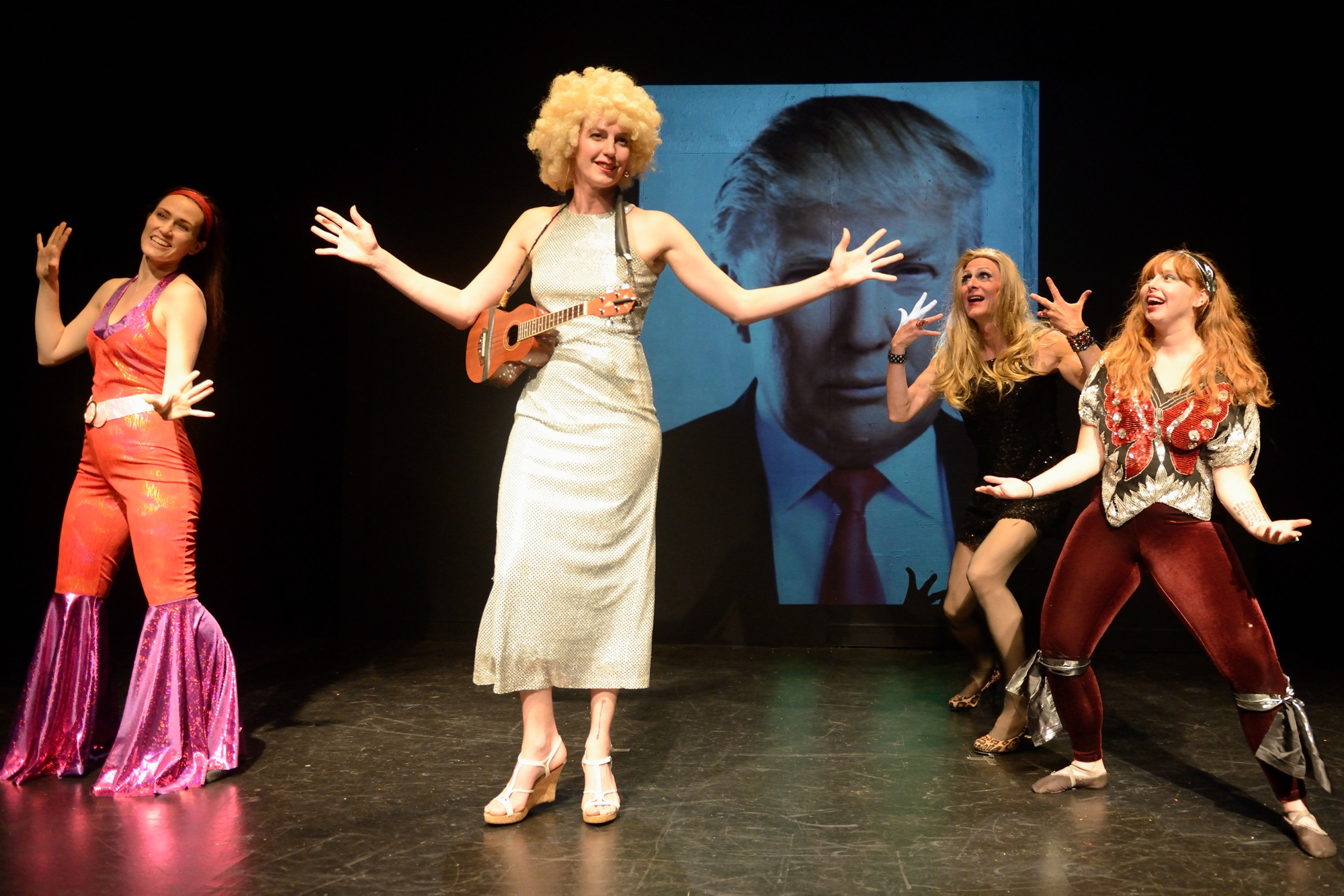
Ron Conway, the tech investor who has become a San Francisco kingmaker, gets a special music and dance diddley in what may be the most entertaining scene in the play. Articles describing the investor’s influence over San Francisco politicians — and Mayor Ed Lee in particular — are flashed on a wall, reminding the audience of the tens of thousands he has poured into city elections.
In front, a group of women decked out in disco garb and leggings — and a man in drag — sing a catchy ukulele number: “It’s Ron Conway’s San Franciscooo, and we all do the discooo to his 1–2–3: plunder, pillage, and destroy.” Buying elections is no light topic, but the breezy dance makes you feel a little better about plutocracy.
After some five minutes, the play begins lambasting other icons of the San Francisco “right.” Planning commissioner Michael Antonini is targeted, and Supervisor Scott Wiener, brooding over a Board of Supervisors meeting with dark eyes, is also criticized for his pro-development stance.
If you don’t know all of those names, you don’t spend your weeks following various hearings at City Hall, which is a slight issue: The play’s hyperlocal focus is likely to be inaccessible to anyone who is not a reporter, politico, or activist daily engaged in these conversations. You’ll be able to follow the basic anti-gentrification themes, but might not understand the significance of the particular names or places referenced, like the “Monster in the Mission” or the Midtown eviction fight.
Which is fine. You don’t need to know that Antonini was once called the “Donald Trump” of San Francisco to know that the housing crisis is devastating the Latino community. But the emotional impact of the marches and protests periodically projected during the play is likely to be minimal for those not engaged in those actions.
Papadopoulos, for his part, acknowledged as much.
“I’ll be honest, even I don’t get all of the references in the show and I’m the director,” he said. “There’s no question that to people that are more involved in Mission politics, they’re gonna get more out of it.”
The play is also weird throughout and deviates from its core themes often. A magician takes the stage for some 20 minutes to do tricks, and a woman dressed in a janitor’s uniform sweeps the room and cracks a laugh when she pretends to be Super Mario with the broom as a moustache. Both are high-points for the play’s comedy, but their relation to the theme at hand is tangential.
In a hopeful, if satirical, note, the Wolf learns the error of his market-rate ways. Instead of pursuing profit, he decides to renovate SROs, fund more homeless Navigation Centers, and pour money into affordable housing, becoming beloved by the community.
A pipe-dream, to be sure, but a refrain often heard in activist circles. If only developers could be less greedy and cut into their profit margins, the neighborhood might grow more equitably. No one really believes this will happen, and the play ends with a line that will never be true of a housing developer in the Mission District.
“Scrooge became as good a guy as the Mission knew,” the narrator says.
“The Wolf in the Mission” will be playing at the Mojo Theater at 2940 16th St. on Saturday, July 9 at 8 p.m., or Thursday through Saturday, July 14-16, also at 8 p.m. Tickets are $15 online or $20 at the door.

