

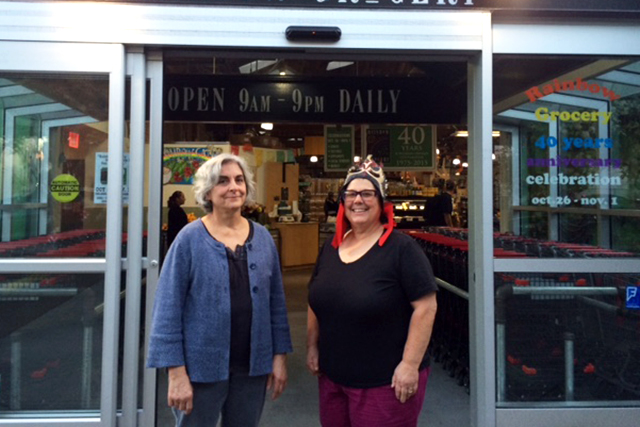

As a week of celebrations – halloween, the coming of fall, and an anniversary – neared its end at Rainbow Grocery, Pat Seguin wandered the aisles that she has helped stock and supply for nearly four decades.
The shelves of herbs and spices, fair trade coffee, and bulks of nuts and beans neatly stowed away in vitrines have customers spinning with options. Seguin says the offerings are a result of research and democracy. Rainbow’s employees vet the products that make it to the shelves – an equation that has made the grocery store a haven for vegetarian and health conscious consumers who care about where their food comes from.
“People know that they can trust us in the information that we are giving them because we stand behind the products we sell – clean and nutritious,” said Seguin. “If we find out that some products are not worthy, we take them off the shelves.
Shoppers agree. “It’s kind of a wonderland for me,” said Philip Patrick, a shopper who treks by bus from Glen Park for his Rainbow groceries at 1745 Folsom St. “They seem to have everything in the world here. I’m in awe everytime I come.”
Pioneering Health Foods in San Francisco
Seguin is one of Rainbow’s originals – her career spans the life of the store, which celebrated its 40th anniversary in August. In celebration, the store put on a week-long party featuring samples, demos and tours.
The employees’ knowledge about the products, she says, is key to the store’s longevity.
“Education is part of our mission,” said Sequin. “We wanted to provide customers with an opportunity to learn about the foods they were eating and why it is important.”
Becoming a Rainbow employee at age 21, Seguin has seen the health food store through two moves, expansions, and a major renovation last year. She remembers its very beginnings on 16th street near Valencia – that was back in 1975 when the neighborhood was a lot less “desirable.”
“That part of the Mission wasn’t the greatest, it was pretty rundown,” said Seguin. “A lot of people couldn’t afford clean, healthy food, nutritious food.”
Seguin said that the idea for an inexpensive natural food store come from an ashram and launched a “clean” food movement in San Francisco.
In the early 70s, devotees of the guru Prem Rawat, or Maharaj Ji, organized around a bulk food buying program to meet the need for accessible, vegetarian food. They soon became part of a citywide network of community food stores.
“The guru said to his followers to go start natural food stores,” she said. And they did, but Rainbow may be the only one still operating.
“Rainbow started that platform for other companies and small business in San Francisco as a collectively run model that takes part in the community as much as possible,” said Esteban Garcia, who has been employed with the store for five years. “We try to buy as local as possible, as organic as possible, and we try to maintain good relation to buyers.”

A Collective Effort
Like the rest of the roughly 250 employees at Rainbow, Seguin and Garcia are not just workers, but co-owners.
”Instead of giving that control to one person, we decide collectively what we need to do and move forward,” said Seguin.
As a worker owned and run food cooperative, Rainbow’s employees generally have to complete 1000 hours before receiving a share in the business.
Garcia, who previously worked at other food markets including Whole Foods and Mollie Stone’s, said he wouldn’t trade the “collective-ownership at Rainbow for a management position at Whole Foods.”
“You get more appreciation for your job, and you don’t dread coming to work,” said Garcia. “Since you are a business owner you want to make it thrive.”
At the bulk section, Seguin is joined by Linda Trunzo, Rainbow’s board president – but that is just a “figure head” title that the co-op was forced to adopt because of their corporate structure.
“It had to do with taxes,” said Trunzo, who has been in the collective for 31 years.
While the collective model in which storewide decisions are made by way of a majority vote is effective and rewarding, it doesn’t come without challenges.
Trunzo remembers when, a few years ago, a 20 percent off coupon deal had workers divided.
“The deal brought in customers, but it was really tough on us. We were stocking and buying every second,” said Trunzo. “The vote to get rid of the coupons was split.”
In the end, the majority vote decided by a hair to get rid of the coupons – a decision that turned out to be best for everyone, said Trunzo.
Workers also were divided in 1983 when faced with an opportunity to move from its 2,000 square foot storefront on 16th street into a 9,000 square foot space at 15th and Mission streets.
“The bigger you get, the more people get involved, and the longer it takes to get things done,” said Seguin. “Some wanted to the store to stay small and intimate.”
In 1996, Rainbow relocated once more, this time to its current location on Folsom Street. Instead of renting, Rainbow bought its building, and it was the smartest decision the collective could have made.
“We all understood that we needed to buy property to sustain the life of rainbow – without that, I don’t know if we could have survived with the way rents and evictions have gone up,” said Seguin.

Despite Changes, Rainbow Continues to Flourish
While the city around them is changing, Rainbow’s employees are holding steadfast to their morals and business model. The business gives back to the community, said Garcia, not just through donations to local schools and organizations, but by enlisting local vendors and offering fair, accessible prices and products.
“We try to build relations with our vendors and farmers because it goes around in circles. The more you keep your money local, the more it benefits your community,” said Garcia.
The biggest change nowadays is that many of the co-operatives members can’t afford the city.
“I don’t know what we can do for the city to get the people who actually work here, the workers who get real, healthy food to the community – to provide them with the opportunity to stay in that community,” said Trunzo.
Rainbow’s celebration continues through Sunday, November 1, with giveaways, face painting, and other activities.
I wish they were more LGTB friendly. We are all humans and should be treated with respect.
They aren’t friendly to anyone Ricardo.
Is this just a big advertorial for Rainbow Grocery? Doesn’t matter how great the business model is, how much they give back to the community. If their service is not good enough they will fail and I’m not sure everything is as Rosy as they paint it in this article. People who work there tell me that WholeFoods is hurting them.
I wanted so badly to shop at this store because I’m a vegetarian but after so many incidents of bad service I drive PAST Rainbow to go to WholeFoods where the staff are friendly, polite and way more helpful. Interestingly this article talks about how knowledgable the staff are on the products, that would be great if they were helpful enough to pass on that knowledge to the customers but the majority of the workers I have encountered there are just plain rude and unhelpful.
I really wanted Rainbow to be my grocery store, I used to go there twice a week but no longer. I’m tired of paying them money to be treated like I’m not worthy to be there.
thanks so much for this article. one small correction, the move from 15th and Mission to Folsom and 16th happened in April 1996, not 1994. I remember this well because I shopped the old location and was hired as a cashier in September ’96 at the new location. After a year in the cashier department I moved to the cheese department, where I still work.
Thanks Peter! Corrected.
Actually, our celebration goes to Nov. 1 so come by the store! Face painters are around for the kids today and tomorrow! Chicks and Love are giving away pizza right now.
Sad to have missed it…:-(
I was one of the original co-creators of Rainbow (Judi Brewer) and its very first bulk-food buyers. Introducing non-sugar jams, healthy snacks, and organic products all had to be okayed at our meetings. I remember going through a lengthy process to align with the People’s Food Coop in the city back then; they were skeptical because we had a guru. But we were into service, satsang and meditation and that, I believe, is why it flourished all these years. I’ve always thought it was 1974… but I very well could have been mistaken… it was a long time ago. I left SF in ’78, but returned to the Bay Area in ’97 and still come to Rainbow whenever I’m in the city. Would have loved to have joined the celebration.
Hi Judi. I knew you in the old Castro Asto premie house way back in the day. Hope life has been good to you! Would love to catch up.
Maxine Schmukler Moody
Thanks Juliette! Updated/corrected the story.