

The Mission has been identified as one of 20 areas city-wide with unhealthy minority populations in a new program by the Department of Public Health that aims to link residents with free exercise opportunities to improve their cardiovascular health.
“The main goal is to address health inequities…for African-Americans and Latinos that live in [areas] where at least 30 percent of the population live below 200 percent of the [poverty level] and 25 percent of adults are without a high school education,” said Jacqueline McCright, the deputy director of community health at the San Francisco Department of Public Health.
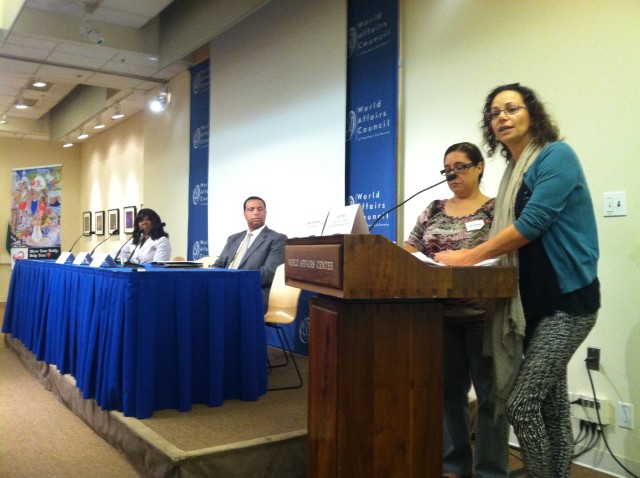
Supervisors David Campos, Jane Kim, and Malia Cohen spoke at the “Healthy Hearts San Francisco” kick-off event Tuesday, alongside health officials and patients who have made use of the program’s “green prescriptions,” which doctors hand out with a recommended exercise regimen.
“When the doctor gives a prescription, they have a menu of things that these patients [want],” said McCright. “They’re offering line dancing, yoga, zumba, water aerobics.…They’re getting a very specific place to go in that prescription.”
Iran Pont, a chronic care coordinator at the Mission Neighborhood Health Center, said compared to other neighborhoods, these classes aren’t conveniently located for her patients, who may not like the idea of walking to Dolores Park at dark. But availability of activities is just one obstacle.
The Mission has one of the poorest populations in San Francisco, but unlike the Tenderloin or Bayview — two other neighborhoods targeted in the program — the Latino community of the Mission faces linguistic and cultural barriers that prevent effective outreach by health officials.
“They’re newcomers, uninsured, undocumented, mostly monolingual Spanish speakers” said Pont. “By the time they cross the border, they have diabetes, hypertension, high cholesterol, obesity.”
And once they arrive in the Mission, impoverished living makes health gains difficult.
“They have to share a room with ten people, they have no appliances, they go to these food pantries where they get ten pounds of carrots,” Pont said. “What are they going to do with ten pounds of carrots? So they just sell them on the street sometimes.”
Mission cuisine, despite its renown, is also not the healthiest option.
“It’s all simple carbs,” Pont said. “Rice, tortillas — they get full with an instant soup. They say ‘Hey, it’s 25 cents for an instant soup.’ But you’re going to pay for it down the line.”
Gentrification is also taking a toll, displacing long-time patients to cheaper neighborhoods and making their treatment that much more difficult.
“Our patients are moving to the cheaper neighborhoods, the Tenderloin, the Bayview — they come back to us because they feel lost there,” Pont said, adding that a sometimes multi-hour commute disincentivizes patients from returning.
Patients only come to the health center on 16th and Shotwell “when they’re very sick,” according to Pont, so it’s difficult for the center to do preventive treatment given its limited resources.
But that’s changing. A new promotora program, run out of the Mission Neighborhood Health Center, teaches patients to speak to their friends and family about getting exercise and eating healthier, and Pont is excited about the possibilities.
“We think that it’s been very successful. They talk to their churches, their communities, they talk to their family…they love it because they feel empowered,” she said, emphasizing the importance of a familiar face. “As a physician talking about carbohydrates — they get lost.”
One of the speakers, Andre Larrimore from the Bayview, underlined the role his friends played in pushing him towards exercise and healthy eating.
“[This program] is for young kids that are five years old, weighing 100 pounds that need this program, not just me at 6’3” and 350 pounds — and believe me I move like a cat, my blood pressure is probably better than all you guys,” he said to hearty laughter. “Because somebody called me on the phone and showed me they loved me. Somebody took the time out for me…[they said] ‘Andre, come on man, you gotta get that diabetes together.’”
Leonor Hernández, another speaker and a promotora at the health center, said her family’s eating situation has improved dramatically since taking health classes.
“My daughter lost a lot of weight, my husband too,” she said. “We used to drink coffee with sweet bread [because we’re Guatemalan]. Now I have coffee with a banana. We don’t buy soda, we don’t buy juices…If we eat tortillas, we don’t eat rice.”
Every month Hernández shares a recipe with her class at the health center, like sopa de calabaza con celery y ajo, so patients learn cheap but healthy alternatives to the carb-heavy Latino diet. And her family has started to exercise and cook together too.
“Now we walk a lot” she said. “We cook together every week, every Thursday or every Sunday.”
The “green prescriptions” from Hearts Healthy San Francisco are just the latest tool for outreach available to the Mission Neighborhood Health Center, and Pont is hopeful they’ll push otherwise hesitant individuals towards regular exercise.
“I’m excited, of course,” she said. “Every little bit helps.”
The three-year program was funded by the Center for Disease Control for $800,000 and started last September. Residents in one of the 20 census tracts can access the free classes by dialing 211 or visiting a participating clinic.