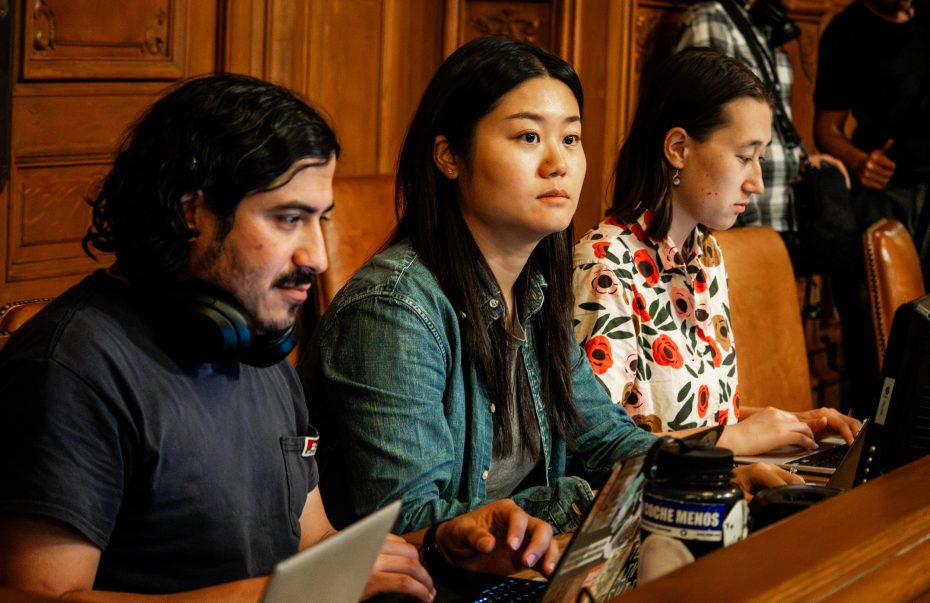
Film buffs and friends gathered at ATA on 21st and Valencia Streets Saturday night for Other Cinema’s screening of four shorts produced by three artists who are members of La Caca Colectiva.
The collective preserves a film archive of found footage and Super-8 home movies shot by middle class families in Mexico, and a selection of 1970’s fireman training and fire safety films. The film archive serves as creative inspiration in the collective’s work, but it is also available for rental.
The shorts included Polvo, showing a Mexico City of the 70s and 80s; Remember Los Siete showing Mission Street from the 70s; and Crow Furnace by Dolissa Medina, a fictional story based in San Francisco with a firefighter and a singer from different times are stuck in purgatory. The two characters visit places in the City related to sites of fire but are unable to find where they died in the rebuilt city.
Caquista Angela Reginato screened a series of portraits in 16 and 8mm, unedited with music chosen by the subjects, and Polvo, a 28-minute short.
In Polvo, Reginato tells the story of her childhood in Mexico City. She compares the city to a downwards spiral ready to consume you. The main plaza of the city, the Zocalo, is a place of stark contrasts with prehispanic temples, the National Palace and a cathedral built on top of an ancient lake-bed causing it to sink a couple of inches every year.
The short shows amazing old footage of the Mexico City of that time: the Zocalo, Torre Latinoamericana, Zona Rosa, Centro Histórico, but also home movies where a 9-year old Reginato can be seen acting as her school’s reporter.
In the film, Reginato narrates how she made sense of events she saw in the news and on the streets – students massacred by police at the Tlatelolco Plaza in 1968; protests in front of the American embassy burning the American flag; the falling of the head of the Independence Angel during the earthquake in 1957.
The film interweaves the story of the disappearance of the son of a French-American couple who used to frequent her house in Mexico. They later discovered that their son had joined a Hare Krishna group.
As a child, Reginato attempted to relate to their feeling of not knowing where their child was, and the uncertainty of life and death. That memory is paired with an incident when her class visited the Templo Mayor in the Zócalo when one of her classmates went missing. They found him hiding in a spot where he had been watching the teacher go into a panic.
Caquista Vero Majano presented a performance where a black and white projection of Mission Street served as the background for her piece Remember Los Siete.
Los Siete de la Raza were a group of seven young Latino men of the Mission who went to trial in 1969 for an incident in which a police officer died. Two officers were investigating a burglary, but after a struggle ensued, officer Joseph Brodnik died when his partner’s gun, Paul McGoran, was shot. The suspects fled and police searched several homes in the Mission District and interrogated dozens of young Latino men.
Six young men were arrested for Brodnik’s murder, the attempted murder of McGoran and burglary. The trial rallied the Latino activist communities who created the La Raza Information Center, where they ran a Centro de Salud or health center, a free breakfast program, the newspaper Ya Basta!, and the Defense Committee for Los Siete.
The six, Gary Lescallett, Rodolfo Antonio Martinez, Mario Martinez, José Ríos, Nelson Rodríguez and Danilo Melendez, were acquitted. Gio Lopez, the seventh, fled when everyone else was arrested and later hijacked a plane to Cuba.
In Majano’s piece, a unique archival piece of footage shows interviews with each of the men capturing their feelings of joy and relief at the verdict.
For more of La Caca Colectiva screenings and archival footage rental, go here.