

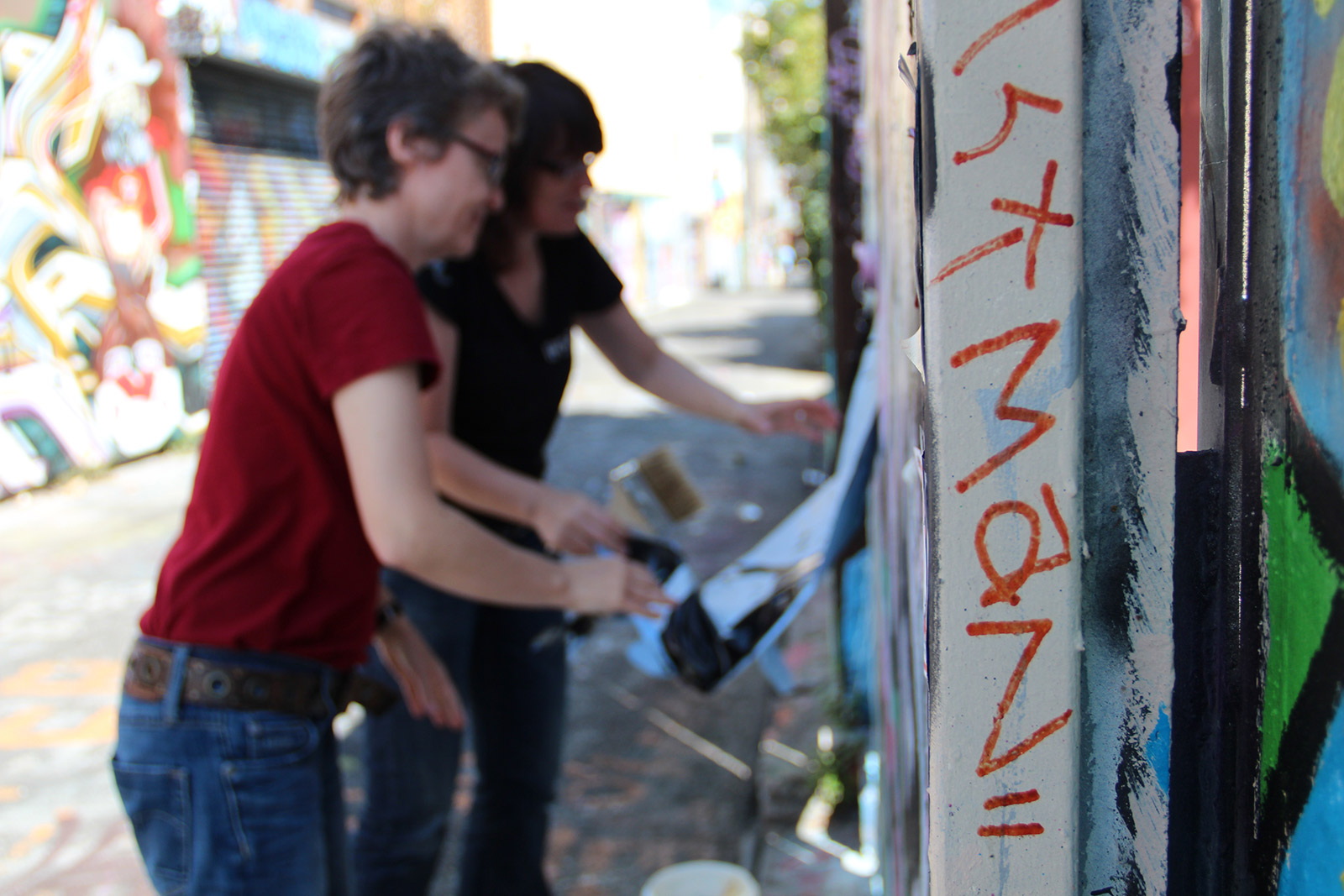

Polish-born, London-based art duo Jola Kudela and Aga Lesiewicz have serious street cred — quite literally.
Lesiewicz, a freelance television producer, and Kudela, a digital effects and animation specialist, are also part-time traveling paste-up artists. Paste-up is the art of pasting, or gluing, symbolically altered images.
The two women, who met in London in 2010 and go by street name YOLA, have traveled across the globe seeking bare walls and alluring alleyways — and at times, less than legal venues — to showcase their work.
Their newest canvas? The Mission, where Kudela, the creative force, are Lesiewicz, the organizer, are absorbing the historic street culture while leaving a contemporary mark of their own.

Missionites can view samples of their work at Alley Cat Books, 3036 24th St., tonight at 7 p.m. In the meantime, here’s what the duo — who seamlessly complete each other’s sentences in Polish — have to say about their art, the Mission and the world.
Mission Local: You’re both professional artists by trade; why did you pick up street art?
Jola Kudela: There was a gallery in Paris that I wanted to approach. I sent them emails and postcards and they never answered me. I said, “Dammit … you don’t want to answer me, I will oblige you to see my work.” So I just painted on a huge [space] and pasted [it] in front of the gallery.
Aga Lesiewicz: On the street.
ML: So did they approach you for a job?

JK: No … But I fell in love with this material. I put my visual in the city and the city became the frame or continuity.
Before I used to just do pictures. But I just changed the way of showing them … when you go to the street, it’s huge and you can go much bigger with your work and with a much larger public.
AL: I really started when I met Jola and found her art amazing. Her enthusiasm is really infectious.
ML: Describe the materials used and the overall process of pasting.
JK: Find the painting that you love … look for [models] who are strong, have some power in them … then do the shoot. I use a green screen and I shoot every person separately.

I can do exactly the same poses like in the painting, or I can try to just cover the main composition of the painting and not really bother about the details. After that, I do work on Photoshop; I try to mix the original painting to … help the viewer, to give him the idea that he has to look for the connections and the symbols.
Then it goes to the printer, you get big huge prints at a commercial printer and they print on blue-back paper. I cut (the printed strips) because I think it doesn’t mix with the environment. When it is cut, it comes together – one whole piece with the surroundings.
AL: And you have to soak [the paper] in water because the paper is strong. You do that just before the pasting. The paper will stretch and become softer. When it dries, all the bubbles and creases go away.
ML: How long does the entire process, from research to paste, take?

JK: It can be quite fast or quite long. For example, a project in Paris with 32 people … took me five weeks. But a piece in Melbourne I made in one hour of shooting and four hours of work.
ML: Do you prepare the images before arriving on location?
AL: It starts before we get to the city. We try to research as much as possible … and find places where street art is. But obviously, it takes time to get to know the city and feel it and also make contacts.
It’s very important that we just don’t arrive somewhere and put the art on someone’s wall without realizing what the wall is, what’s the dynamic of the whole place.
Then when we actually get to the city, it’s a lot of legwork … looking at walls and taking photos and just trying to find places to do street art.
ML: There are often legal limits on public property. How do you work around them?
JK: When you do it illegally, you do it in silence. [When we are traveling], we try not to get into trouble. We try to learn first what we can do and where. But when I am home in Poland, I’m going much farther. [One of my pieces] in Warsaw is in the middle of the street. I hired a cherry picker [a truck with a rising platform] in the middle of the night and two guys … We weren’t stopped.

The same night, we went to do another small piece and we were caught by the police. This was one month ago. [She paid a fine, which she claims was illegal, and had to restore the bridge.]
ML: Are your pieces commissioned?
AL: Mainly we do it for ourselves, but occasionally we get commissioned.
JK: Most of the things we are paying for … it’s a hobby.
AL: An expensive hobby.
ML: You travel around the world. Why the Mission?
AL: It seems to be the center of street art and a very vibrant community … this is our favorite part of the city. We really feel at home here and this is where things are really happening in terms of art.
[Mission artist and author of the book “Mission Muralismo”] Annice Jacoby has been very helpful, and she’s given us a lot of suggestions and a lot of help with getting in touch with people. She’s a really wonderful curator of street art.
ML: Talk a bit about the paste-up pieces specifically in the Mission.

AL: In total, we have two pieces [on the street], plus there are two pieces in a gallery at Alley Cat … we have “Orestes” [based on a painting of the mythical figure by William-Adolphe Bouguereau] and then we have “Calliope,” based on the Greek goddess of art.
JK: Every visual has a sense, has a meaning … [The piece on Clarion Alley] is called “Corporate Jesus.”
AL: Instead of being crucified on a cross, [the model] is being crucified on a dollar sign. He has a briefcase, and he’s like an ordinary guy running around in the city.
JK: He sold his soul to his religion, which is money.
ML: The question asked of every artist: what is your inspiration?
AL: [The original art] has to be relevant for us … it still has a meaning that can be understood today or translated.
JK: What we’re trying to do is play with the meaning. You tweak the original painting, the original meaning or the original story. You change the models and you transform the story and you adapt it to our world. Most of the subject is tolerance for the differences the people can have. That society is not …
AL: … not homogenous. There isn’t anything called normality because everyone is different.
ML: What is your favorite — or the most interesting — location for pasting?

AL: Apart from being in the Mission, our favorite street art cities are Melbourne, Australia, and Buenos Aires, Argentina.
JK: Both of these cities are very open, and helpful people … and you feel like a part of a kind of movement … You are part of something bigger.
[In the Mission] we found really that when we approach people … they’re quite open and helpful. It’s quite unusual.
AL: We feel very much at home here … in fact, we are quite addicted to 24th Street and all the little coffee shops there. And also the little Mexican food restaurants. Europe is so far from South America, we don’t even know what Latino food is. So we love all those little places, the taqueria and tamale places — this is quite new to us.
JK: It’s so far from our culture. It’s a completely different visual that I really didn’t know before.
For more on the artists, click here.