


In 1999, Linda Wilson returned home after a bike ride and started to climb the stairs to her apartment door. It had not been a strenuous ride, so she figured the dizziness and nausea she experienced signaled an oncoming cold, or at worst the flu.
More than 10 years later, Wilson, diagnosed with chronic imbalance or ataxia, has lived a slower lifestyle. It’s one dependent on a host of public and nonprofit services for the disabled. Most of these are within walking distance of her home on 24th and Harrison streets.
Even as rents and income levels have risen in the Mission, so too have the number of residents on Social Security and disability — from 6,500 in 2003 to 7,000 in 2010.
The services — everything from help with pets to free food delivery — grew in earlier years, when the neighborhood was mostly low-income. Now their existence, as well as the close proximity of stores and restaurants, continue to make the Mission an easier place to live for low-income seniors and those with disabilities.
Disability payments, dependent on wage history, average about $1,070 a month, according to the Social Security Administration. Some qualify for a supplement, SSI, for aged, disabled and blind citizens, of $400 to $500 a month. Now 68, Wilson lives on Social Security, which averages about $1,183 a month in San Francisco, though she receives only about $700.
After months of tests in 2002, Wilson’s neurologist told her there wasn’t anything that could be done for her ataxia. “I’d just have to live with it,” she said, and that means living with an unnerving lack of balance and frequent nausea.
Years earlier, Wilson’s mother-in-law went to the 30th Street Senior Center, where she ate lunch, played bridge and took painting classes. When Wilson got sick, she went by the center and discovered she qualified for its case management and food delivery programs.
Wilson’s case manager helped her apply for the services of Rebuilding Together, a nonprofit that helped make her house safe by installing bars and racks for grasping.
“Linda’s a good advocate for herself. She got herself connected,” said Valorie Vallela of the 30th Street Senior Center.
She tries to forget about her health problem, Wilson said, but it’s not easy. Her neurological condition causes a similar feeling to that suffered by astronauts returning form long periods in zero gravity. It’s constant.
Wilson still lives on the second floor of her house. “It’s good to get the exercise,” she said, but she doesn’t go anywhere without her cane, which she got in Ireland years ago. And she doesn’t like crowds. “I don’t want to fall down and cause a scene.”
She has acupuncture treatments every other Tuesday at Community Acupuncture Works on 24th Street, to treat her nausea and anxiety caused by balance issues. “You’re worried you’re going to fall,” she said. Doing simple chores like taking out the garbage can be scary.
The senior center offers a donation-based lunch, with a suggested donation of $2 for food that costs around $8, according to Vallela. No one is turned away. Wilson doesn’t eat there, but at night the center delivers a homemade dinner to her home. It’s made with vegetables from the center’s garden.
Such help has allowed her to focus on other areas of her life that bring her pleasure.
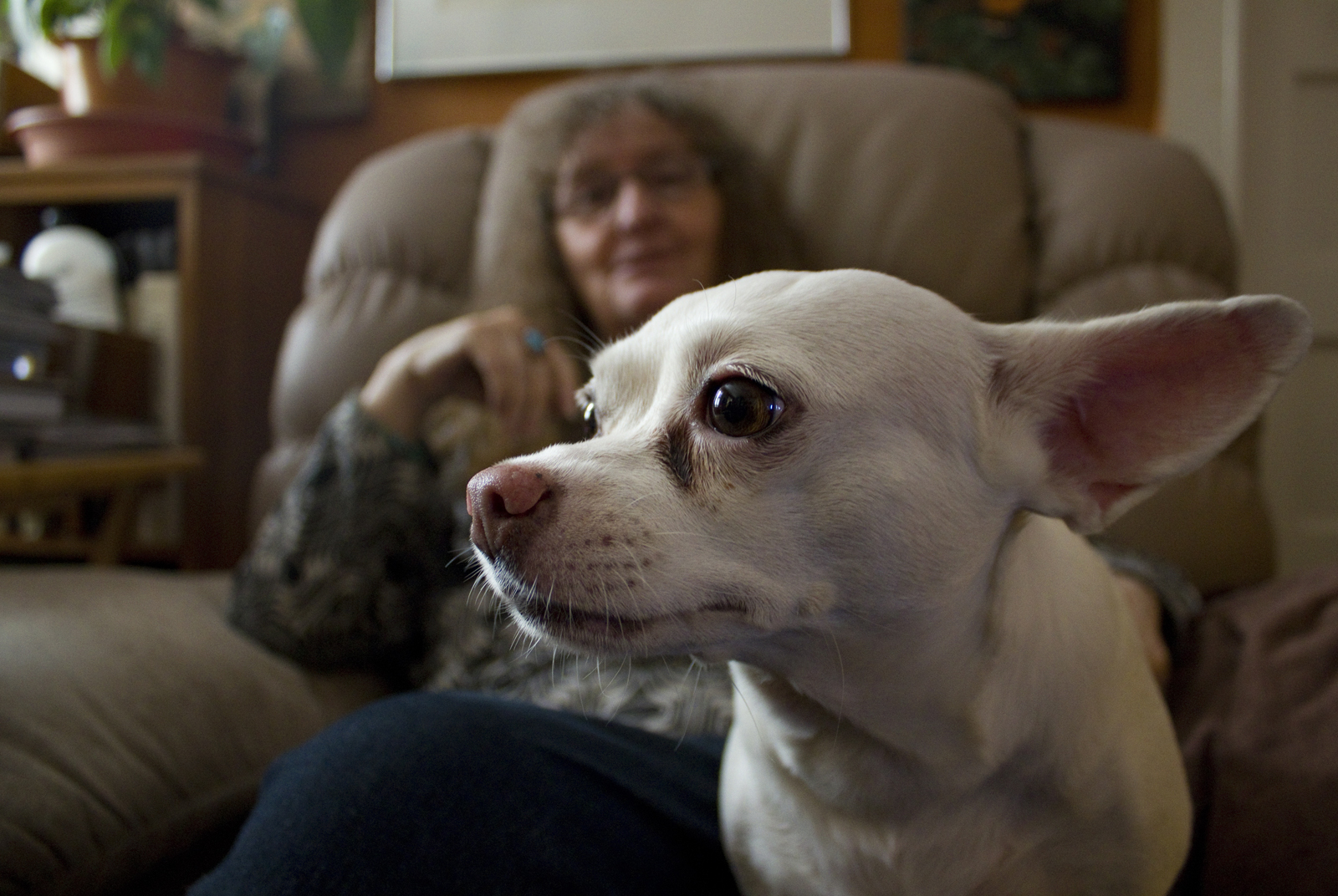
These days, one of those is a white chihuahua-terrier, who keeps her company. “Mija! We have company,” Wilson said, showing sweet affection for her “little daughter,” whose white ears, freckled with light brown spots, flatten submissively when strangers approach.
Wilson ended up with the dog when a friend, Amanda, dropped her and all of her paraphernalia — beds, toys and food — off for a week’s visit. Three years later, Mija’s white hair still decorates the area rug and Wilson’s bedspread.
“I used to be very picky about beds,” Wilson said, going through the motions of brushing away a few hairs.
Keeping Mija might have been impossible, however, without Pets Are Wonderful Support, known as PAWS. Wilson heard about the Mission nonprofit, which started as an HIV/AIDS support organization in the ’80s, through the SPCA.
PAWS expanded its coverage first to help disabled San Franciscans and then, in 2007, to support seniors. The organization now helps some 740 residents — 63 in the Mission — keep about 950 animals. PAWS also helps Wilson’s longtime friend, who is in hospice, keep his teacup chihuahua, Molina.
Spontaneous hikes to Bernal Heights have been replaced with methodical walks around the block with her little Mija. “I’ve become very attached to her,” she said. “I’ve got this companion who makes me feel good in the morning, who gets me up and going.”
She and Mija walk to El Tecolote, a Mission neighborhood newspaper, where Wilson scans photos and helps set up the archives. The archives are handled as are the rest of her affairs — slowly, “a little bit at a time.”
A photographer with an M.F.A. from the Academy of Art in San Francisco, Wilson has worked for many nonprofit organizations over the years, including Intersection for the Arts and Creativity Explored.
She was working at Creativity Explored when she became sick in 2002, and her manager was supportive throughout her months of doctor visits and medical leave. She received disability, and eventually, at 62 years of age, qualified for Kaiser Senior Advantage, a health program that covers all of her prescriptions.
“Hi Linda,” the UPS delivery delivery man shouted from his truck as we walked down the block on a recent afternoon.
Mija barked while Wilson held back on the leash.
“Can I remind you of something? You’re lucky Linda took you from the pound,” he said.
“I told you, she always barks at the UPS guys,” Wilson said. And skateboarders — a fact that Mija demonstrated, more than once, later on our walk.
Turning off of 24th, we continued our journey around the block. Wilson stopped at an altar residents had set up for Reynaldo Cordova, who was shot and killed near 23rd and Harrison two days earlier, on Oct. 28. “Mija. Some poor young boy,” she said, trailing off.
Years ago, when the neighborhood was much rougher and there were more shootings, Wilson photographed all the altars she came across. She would give the photos to the victims’ families.
Walking back down Harrison, Humphrey Slocombe sits near the corner, aggravating some longtime residents, Wilson included, with its notorious weekend lines — trend-seekers just passing through long enough to take over the sidewalk.
“You know, I have a bunch of things I can bitch about,” she said, laughing.
As for these other things she adds, “I just go complain to Marta,” referring to Marta Sanchez of Casa Sanchez, who rents space to another tragically hip food place on 24th, Dynamo Donuts.
Inside her house are the objects Wilson has collected over the nearly 40 years she’s lived on Harrison Street — things she can’t part with, like her old cameras. Colorful memorabilia turn flat surfaces in her living room into altars. Los Muertos figurines and masks cover a bookshelf in the living room. She gets a new one every year.
Her prized mask stays in her bedroom, though — a piece from the Linares family of Mexico City.
Like many other San Franciscans, Wilson’s Social Security benefits are never enough. “But I’m very blessed,” she said. She can find most anything she needs within two blocks of her house – markets, buses, restaurants. “I have been very lucky.”
What a wonderful story! Thank you for this beautiful profile of a woman and her animal companion making their way through the world.
Thank you Linda for being such an inspiration and a mirror through which we see the Mission with your photographs. Tell Mija I said hi!
And thank you ML for featuring Linda.
Martha D.