
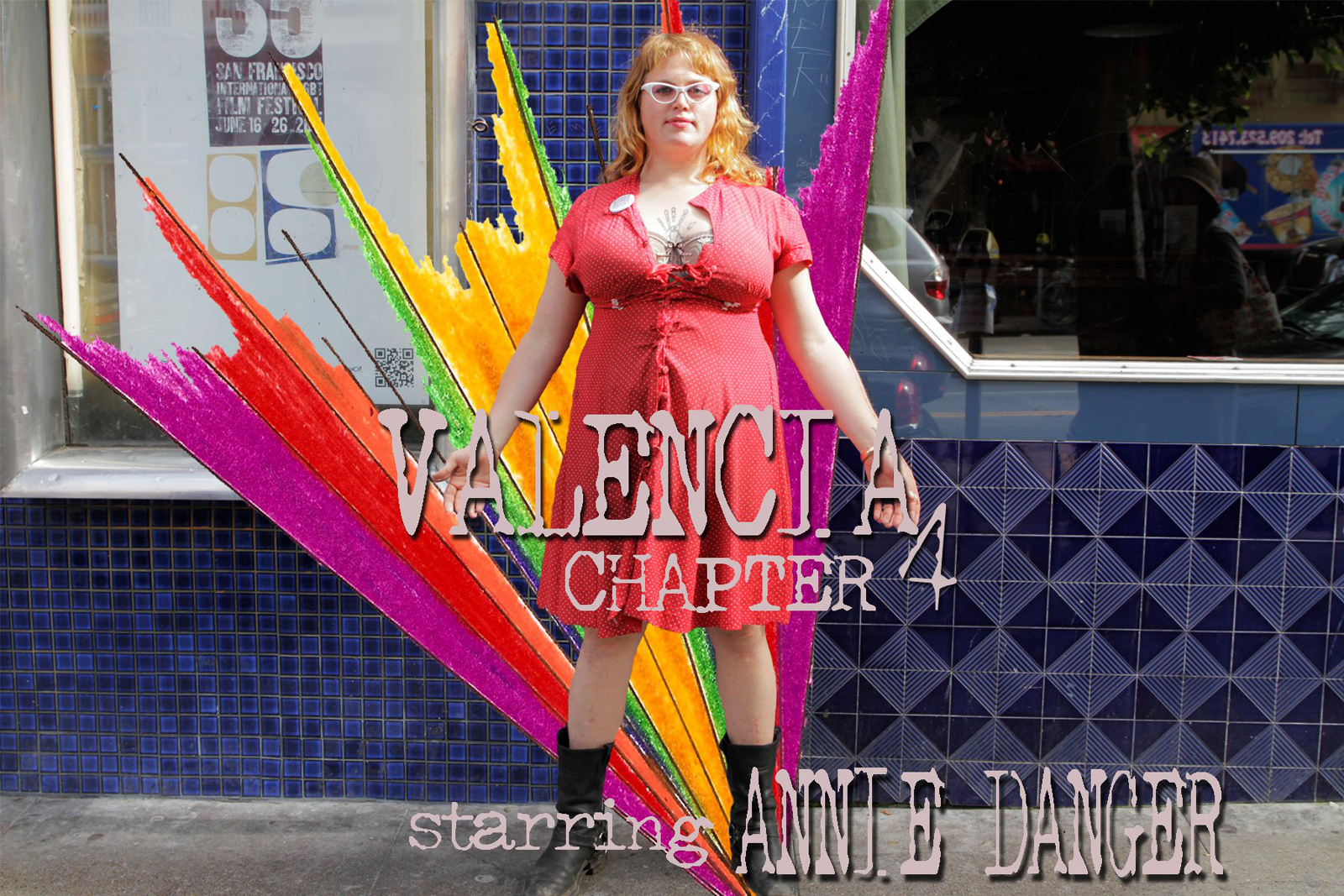

It’s a party masquerading as a film shoot masquerading as a party. Or something like that. People keep stumbling in from the backyard to investigate the beer supply in the fridge, as Lares Feliciano, director of “Valencia the Movie: Chapter 4” confers with the actors. Once shooting begins again, Feliciano will manage crowd control via the expedient measure of locking the crowd in the backyard.
Twenty-one chapters — each shot by a different director, with a different cast — will make up “Valencia: The Movie.” Feliciano, a film student at San Francisco State, took charge of this chapter after its previous director dropped out.
Each chapter has its own way of doing things, and the set for Chapter 4 is notable for its bare-bones creativity. The set tonight is Feliciano’s apartment. Lighting is provided by silent assistants who are holding, just out of the frame, the sort of white paper lanterns that one buys at Ikea. Other chapters go to great effort to maintain historic verisimilitude. The actors in Chapter 4 wear their own clothes. They do (or don’t do) their own hair. They try to keep cellphones out of the shots. That’s about it.
This is in part because some of Chapter 4 takes place at the Dyke March, which in the ’90s didn’t start in Dolores Park. Lacking the budget to re-create a ’90s Dyke March brought a certain freedom. A freedom to not fuss too much about not looking specifically ’90s lesbian enough. The decision was made. Dyke March was shot at Dyke March, documentary-style.
“It was a little strange,” says Rayna Matthews, who plays Iris. “People would come up to hug me and I would say: ‘You’re in a movie right now if you’re giving me a hug.’”
“But then Lares gave us 40s,” says Annie Danger, who plays Michelle Tea, “Valencia’s” author. “And it was all better.”
Danger is in the interesting situation of both knowing and now pretending to be Tea. The two toured together last year as part of a spoken word show that Tea began and still organizes. “Now we see each other,” says Danger, “and I’m like, ‘I’m playing you! Weird! Awkward!’”
Danger arrived in San Francisco to, as she puts it, “be in art school, and to be gay,” before leaving to travel around the country selling graywater systems. “I never read the book,” she says. “It was just not interesting to me. I was living it.”
Danger was here for the book’s era, but was not in the book itself. A lot of other people in San Francisco were. “Valencia,” which is often shelved in fiction, has both the feel and the lack of narrative arc found in real life. When it was published it caused a memoir-sized furor among people who saw themselves, for real or imagined, in the sex, drugs and questionable life choices within its pages.
Tea has been more than frank about its grounding in real-life events, up to and including posting photos of herself and the real-life Iris in an interview with Samuael Topiary, both director of Chapter 18 and the real-life analog of a character named Bonzai in “Valencia.” In Chapter 18, Topiary appears as herself, confronting, as she once did, a group of Christians at Gay Pride while on acid.
Writes Tea in the interview:
Yes, people, Valencia is a memoir (please don’t take my Best Lesbian Fiction award away, Lambda Literary Foundation)! I wrote it when I was young, too young to know that people fictionalize that [Expletive Deleted], and by fictionalize I mean they say, ‘What? It’s fiction. I don’t know what you are talking about.’
“Valencia” blurs other lines, too. It becomes clear that Danger and Matthews, who play a couple on the verge of getting together, are an item in real life. “Annie called me and said ‘Do you want to be a star with me?’” is the way Matthews describes the casting process.
So are they acting?
They are, says Matthews, with conviction. “We have to act like it’s never happened before.”
Mercedes Gibson, who plays the soon-to-be dumped Willa, is fortunately no one’s real soon-to-be dumped girlfriend. She was cast after appearing in a television pilot in a role that she describes as “hot DJ eye candy.” Danger was cast first.
“She’s tattooed almost all of my left arm,” says Feliciano, by way of explanation. “Annie has tattooed half this cast. Annie is the first person I thought of. Annie embodies everything I wanted in a performer.” She looks over at Danger, who is speculatively trying to wedge a glowstick up one nostril.
It’s time to release the crowd. They fill up the living room, as the made-up-for-one-night-only band, Rescue Dachsund, begins to play a raucous punk number.
“I need you to MOVE,” yells Feliciano as the cameraman swings into position behind her.
“You mean dance?” asks a voice from the crowd.
“Yes. By move I mean dance. Thank you for clarifying.”
And with that, the crowd begins to dance.