


It’s the rare performance art these days that actually has the power to make people feel creepy.
What still has the power to make an audience feel creepy? As it turns out, hiring Latino teenagers to hang out in the bedroom of your apartment on Folsom Street as part of a performance art festival. If you happen to be a white person.
Last year, as part of the Home Theater Festival, performance artist Keith Hennessy did a piece in which he and his roommate, Ian Waisler, took turns standing on each other’s heads. It looked uncomfortable, but the audience seemed fairly nonchalant about the whole thing.
This year, Waisler decided to do his own project. He built a sweat lodge in his bedroom, rigging a tent out of blankets and making steam by pouring water into cast-iron cookware that had been heating in the oven. Their neighbor, Adriana Camarena, also did a project. She hired a day laborer named Manuel to play cards with her – something that he normally does with other day laborers a few blocks away, while waiting for work. They argued for several hours — her in Spanish, him in Tzeltal, one of the indigenous languages of Mexico.
In December, Hennessy re-created “Saliva”, a performance he’d done in 1998 under a freeway off-ramp near Clementina. “I go into places that seem empty, interesting, and cool,” he said. “But of course they are never empty.” An entire homeless community turned out to be living under the off-ramp. In doing the show, Hennessey was moving into someone’s home.
“This was the reversal,” said Hennessy. “Invite people who would never in my home, into my home.”
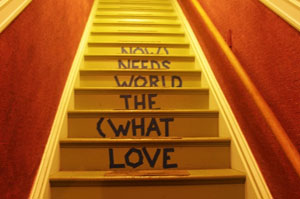
And so, in the living room, the mariachi band Trio Sol de Mexico, playing “What the World Needs Now is Love” by Burt Bacharach and Hal David. Unsure of what to do, audience members sat down on the sofa and watched them like they were television.
In the office, a teenage boy named Kore. Kore was supposed to sing “What the World Needs Now is Love,” but he had laryngitis. He spent the night chatting with his girlfriend on Hennessey’s computer while people stumbled into the room, looked around awkwardly and stumbled out again, uncertain as to whether this was part of the performance.
In Hennessy’s bedroom: two teenage girls — Linda and Griselda — who he met hanging out at the corner of at 24th and Shotwell, reading the lyrics to “What the World Needs Now is Love” out loud from a sheet of paper. The original plan, to find some homeless people to hang out in his bedroom and read Burt Bacharach lyrics, was perhaps doomed from the start. Camarena, who had met the girls before, suggested them at the last minute.
“I went up to them,” said Hennessy, “and I said, ‘You can pretend that you don’t know me. I’ve lived in this neighborhood since before you were born. You pass me on the street. I pass you on the street. We never talk to each other. I want to hire you to be in my apartment, in my bed.’” They arrived with a friend, Chris, who sat on the bed with his back to the crowd.
In the back room, Hennessy, covered in glitter and wearing a jumpsuit and a blonde wig, sang “What the World Needs Now is Love” over and over, like a lounge singer who had lost all hope in the world. As in the front room, people sat on the sofa facing him, and stared. A man wandered in, sat down in the corner, and began meditating.
After about an hour, the guest performers began to rebel.
As the mariachis neared their twentieth rendition of “What the World Needs Now is Love,” an audience member asked, plaintively, if the band knew any other songs. That was all they needed. Did they ever know other songs. They knew “Sabor a Mi” (“The Flavor of My Kiss“). They knew “Solamente Una Vez” (“Only Once.”) Had it not taken them only five minutes to learn “What the World Needs Now is Love” — a song they had never played before?
With great aplomb, El Trio Sol de Mexico began to play their repertoire instead. People got up from the sofa and started dancing.
In the bedroom, Griselda and Linda, bored with reading the lyrics, began talking with people who wandered into the room. “Have you ever seen any people like us in here before?” asked Linda.
“Like you?” said Jack Davis, from a chair off to the side of the bed.
Linda looked impatient. “Have you seen any brown people in this apartment before? People our age?”
“Well,” said Davis carefully. “A few times. But I would have to say no. Not very often. Not like you.”
They talked back and forth for awhile, with both the convivial, casual tone of neighbors trying to place each other in context, and the uneasiness of people thrown together into a discussion that they’re not quite ready for.
“If I saw you on the street,” said another man, “could I say ‘Hello, Linda?’”
“My name’s not really Linda,” said Linda.
In the back room, Hennessy finished his last round of “What the World Needs Now is Love.” He outlasted everyone else by at least an hour, cocooning into some kind of feverish glitter trance state. Linda, Griselda and Chris, who had been watching the clock, saw their shift end and walked off into the night. Hennessy abandoned his wig and walked over to watch the mariachis.
This is not, said Mario Hernández, the strangest gig he and his bandmates, Salvador Aguirre and Jose Luis Ahumada, have ever played, even though dazed, partially clad people keep stumbling in from the sweat lodge next door.The strangest gig was a quinceañera thrown by a woman who used to be a man, on the occasion of her having been a woman for 15 years.
It was also not the only time they’ve been hired to play the same song over and over again, said Hernández. To be a mariachi is to often find yourself in other people’s space, providing a soundtrack for hire to their emotional state. There was the time that the woman who was moving from Hayward to Mexico hired them to play her going-away party, and demanded that they play “El Cruz de Olvido” over and over. “El Cruz de Olvido” is a big hit at funerals, breakups and going-away parties. So is requesting repeat performances of the same songs, especially once everyone at the party is drunk. “She was leaving everything behind,” said Hernández. “Every time we stopped she would say, ‘Again!’”
“She cried and cried and cried a lot,” Hernández added.
Still, said Hernández, it was nice to stop playing the Bacharach. “Not that it was a bad song,” he said graciously. “I love to sing about love. That song is about the fact that we are in lack of love for each other. We tend to forget what the essence of life is.”
Enjoyed this piece. As someone who has played in a mariachi band, I agree that you often find yourself in the most intimate of spots with complete strangers. At funerals you’re in the middle of great sorrow, watching people in their vulnerability and adding, what seems to be, a soundtrack that complements and even triggers great emotion. Props to Keith Hennessey for his art and the statement this particular piece of his makes. I only wish I could have seen it myself.
More stories like this, please! Heather Smith, you really have a way with words!