

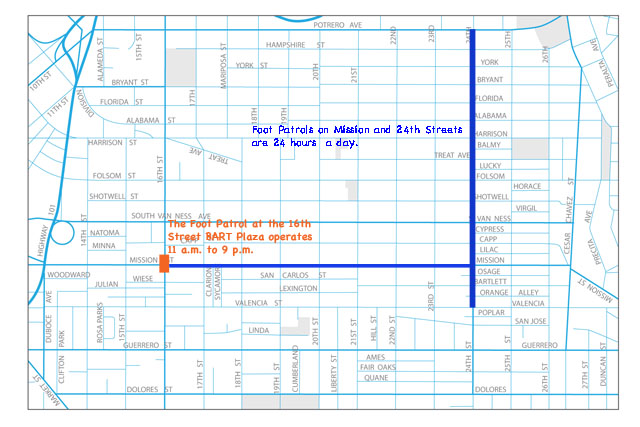

District 9 Supervisor David Campos said that the recent gang violence in the Mission District and its aftermath demonstrates the need for strong community policing that includes foot patrols and outreach.
Earlier this month, Mission Police Capt. Greg Corrales described in detail how police cooperated with community groups to de-escalate the violence.
With the budget cuts of the last year and half, Campos, a former police commissioner, said that foot patrols citywide “have either been cut, completely eliminated in some places, and do not happen with the frequency that we want to see them.”
“There needs to be a level of trust and comfort between the police and the community,” Campos said in an interview with Mission Loc@l. “You can always have more community-based policing.”
At present, police said, there are three regular foot patrols in the Mission: one from 11 a.m. to 9 p.m. at 16th and Mission, and two 24 hours a day, on Mission between 24th and 16th streets and on 24th Street.
However, foot patrols are redirected when violence escalates, as was the case with Aldo Troncoso’s fatal shooting in late February.
Although residents often talk about the need for more of a police presence, Proposition M, a ballot measure that would have required each police captain to establish a “Foot Beat Patrol Program,” failed last November, with 53.4 percent of the voters opposed to the measure. In the Mission, however, 62 percent of those who voted favored the proposition.
As a member of the Public Safety Committee, Campos has been holding hearings to assess community policing, which was first outlined in November 2006.
He said he would like to see a citywide policy that’s flexible but consistent.
There is some resistance from the police department to setting a fixed policy on community policing, and it’s unclear what Campos’s committee will finally propose.

why does the 16th and mission patrol start so late ?
there’s already urine and drunk people all over the plaza well before 11 am.
FOOT PATROLS ARE MORE EFFICENT THAN DRIVE THROUGHS, BUT MR.CAMPOS IS THE SAME GUY THAT IS AGAINST THE DEPORTATION OF VIOLENT CRIMMINALS, LMFAO.
I’m saying that to the extent you consider junkies, gangsters, and vagrants to be a part of the “community,” which is certainly arguable, “community policing” can mean something very different than it initially may seem to.
sfmissionman — what are you talking about? – are you suggesting that the police or the neighborhood is trying to have the police, what, perpetuate gangs and drug addicts rather than help create a safer neighborhood? talk about wild-eyed.
Community policing means a whole lot more than foot patrols. Google it to find out. It sounds good, but it hinges on who or what the “community” is. If the “community” is largely shopkeepers, renters, homeowners, and the habitually employed, that’s one thing. If the “community” is gangs, their enablers, and those they parasitize; those caught up in the downward spiral of substance abuse, and their advocates and activists; wild-eyed anarchists; and desesperados from foreign failed states who are essentially refugees; that’s quite another. To the extent that criminals, by the usual definition, not Campos’, are considered a legitimate part of the “community,” community policing would appear to be nothing more than an abandonment of law abidance altogether.
Yes please, more foot patrols! What makes this city great is that it is walkable, and when we are on foot we get to know each other and respect each other. Cars are the great source of alienation and separation in our world. This is true for all of us as community members, and equally true for police and their efforts to keep a neighborhood safe. By being on foot and approachable, the police become a human part of the community like the rest of us. They get to know the community better. It is impossible to build connection through a tinted window.