

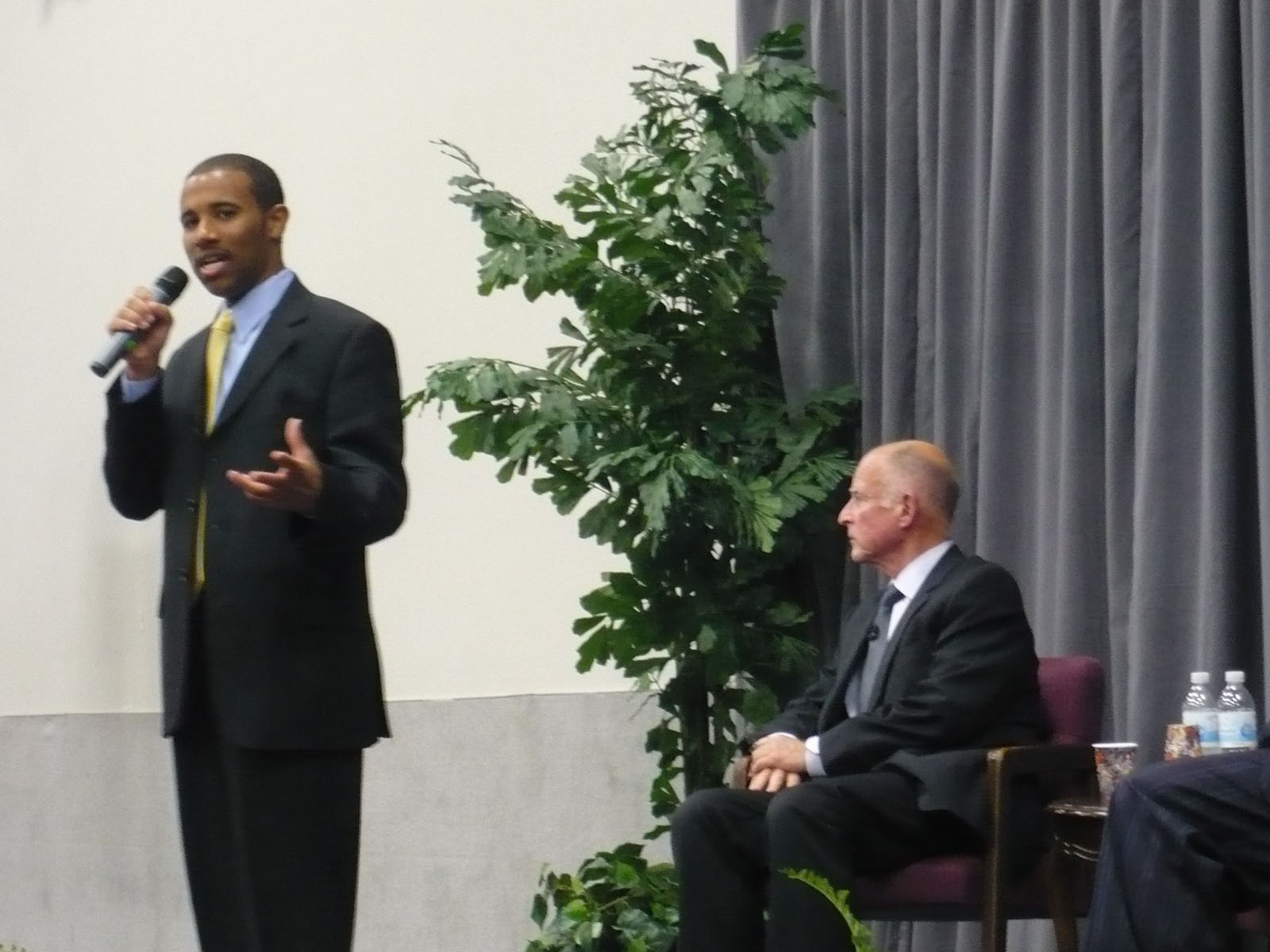

Loran Simon thinks Mayor Gavin Newsom should pay more attention to black and Latino voters.
The mayor and candidate for lieutenant governor rejected an invitation from Simon’s organization, the California Foundation, to debate opponent Abel Maldonado in front of a mostly Latino and African American audience in the outer Mission. Maldonado agreed to attend.
It was the second time Newsom skipped a candidates’ event organized by the Foundation — in July he missed a faith forum in the Mission attended by both his opponent and gubernatorial candidate Jerry Brown.
“He wants us to send him to Sacramento, but we’ve got to know where he stands on these issues,” said Simon, a student at the the University of San Francisco’s School of Law who cofounded his organization in 2004 as an undergraduate student and has organized many well-attended events.
But some political consultants say that it’s non-Bay Area voters who need to know Newsom better.
“Chances are people [in the Bay Area] are going to vote for him anyway,” said Johnny Wang, who worked on Newsom’s mayoral campaign and is president of local firm JKW Consulting. “He’s our guy and he’s a Democrat. If this was a debate amongst independent voters who haven’t made up their mind and it would be broadcast heavily, that would be worthwhile.”
San Francisco does have a history as a Democratic stronghold, with just 9 percent of voters registered as Republicans. The city has 37 percent of the state’s registered Democrats.
With such a base, focusing on debates in San Francisco may not benefit Newsom enough to be worth it, Wang said.
Running for state office, Newsom needs to be visible in areas like southern California, where Democrats may not be as familiar with him, Wang said.
Newsom campaigned in Los Angeles the past two weekends, including an appearance at a celebration of Mexican Independence Day last Sunday.
Lieutenant Governor Maldonado, behind by 9 points in the most recent Field Poll, is willing to fill in for any of Newsom’s absences, even in his home city.
“I know people look at the label ‘Republican’ and have some notions about how we campaign, but Abel Maldonado will campaign anywhere and everywhere for the votes of Californians,” said Brandon Gesicki, Maldonado’s campaign manager.
Gesicki said his candidate agreed to debate in San Francisco, Silicon Valley and southern California, but as far as he knows, Newsom has accepted no invitations.
Support for the lieutenant governor candidates is mixed in the minority community, Simon said, and he’s concerned the politicians aren’t engaging directly with those communities. The debate would be an opportunity to ask the candidates about minorities in education, job growth and policies on immigration, he said.
“It was our idea of bringing black and Latino voters together to hear about issues that are important to our community, so we can make informed decisions in November. So we won’t just be caught up in the charm — we would go deeper than that and really see the issues.”
Simon said the 300 people he had anticipated would show up for the debate don’t want to be left out.
“They want to know that you care. They want to know that you have their back when you get into office — that you’re not going to ignore them like many candidates have in the past.”
Wang said the Latino and African American communities are not alone in feeling neglected.
“I do believe it’s a valid complaint. He’s not been the most involved mayor in San Francisco history. I think there are a lot of people he needs to reach out to and he hasn’t reached out to — not just minorities, but interest groups.”
In 2006, 74 percent of San Francisco voters chose a Democrat for lieutenant governor, the largest percentage of any county in the state. Will enough people swing to the other side of the ballot if they don’t get enough attention in 2010?
“Newsom had a lot of bad publicity come out against him and he still won the primary pretty handily,” Wang said. “San Franciscans are relatively loyal to their politicians.”