

Living on the streets, in a homeless shelter, or somewhere in between, Pepe long ago developed a system to get by.
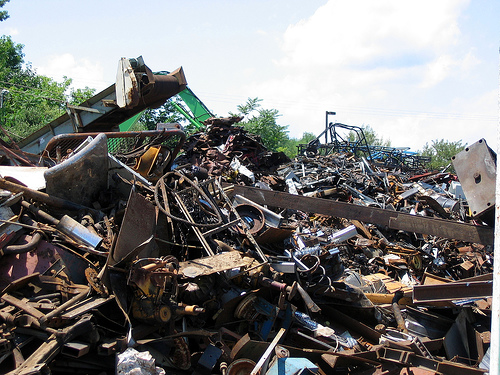
Six months ago he had a profitable routine: Scour the lower Mission and Bernal Heights for scrap metal and recyclables early in the morning before workers arrived for the day. Then sell it—for as little as $15 on a bad day, or more than $70 on a good one—to a metal company or recycling center in the afternoon.
After that, Pepe (he prefers not to use his real name) would take the cash to the Army Street housing projects to buy heroin. He would use a little, careful to inject it into a vein rather than straight into his skin. (He made that mistake four years ago, and developed necrotizing fasciitis—a flesh-eating bacteria that nearly took his life.) Afterwards, he would sell what he could and save the rest for a morning fix.
Then the housing market crashed.
Builders stopped building, leaving little scraps for the scavengers. And metal prices plummeted, rendering a day’s work less valuable. Suddenly the chaos on Wall Street could be felt on “the street.”
Now, Pepe barely even tries.
“I mean, yeah, if I find something, I’m going to take it and sell it. But it’s not even really worth trying anymore,” said Pepe, a stocky man who once frequented construction sites in search of scraps, sometimes sneaking into unfinished buildings to steal metals—mostly copper and steel.
The price of copper has fallen 63 percent in the last eight months, from $4 per pound last June to $1.48 per pound on Feb. 18., according to the London Metals Exchange. Iron and stainless steel have also fallen dramatically.
Now, Pepe focuses more on gathering recyclables, searching the sides of streets and digging through people’s garbage. Those prices—$1.57 per pound for aluminum cans and 10 cents per pound for glass beer and juice bottles—have remained steady.
He fills his extra time by begging for money, often offering favors to strangers in exchange for a few bucks. He would focus on selling more heroin, he said, “but I don’t have the cash to get the extra dope in the first place.”
Scavengers aren’t the only ones hurt by the decline. At Potrero Hill’s San Francisco Scrap Metal, owner Louis Dhority said earnings have fallen by approximately 60 percent since November of last year.
Dhority’s business buys metal from local electricians, carpenters, scavengers and others, and then turns around and sells it to large brokers, who distribute the metal in large quantities to clients both in the United States and abroad.
Dhority has already laid off one employee since the prices started to drop, leaving him with five workers. Personally, he said his retirement savings have declined by 40 to 45 percent in the past year.
“It’s getting worse every day,” he said. “And I don’t think it’s going to stop.”
Mission-based electrician Ike Garcia monitors the prices of metals on a daily basis, paying special attention to steel and copper. Garcia said he never needs to sell off a surplus—he buys the exact amount needed for each job—and the lower prices have made his job easier.
“When things were sky high it was tough,” said Garcia, owner of Ike’s Electric on 19th Street.
But for those scraping together metals and recyclables for a day’s work, the dip is devastating.
“There’s only so much time to look around,” said James Rice, a homeless man who calls Bernal Heights Park the best place in the city to find recyclables. “And right now, recycling is just the best way to spend it.”
On this Friday, he walked along Jerrold Avenue, crossing underneath the 101 bridge back into the Mission. He pushed an empty cart after selling his day’s load of glass bottles at Paper Rush Co. minutes ago. For the day, he earned $27.
“Not a bad day,” he said. “Not a bad day.”