

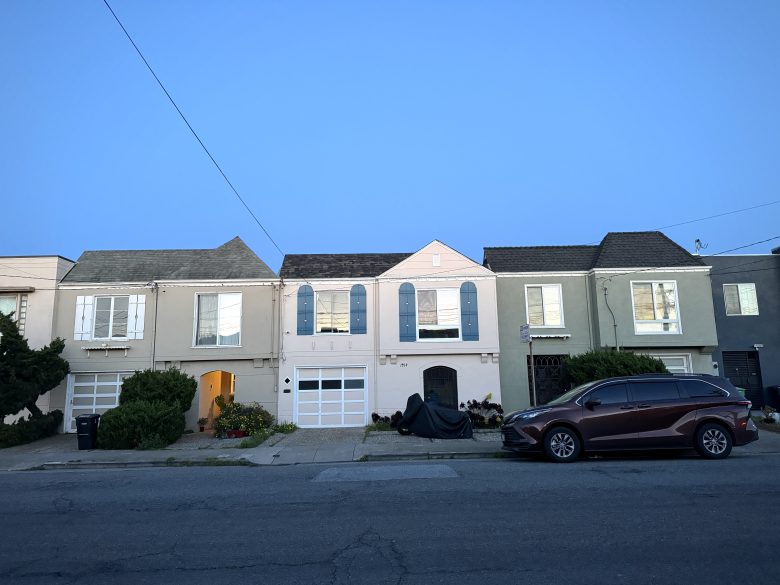
The San Francisco Board of Supervisors unanimously passed an ordinance Tuesday afternoon to let property owners build in-law units on their lots that can be sold separately as condos.
The legislation is aimed at boosting the number of such units across the city. From 2020 to 2024, only about 1,300 in-law units have been added in San Francisco, according to city data.
The ordinance, sponsored by District 4 Supervisor Joel Engardio, offers a vastly improved incentive to add an accessory dwelling unit — commonly known as an ADU or in-law unit. Until now, the units could not be sold as separate properties.
The new incentive is restricted to property owners who have a single-family home or a condo with fewer than four units on their lots. It will also apply to newly proposed single-family homes or condo projects. Only in-law units built after May 1, 2025, are eligible.
The legislation helps homeowners, especially low-income immigrants who bought their homes decades ago, unlock the “generational wealth” they have in the property without moving or selling their homes, Engardio said.
“It’s taking the one asset that you have that is the most valuable, and maximizing it,” Engardio said.
It’s unclear if the legislation will help Engardio in his efforts to prevail against an upcoming recall in September. But it will benefit the city’s western and southern homeowners, including those in the Sunset, Richmond, and the Excelsior, where single-family homes dominate the landscape.
The Sunset and Parkside neighborhoods, for instance, which Engardio represents, are about 62 percent owner-occupied, almost double the percentage citywide, according to the 2023 Census American Community Survey.
“Our elders are house-rich, cash-poor, and disconnected from their families as younger generations are forced to move from the communities they grew up in,” read a report released in April by the Sunset Chinese Cultural District.
The report recommended the city explore legislation to “allow ADUs to be individually titled and sold separately from the main property.”
The ordinance’s goal is to help grow San Francisco’s supply of “affordable, entry-level” homes, Engardio said, and move the city closer to its mandate of building 82,000 housing units by 2031 without increasing the height of buildings. The latter has drawn strong opposition from residents.
“This does nothing to change the height of anything in the neighborhood,” Engardio said. “It’s a single story in the backyard.”
The restriction to in-law units built after May 1, 2025, is meant to alleviate concerns from advocates that rent-controlled tenants in older ADUs would be subject to displacement.
Nearly 10 years ago, San Francisco approved building ADUs in all zoning districts. In the same year, building permits filed for ADUs grew to 217 in 2016, from 34 in 2015, according to city data.
In recent years, there have been various incentive programs to encourage homeowners to build more ADUs: In 2018, then-Mayor London Breed issued an executive directive to speed up ADU approvals. In 2019, the Board of Supervisors passed a pilot program to eliminate building inspection fees for ADUs for a year.
Former District 4 Supervisor Gordon Mar also launched a pilot program in 2021 in the Sunset to provide technical assistance to homeowners interested in adding ADUs.
But none of these programs have led to significant building.
Engardio thinks this time is different. The opportunity to sell the ADUs, he said, lets homeowners recoup the costs of development faster than relying on monthly rent checks.
Engardio said he will pursue additional legislation to make it possible for homeowners to defer building permit fees until one or two years after construction. “It just gives more incentive for people to get started and get it built and not having to pay all the fees up front,” he said.
“Not everyone’s going to want to do this, but it’s just creating an option,” Engardio added. “We want to make sure families have all the options available so they can stay in San Francisco.”

So will they own the land under the ADU? How about use of grounds? Property taxes? I see a lot of headaches for homeowners trying to effectively subdivide their property.
When did legislating to incentivize actions on the part of humans become the norm? Did anyone bother to ask the voters how they feel about being played? That happens to the property owner after they split their lot? What happens to their home?
Does the split constitute a new sales transaction and bring about new asset evaluations and higher taxes on their home? Does the split mean the home is now obligated to meet new building codes with improvements that raise taxes on their home after the new upgrades are complete?
We are hearing a few horror stories from property owners that lead us to believe the path is not a rosy one. These are a few Questions we hope to have answers to soon.
Engardio sold out. The whole point of the ADU program was to help renters.
LIAR.
Nice reporting. Are you able to write a story as to why so many communities are against building vertically here in S.F. ? If we can’t allow more middle income people to move to city , the economy and businesses will be unable to grow. Why are people so territorial about bulging upwards ?
Many thanks,
AJ
Financial District
The best way to encourage ADUs is to exempt them from San Francisco rent control—at least when added to a property that already contains a rent-control–exempt single-family home.