

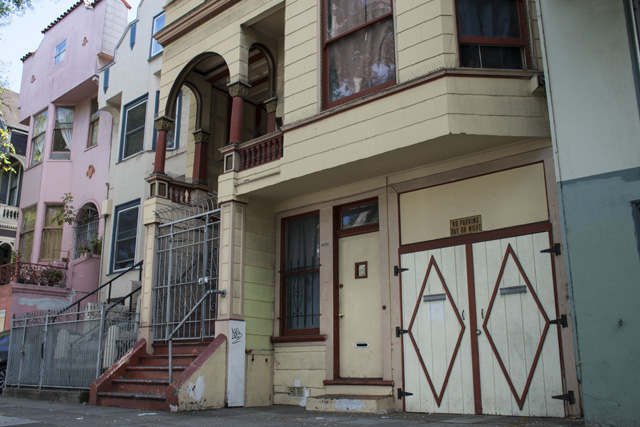

As Mission Local reported yesterday, some 14 rent-controlled tenants in the Mission District are being evicted by their landlord after he received loans from a handful of wealthy families.
All but two of the tenants at 2820 Folsom St. have declined buyouts of several thousand dollars each and opted to fight the eviction legally — even if that only delays the inevitable.
“It’s an ethical reason,” said Tommy Seiler, a tenant for more than two decades. “We want to cause them pain because they’re scum. They’re not building housing, they’re not creating products, not doing anything with their money except speculating, sucking money from the working class to make money for themselves.”
Danny Sun, the landlord, purchased the building in 2015 after receiving $1.64 million in funding from a variety of family trusts. One of those trusts was tied to the Levines, who are also backing the Howard and Levine Program for Housing and Social Responsibility at the University of California, Los Angeles.
The loaned $200,000 to Sun for the purchase of the building.
The UCLA program funded by the Levines has a special focus on the “housing needs and outcomes of low-income and workforce households.” UCLA did not respond to requests for comment, nor did the Levine family.
The four lenders tied to the building — the Levines, Leo and Donna Boger of San Jose, Boris and Tiffany Beljak of the Boris Beljak and Tiffany Beljak Family Trust, from Michael Moser of One to Four, Inc. Profit Sharing Plan — are entitled to full repayment with interest, and can take ownership of the house if Sun fails to honor his debts.
In April of this year — eight months after the purchase of the building in August 2015 — Sun served all its tenants with Ellis Act evictions.
Once the building is cleared, it can be remodeled and resold as tenancies-in-common, a tactic Sun used on another building in the SoMa in 2014 and a common approach following Ellis Act evictions.
The Ellis Act was approved in 1985 to allow landlords a way out of the rental business, but in the San Francisco housing market it has been abused by speculators looking to flip properties. Several attempts to change the law have failed.
For a primer on the Ellis Act, click here.
Seiler and 11 other tenants have hired a lawyer with the Tenderloin Housing Clinic to fight the eviction. That lawyer — Stephen Booth, who first wrote of his clients in Beyond Chron — said that the eviction has been delayed by a year and that tenants hope it can be quashed through legal means.
“I want to stand against this whole process of people buying out rent-controlled properties,” said Jason King, another tenant and a recent transplant from Portland who works as a musician and electrical engineer.
King moved into the building in 2013 and said that while he is in a “better position” than many of his housemates for life post-eviction, he’s concerned that others in the building will be permanently displaced from the city.
“It’s a great little community — like a pocket of old San Francisco,” King said. “It’s a building full of musicians and artists and people who just aren’t going to be able to afford to stay in the city.”
Seiler — who has lived in the building since 1992 and in San Francisco since 1985 — said 2820 Folsom St. has for decades catered to artistic-types. “It was never rich kids slumming it. It was always working class people who were always creative,” he said. And locally-employed.
Seiler now works at Last Gasp, an underground comix publisher on Florida Street, but listed stints at Bay Area music labels Mordam Records, Alternative Tentacles, and Lookout Records.
“I’m lucky enough that my jobs have been in the Mission District for almost 20 years,” he said.
His 13 co-tenants are in their 20s through their 50s and run the gamut professionally, but lean towards the artistic: several are musicians alongside more conventional jobs as teachers or baristas. Another’s a baker at La Victoria on 24th Street, and another a swing dancer who immigrated from Mexico.
Booth, the tenants’ lawyer, said that at least one person in each unit is a senior or disabled, allowing him to make use of a provision in the Ellis Act that will extend their eviction for a year. Without that delay, all the tenants would face removal 120 days after receiving notices.
For current tenants, that one-year delay gives them breathing room and a chance — however slim — that the legal route may quash the eviction. Booth, for his part, said that he is confident in his ability to kill the eviction legally — though he would not reveal his strategy for fear of tipping his hand.
Still, the chances for remaining in San Francisco — to say nothing of the Mission District — are vanishing.
“None of us make that good of money, me and Nick [a roommate] are older,” said Seiler. “The last thing we want to do is lose our home and go to a strange city where we don’t have a network.”
This is the second in a three-part series about the purchase of the building at 2820 Folsom St. and the eviction of its tenants. Check back tomorrow for the next installment.
Part One: UCLA Philanthropists Fund Purchase Evicting Mission District Tenants, June 16
Part Three: Mission District House Targeted by Wealthy Investors Could Become Affordable, June 18
“We want to cause them pain because they’re scum”
Yes, you greedy property thieves are such “good” people…….
My thoughts exactly! It’s funny that Seiler and his ilk never seem to express gratitude for having had the opportunity to live in a rent-controlled apt. for decades, as he has done for all but his first few years in SF. He’s clearly an ingrate with no idea how fortunate he has been in his adopted city.
“I grew up in Ohio and I still have a lot of friends there, but it’s been 25 years in San Francisco and this is my home. Where do I go? Do I go to Portland? I don’t like Portland. None of us make that good of money, me and Nick [a roommate] are older. The last thing we want to do is lose our home and go to a strange city where we don’t have a network. There’s reasons that I moved to the Mission. I’m lucky enough that my jobs have been in the Mission District for almost 20 years.” Seiler now works at Last Gasp, an underground comix publisher on Florida Street.
“It’s an ethical reason,” said Tommy Seiler, a tenant for more than two decades. “We want to cause them pain because they’re scum. They’re not building housing, they’re not creating products, not doing anything with their money except speculating, sucking money from the working class to make money for themselves.”
It seems that Danny Sun’s and the Levines’ contributions to the greater good are not altruistic enough for Seiler. Apparently, they should be willing to continue to subsidize his work in the comic book business because, after all, he’s entitled to that subsidy and there is no contribution greater than the production of comic books.
There have been many egregious situations with victims of the Ellis Act and I do have empathy for some of them, particularly those who are disabled. However, that’s not the case with Seiler and his attitude of entitlement makes it impossible for me to have any empathy for him whatsoever. If I happened to be one of the other tenants in that building I would not want Seiler speaking for me as he his the worst possible representative of their cause.
OMG ! Call the Frisco 5! Oh, I forgot they are only interested in the dead and the poor. Instead of committing acts of “community orgasm “, u guys might looked to citywide coalition building on this issue and police reform. Similar to the labor movement after the 1934 general strike.
And what will you do about this personally, Mr. Donton? Or do you only talk the talk?