

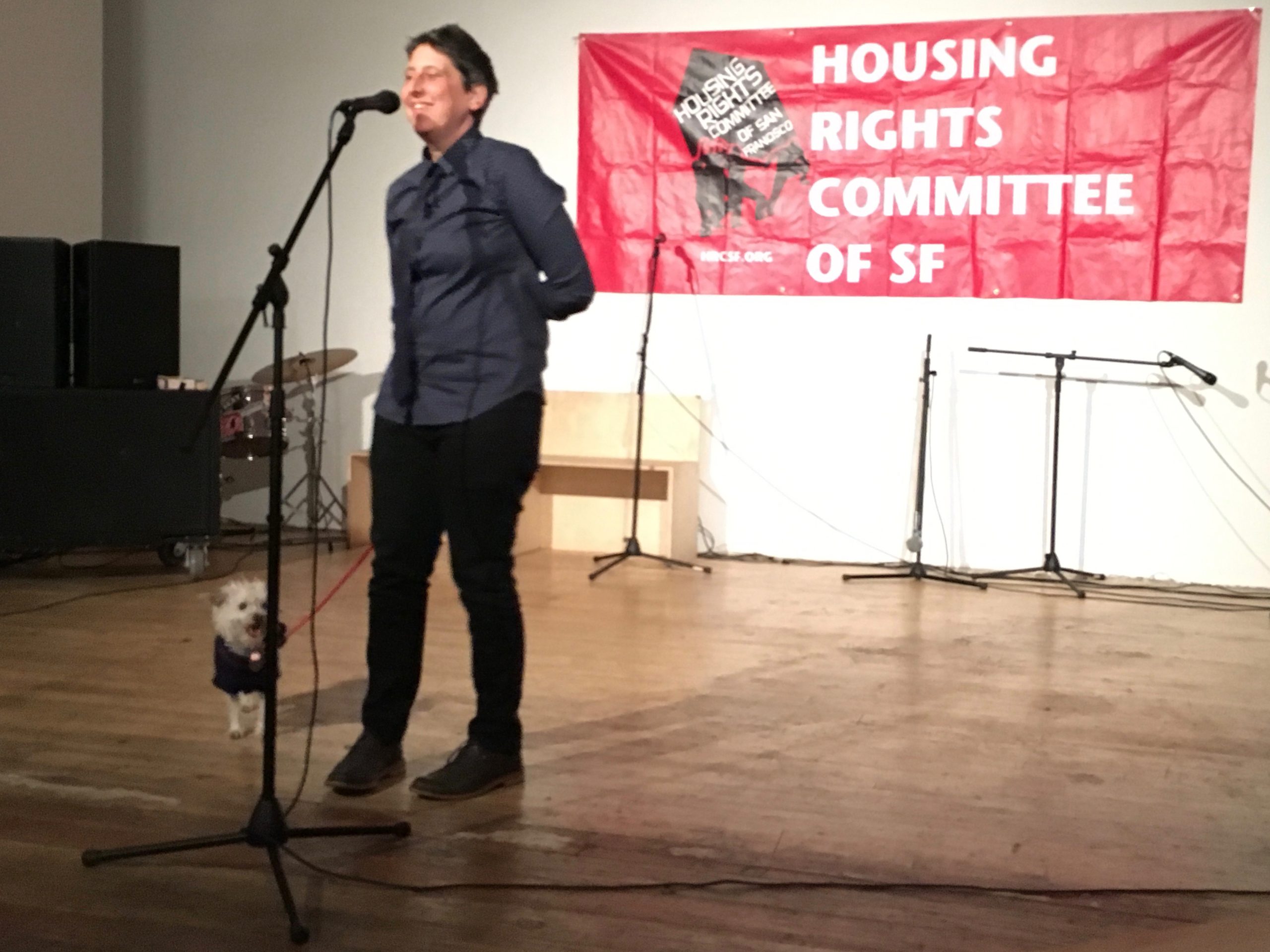

A room packed with old-time housing activists as well as more recent recruits celebrated Sara Shortt’s 17-year-stint at San Francisco’s Housing Rights Committee, including the last 11 years as the executive director.
Shortt will be moving to Los Angeles at the end of the month, where she will be with an organization that works to get housing for the homeless. Though she was empathic that “there’s no other city in this country or in the world like San Francisco,” Shortt acknowledged that the housing crisis has taken its toll on her.
“This city has absolutely, totally broken my heart,” said Shortt to a crowd of some 200 supporters on Thursday, December 17, at the Lab, an arts space in the Mission District. Shortt spoke on the rapid displacement in San Francisco and the Mission specifically. Until it got priced out, the Housing Rights Committee was based in the Mission.
“I am so aware that it’s not just for me. Everyone I talk to on the street — it’s just so evident, the pain and trauma,” she said.
Shortt is leaving to be with her girlfriend in Los Angeles — “I’m moving towards something, not just leaving,” she said — and chided those who predicted she would be back in the San Francisco soon, ready to jump back into the housing wars here.
“I can go, I can leave, because you guys have got this! You’re strong and you’re kicking ass,” she said.
It’s a turbulent time for the progressive housing movement: The recent electoral defeats of short-term rental regulations and the Mission moratorium were a setback, and just a year ago long-time progressive housing leader Ted Gullicksen died in his sleep, a fact not lost on those in attendance.
“When you think about the housing crisis in San Francisco, two names come to mind: Ted Gullicksen and Sara Shortt,” said Supervisor David Campos, who lamented both losses but said each had coached people to “step up to the plate” and continue the movement.
“Those are big shoes to fill, but they trained a lot of people,” he said.
Shortt and others emphasized the strength of their movement in spite — and perhaps because — of recent losses.
“I’ve seen coalitions, alliances, and a real fucking movement more now than in the last 17 years I’ve been here,” Shortt said in a brief farewell speech, to hearty applause.
She cited partnerships “from Chinatown to the Mission” and named some now well-known victims of eviction: Benito Santiago, Patricia Kerman, among others. “We know the names of the evicted, the public knows — they’ve been in the papers. That’s new for us. We’ve never had such power.”
Shortt came to San Francisco 17 years ago during the first dot-com boom (and bust), but has been involved in housing since her 20s. The housing scene was different in the early 2000s. Many found themselves unsure how to approach the rapid changes happening in the city.
“There were a lot of community groups going back then like ‘How do we do this job?’” said Joseph Smooke, an employee of the Housing Rights Committee who started at the Bernal Heights Neighborhood Center at around the same time as Shortt came to San Francisco. She would come to him for advice, but he didn’t remember her needing any. “It didn’t take her very long, she didn’t need much help.”
Shortt took over as executive director in 2004 and led for the next 11 years, never scared of “pushing the envelope as far as it [could] go,” according to Fred Sherburn-Zimmer, a co-organizer at the Housing Rights Committee and Shortt’s replacement as director.
Sherburn-Zimmer praised Shortt’s candor and analysis, repeating an oft-heard refrain that night.
“There’s just something about the way that Sara gets up there and tells it the way it is,” she said.
“She’s the kind of person who can break down really complex issues for real people, make a radical position seem reasonable,” said Smooke.
Others recalled particular actions like the takeover of Airbnb’s headquarters or the Google bus protests, the latter perhaps the most remembered event that night and an action that garnered attention nationwide.
“The Google bus blockades were amazing, the creativity of them,” he said, remembering them alongside the “many hours” organizers spent in Shortt’s office “conspiring against the Board of Supervisors, the Planning Commission, landlords, speculators — basically all the evil that exists in the world.”
Tom Ammiano, former state assemblymember and supervisor, remembered honoring Shortt in Sacramento. During an awards ceremony, Shortt went up to a fellow honoree — a female police officer from San Francisco — and asked her point-blank: Did you arrest me? “I did!” Ammiano recalls the cop saying, an example of Shortt’s proclivity towards humor — one he himself displayed that night.
“A lot of people make fun of her height, but I’m not going to stoop to that level,” Ammiano said, the first of many one-liners. The former supervisor was replaced on stage shortly afterwards by sitting supervisors Aaron Peskin and Norman Yee, who presented Shortt with a commendation from the Board of Supervisors, the second in two days.
Unlike the one she received in front of the full board, this one was signed only by the progressive supervisors — Campos, Peskin, Yee, Jane Kim, Eric Mar, and John Avalos — leading Peskin to call it “the real commendation.”
Peskin also remembered his time at the Housing Rights Committee — he was a board member in the 1990s before running for office — and his work with her in the last seven years, during his hiatus from office-holding.
“A little while ago it felt like the darkest of times in San Francisco,” Peskin said. Housing groups were rallied against “Google buses, short-term rentals,” he said, and “everything that could go wrong was going wrong.”
But, Peskin said, “at the forefront of that fight was Sara Shortt.”
Shortt was upset to be leaving, calling her move “heartbreaking.” She was not worried about the survival of the movement in her absence, however, and ended the night with a ubiquitous call-and-response of San Francisco housing protests, well-known to the activist crowd: “What do we want? Stop the evictions! When do we want it? Now!”
How successful was she? Any idea what rents would be like without her hard work? Like $10,000 for a 1 bedroom versus say $3,000 which it currently is in the Mission. Not Mish like I heard some hipster this morning.
While fighting for tenants rights when dealing with shady landlords is really really good, the anti-construction policies the Housing Rights Committee supported are a direct cause of rising rents. The fact is that more people want to live in San Francisco than there is housing for them to live in. As a result, people who can afford to pay $4,000 a month for a 1bd bid the prices up. Attaching massive fees to new development projects and making the approval process incredibly long and uncertain makes building housing very expensive, which means that only expensive (high revenue) luxury projects will get built (along with the tiny number of income-restricted units required).
The problem is that housing in San Francisco has become a scarce luxury item coveted by the wealthy. Making it even scarcer only makes it more coveted.
Bull Shit !!
Best of luck with new political endeavors in LA!!