


This is one of a series of profiles on the musicians who make up the Mission District. The first profile, on the Mission “Blues Man,” can be read here.
On a recent day in Richmond, California, Luis Aranda greeted me at his door, dressed to kill.
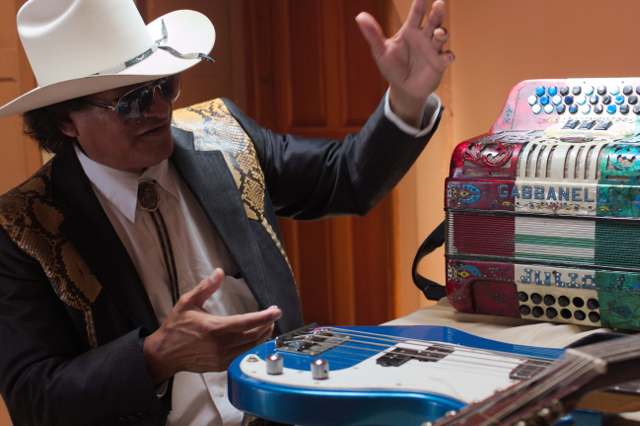
He wore a cowboy hat and boots, a black suit with snake-skin accents on the shoulders, and a pair of dark aviators that he never removed, even though we immediately went indoors. He looked much younger than his 66 years, which is what people tell him.
Some of that was surely meant for me — I’d told him I wanted photos. But after our interview, he said, he planned to work a shift in the Mission District.
For six years, Aranda has walked the Mission’s boulevards almost every day, carrying either a guitar or accordion. He generally makes his living by playing corridos, or Mexican folk songs, for the nightly throngs.
Aranda’s shifts can last up to seven hours. The work is hard and sometimes thankless. On the bad nights, he said, “I can barely make enough for BART.”
He’s found that Missionites will more often tip a band than a solo performer, so he brings his friends with him whenever he can. They call themselves “The Canaries of the North,” Aranda said.
Some restaurants love Aranda’s band. Others, like Pancho Villa’s or Gallardo’s, have told him not to return because their customers preferred silence, he said.
Sometimes the band was a victim of its own success. At one taqueria — Aranda would not say which — customers adored the Canaries but the manager blacklisted them, concerned that they were getting tips that should have gone to the house staff.
“It feels bad,” Aranda said, recalling the experience. “We play to make people have a good time, and now we can’t do that.”

This last Friday night found the Canaries playing in front of Gracias Madre, at 18th and Mission streets. Wayfarers slowed, drawn by the music, and they in turn drew others until about 20 people huddled together. One couple started dancing on the sidewalk.
The song grew louder — the crowd was singing along. Blanca Eusse said she’d learned the song, Canción Mixteca, as a child in Colombia. Her friends had similar stories: Ana knew it from her childhood in Honduras, Adelmo was raised on it in El Salvador, and Candelario grew up with it in Mexico.
“The song’s about how you’re longing to be back in the town where you grew up,” Eusse said.
The last note dropped. Then Dilan Arellano, a young construction worker who was in the neighborhood with friends after his shift in Sacramento, handed Aranda $10 and requested a song about a ranch hand’s toils, harvesting fields of wheat. “I learned it from my Grandpa, when I was a kid back in Mexico,” Arellano said.
Aranda called his life here “bittersweet.” When he makes good money playing on the streets, or at private parties, he sends some of it back home to his youngest son, José Guadalupe, who is studying computer science in Mexico City.
But he misses his family in Mexico. Although he lives with his wife, and two of his children are nearby in the Bay Area — his five other children and his ten siblings are still back in Mexico. To this day, his 98-year-old mother lives on the same hill-top ranch where Aranda grew up tending the cows, horses and goats, in a small village in Guanajuato state.
It was there that he first learned to play the guitar for the express purpose of wooing women — the strategy was pretty effective, he said, though the music itself has become his longest romance to date.
When he turned 22, he moved to Mexico City and got a job at a factory that made frosting for cakes, and he started a family.
Then, when Aranda was about 40, he and his brother formed a band called “Embajadores Del Cerro Guanajuato,” or “The Ambassadors of Guanajuato Hill,” after his childhood home. Their music followed the Norteño, or “Northern,” style — the songs were raw and edgy, telling stories about romance, the harshness of ranch life, or “just getting drunk,” Aranda said.
They were booked for shows almost every weekend. They recorded eight albums together, and landed on the soundtracks of four films, Aranda said. He eventually built his own studio to help groups record their music.
“But I left all of that behind,” he said.

When he turned 60, he was diagnosed with diabetes. The medical bills started to pile up. One of his sons, who lived in the United States, told him that the medical care was better and cheaper here, so Aranda and his wife packed their bags and moved.
Now, as the years roll on, the swelling in his legs is getting worse, forcing his shifts to get shorter and shorter. Time has marked him in other ways.
“I don’t see very well, and I’ve lost a lot of teeth.” he said, smiling. “What can we do? We have to keep living.”
