

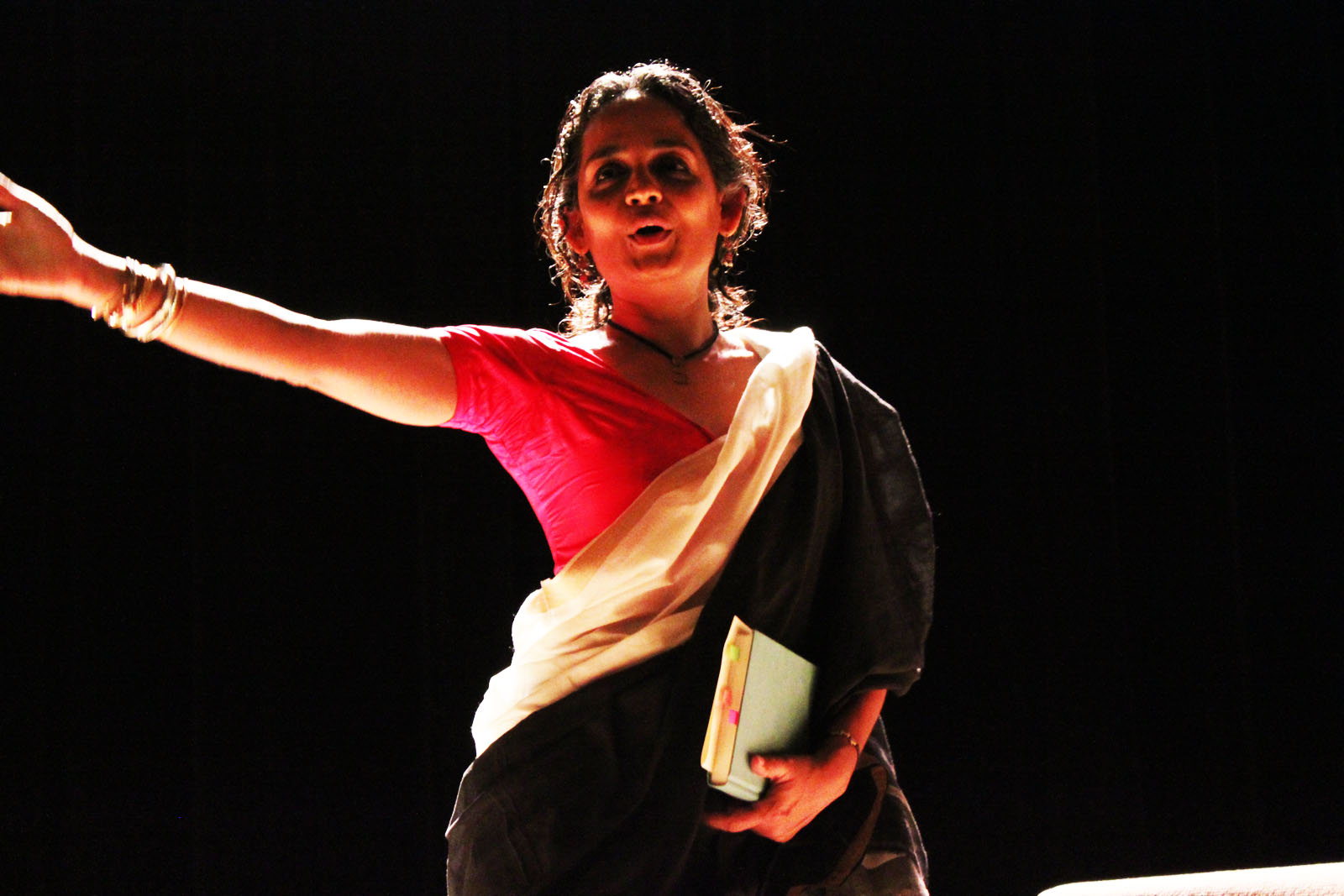

Tiny, with a shock of silver-lined hair and an almost ethereal appearance, Arundhati Roy captivated an audience at Mission High School Friday night as she told a story of repression and the changing face of democracy in India.
Approximately 1,000 people joined the world-renowned Indian author in the school’s auditorium on 3750 18th St. for a discussion from her latest collection of essays, “Field Notes on Democracy: Listening to Grasshoppers.” Among the audience members were actor Woody Harrelson and novelist Alice Walker.
“What makes a really great writer, person, and rebel–is someone who listens more than he or she talks,” said Walker in her opening words for the evening. “Someone who goes to where the silence is, and tries to understand why it is there.”

If listening is one thing that Roy does well, telling a story is something she does even better.
Throughout the evening, Roy touched on heavy topics such as the “mutation of democracy” in India, Kashmir’s struggle for independence and the oppression of it’s people by the Indian governement, as well as the displacement of thousands of people from the Narmada Dam project.
Despite the sobering revelations of her essays, Roy never fails to instill humor–and hope–into her writing.
“At a crucial time like this, few things are more important than dreams,” said Roy. “The younger generation has discovered the power of mass protest, and the dignity of straightening their shoulders and representing themselves.”
Although her first novel, “The God of Small Things,” catapulted Roy to international fame, she stepped away from fiction and has devoted herself to non-fiction writing for social causes in recent years. Roy’s political essays touch on everything from social injustice to environmental issues and economic inequality.
“I love the way Roy intertwines humor with serious matters,” said Aryenish Birdie, an animal rights activist whose parents are from Pakistan. ” Her words really hit home.”
After a thought-provoking Q&A session with the Alternative Radio’s David Barsamian, it was an audience member who posed the perhaps most difficult question of the evening: When will she return to writing fiction?
“It’s very difficult to live in India at these times and to be able to put time aside for a project–I’m on such a roller coaster,” said the Booker Prize – winning novelist. “You have to write now, and people are dying now. It’s a dilemma, but I’m desperate to write fiction again.”
Great story girl, keep it up. I always knew what potential you’ve got!
Great story.
Great writeup. I deeply appreciated her comments, as well as her thought-provoking observation that the world’s biggest occupations (Kashmir, Iraq, Afghanistan, Palestine) are maintained by nations with democratic systems (India, U.S., Israel).