

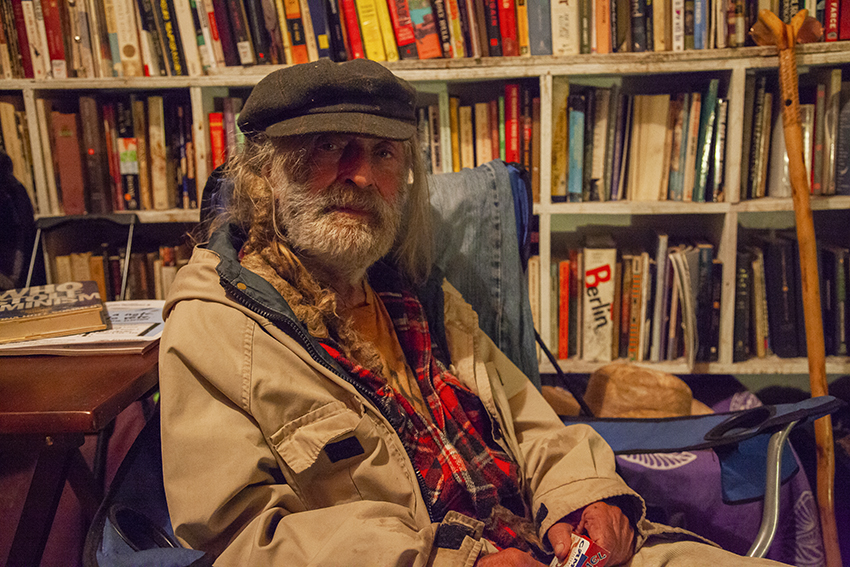

By the time “Diamond” Dave Whitaker died on Monday, March 2, at the age of 88, he had been privy to a number of things.
He was a member of the Diggers, a countercultural community activist group founded in the late 1960s. He was a co-founder of the KPOO radio collective in 1974. He served as a founding member of San Francisco’s Community Congress in 1975, which helped institute the city’s first district elections.
He was involved with the Rainbow Family, which organized large camping trips in the 1980s and 1990s. He cooked with Food Not Bombs, which gave away free food in the spirit of the Diggers.
He moshed with the punks at the turn of the millennium, and hosted a show on Pirate Cat Radio from its early days into its time as Mutiny. He was, for quite some time, the oldest senator of the Associated Student Council at the City College of San Francisco.
He was part of the crew that lived in Justin Herman Plaza during 2011’s Occupy movement. He was the organizer of an annual birthday party (for himself) at Adobe Books as recently as 2019. He was the founder of numerous poetry-reading events — including Poems Under the Dome at City Hall — which he attended every year until 2025.
Before any of that, according to legend and reiterated by local Dylanologist Ian Grant, he introduced a young Bob Dylan to a few key influences that would prove critical to the legendary musician’s artistry: Woody Guthrie, Jack Kerouac, and weed. Some of Dylan’s early bootleg tapes were recorded in Whitaker’s Minneapolis, Minnesota home.
Whitaker’s home was one of a few “sites of really important cultural meetings” for folk musicians in the area, Grant said. At the very least, Whitaker has his place within the “constellation of people and personalities that Bob was running with back in the early, early days.”
But that is, be assured, the very least.
According to frequent collaborator Val Ibarra, Whitaker was also somehow present for Martin Luther King Jr.’s “I Have a Dream” speech in 1963. And he rode the Further Bus to the Human Be-In (1967) followed shortly by the Death of the Hippies funeral (also 1967).
Diamond Dave was, basically, in the words of local poet and musician Jeremy Pollock, “San Francisco’s Forrest Gump.”
“The lore and legend of Diamond Dave is all true,” Ibarra said.
“He really loved people, and really loved politics,” said Barbara Bennett, Whitaker’s longtime partner. “And he was the kindest person I’ve ever known.”
Whitaker first hitchhiked to San Francisco, he said, in 1957, at the age of 19, and fell in with the local beatnik scene, though he soon expanded from there.
Whitaker was “part of every interesting counterculture movement happening around the city for the last 60 years,” Pollock said.
“Beatnik, hippie, punk rock, hip-hop, four generations, different styles, but something in mind,” Whitaker rapped in a 2005 oral history interview at San Francisco Public Library’s Park Branch.
“Of the three — the beatnik, hippie, punk — I think the hippie was probably the most prevalent in how he lived his life,” said Ibarra. “He depended on other people. He lived in communities or collectives. He built collectives.”
“He was more gifted than anyone else I’ve ever encountered at creating community,” Ibarra said.
“He just had a lot of faith in the universe,” said Cat Bell, who met Whitaker in 1979 around Haight-Ashbury. “He was truly in the moment. And just very devoted to peace, justice, actions.”
Current S.F. Poet Laureate Genny Lim remembers Whitaker as something like the consummate street poet:
“People talk about poetry for the people, but he was really poetry in action,” Lim said.
“He had no pretensions at all. He was who he was, which is a very rare thing. He didn’t subscribe to academic poetry standards.”
Lim also recalled Whitaker as “always supportive” at a time when most people “pretty much dismissed Asian-American poetry.”
“He supported us. He supported me,” Lim said. “Because he was all-inclusive.”
Whitaker’s poetry was rarely formally published, but in recent days, some of his colleagues have turned to his many figures of speech for solace: “Don’t panic, keep it organic” is one. “Doing more together than any of us can do on our own,” is another.
Diggers archivist and historian Eric Noble pointed to one rather timely phrase that Whitaker wrote in the Diggers online guestbook:
“The past shakes hands with the future through the now.”
“Cast a wide net, and find the common thread,” was another of Whitaker’s well-worn catchphrases. For years, he and Ibarra hosted a radio show called “Common Thread Collective.”
In retrospect, of course, the common thread was Whitaker.
A memorial for Diamond Dave will take place on Golden Gate Park’s Hippie Hill Saturday, March 7, from 3 to 6 p.m.

As he states in the video he was a bike messenger in the 1950s. At the time he passed away earlier this week, he was probably the oldest surviving messenger in San Francisco. Always liked the way his hand gestures enhanced his storytelling. Thank you Diamond Dave for being here for us.
I met Dave some years back at a “brunch with commies” event at a friend-of-a-friends home. I knew nothing about him, but there was an instant connection. He left quite an impression on me. I didn’t know all these things about him until reading this obit. RIP Dave! See you soon!
Diamond Dave was in the house at 924 Gilman on November 3 1989, after I’d been in San Francisco for less than one month, when my husband and I met at a Tragic Mulatto show. BART had closed and the Bay Bridge was down so I caught a ride home with he and his friends through Marin and the rest is history.
he lived at the facility I work at his last three months…I worked with him a bit…he asked me once ‘where is everybody?’…why don’t people reach out while someone is alive rather than waiting till they’re gone. Barbara did her best but he had NO visitors during his time at my facility. He was frail, he was confused, but he still would have been glad to see someone.
Just a reminder to folks
Remember seeing him at Punk shows at The Farm in the early 80s