

Every night before Oscar and Brandy climb back into their minivan, they plaster the windows in towels and spare blankets to hide themselves from view — even though most San Francisco city workers who are familiar with their faces, they say, turn a blind eye.
Technically, sleeping in a car is not legal in San Francisco — though, for now, sleeping in an RV is — as long as the vehicle’s owner is working with the city to find alternative housing.
But the couple has no other choice. Oscar has been alternating between sleeping in a tent under a freeway overpass on the border between the Mission District and Potrero Hill and in his girlfriend’s broken-down car ever since the mobile home they shared was towed by the city at the beginning of the month.
The couple are two of three former RV residents Mission Local interviewed who have become street homeless since San Francisco began its crackdown on people living in mobile homes on public streets, closing its last free parking site last year and implementing a two-hour parking restriction on oversize vehicles in November.
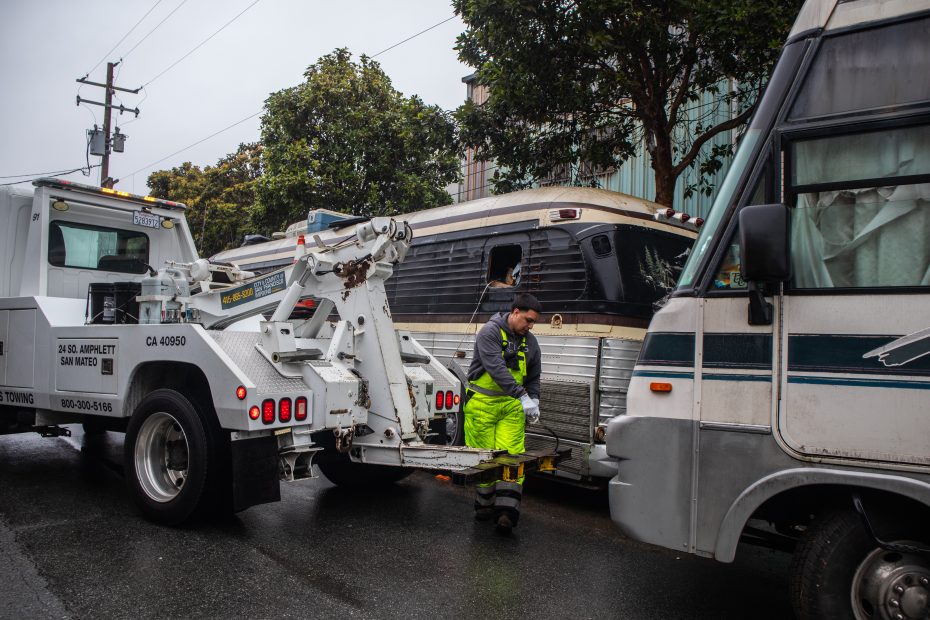
But there are many more like them. In the last five months, 169 large vehicles have been towed in San Francisco, the majority of which were parked in Bayview-Hunters Point.
The mayor’s office promised that it would help RV residents secure alternative housing if they enrolled in the city’s large vehicle permit program, which offers RV residents who have parked in the city since May 2025 or before a temporary, six-month permit if they work with case managers to find housing.
It hasn’t always gone smoothly: An AI chatbot designed to answer RV residents’ questions about the program was rolled out with numerous errors, and many RV dwellers say they were missed in a citywide count of RVs parked on public streets last May.
Just over half of an estimated nearly 500 RVs parked on San Francisco streets enrolled in the program and received a temporary six-month parking permit and the promise of support to find permanent housing.
Five months into the parking ban, 30 percent of the 271 RV dwellers enrolled in the large vehicle permit program have been matched with housing. That’s 82 people. The rest remain in their vehicles.
But for some who did not obtain a permit and have been towed, the loss of their vehicle has catapulted them into life on the street.
Several excluded from RV permit program lost housing
The three former RV residents who now live in a car or a tent did not have a permit, and thus, are not enrolled in the city’s program to secure housing. They say they were missed in the eight-day May survey count of RVs across the city that would have automatically enrolled them.
Though each tried to appeal, they were rejected for not having a license plate or valid registration, they said.
Oscar, whose last name, along with three others, has been withheld for fear of retaliation, managed to reside in his RV for nearly six years on San Francisco streets before his mobile home was towed earlier this month.
His RV had been towed before. The city allows homeless RV residents to retrieve their vehicle for free one time after it is towed. But this time, he would need to pay more than $6,000 in unpaid parking tickets in addition to the retrieval fee of over $500, he said. He didn’t have the money to get it back.
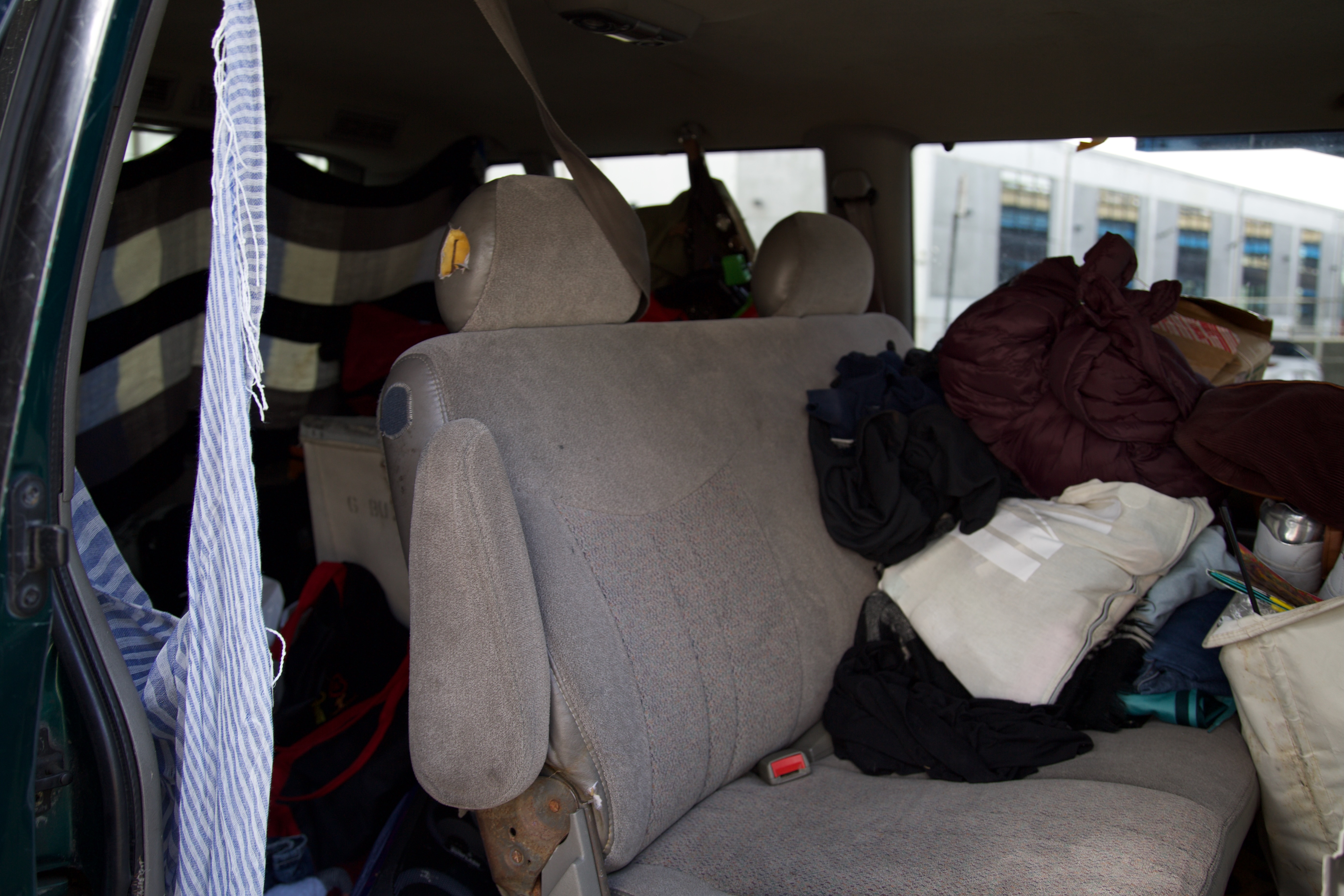
Oscar removed his belongings from his vehicle before it was taken to a nearby impound lot, and borrowed a small camping tent from a friend for the night, fitting as much of his clothing, cooking supplies and documents as he could inside the tent, along with his two small dogs.
Many RV residents without a permit are desperate for one to stave off losing their mobile home and entering congregate shelter — or becoming street homeless.
Three other RV residents alleged to Mission Local that outreach workers asked RV residents for hundreds of dollars in cash in exchange for enrolling them in the permit program.
The city attorney’s office investigated allegations against one accused worker, Jacoby Morales, who no longer works for the city as of earlier this month, according to the city’s contractor, Heluna Health.
Imminent housing is ‘relief’ for those enrolled in permit program
For others who are enrolled in the city’s program, it’s been a success.
Carlos Brito, 76, is expecting to soon move into permanent supportive housing for seniors, along with his caregiver, Darwin, 33, who also lived with him in their RV with their four dogs.
For now, Brito is living in a hotel paid for by the city with two of his dogs. Brito and Darwin have already sold their RV to the city for $3,500. It’s a temporary solution, but one that Brito said has already been a relief.
Mission Local spoke with Brito in December, when he was still waiting to hear back from his case manager as to whether he would receive housing. At the time, he was living in Darwin’s 1990s Dolphin mobile home.
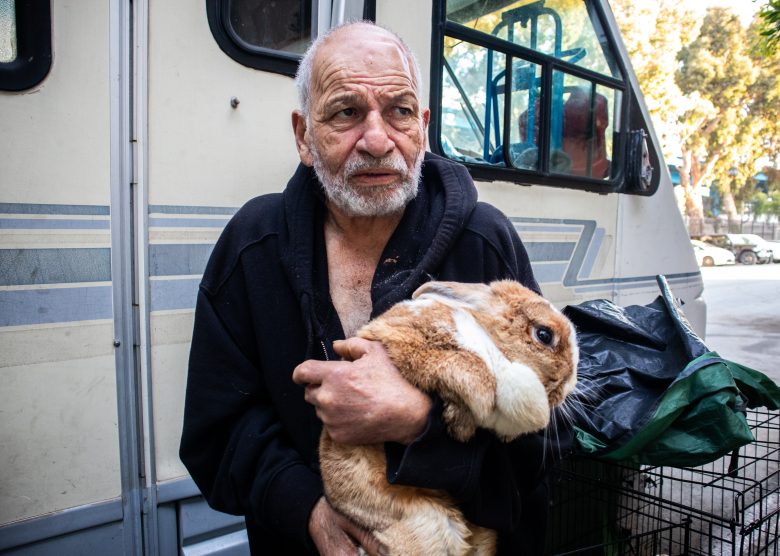
On the pavement, he and other nearby RV residents sat in folding chairs, eating tacos off of paper plates and stroking Brito’s pet rabbit. Brito has lived in Darwin’s RV since his mother died of ovarian cancer in August of last year; he had been living with her as her caregiver, and has struggled to find housing since.
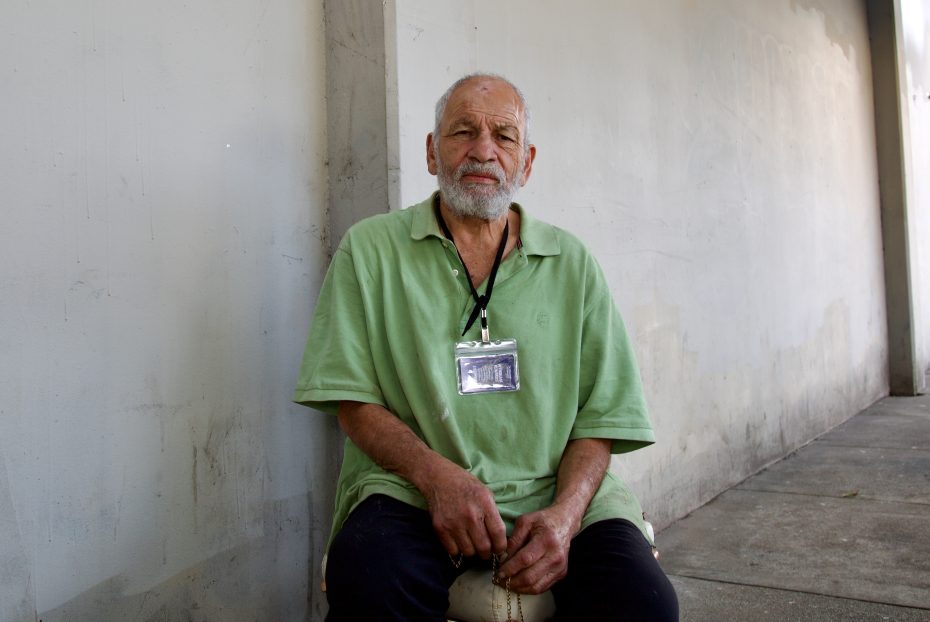
“We’re moving into a different phase of our lives,” said Brito. “I’m tired. Now it’s become just a pain.”
It’s still an adjustment. Their mobile home afforded the men a level of freedom that many hotels and shelters do not provide.
“There are many rules,” Darwin said of the hotel. “We can’t have any visitors.”
Darwin, whose last name has been withheld, has chosen to sleep in their spare truck to watch over their other two animals. The hotel, he said, only allows for two animals. The move puts him at risk of citation or arrest until they move into permanent housing together.
According to data shared by the Department of Homelessness and Supportive Housing, of 60 adults and families that have been housed through this program as of March 13, three are in permanent supportive housing, which provides on-site social services for people stuck in chronic homelessness and a rent of 30 percent of tenants’ monthly income.
Fourteen, including Brito and Darwin, received a hotel voucher, and the majority, 43, received a rapid re-housing voucher, which provides a time-limited rental subsidy at apartments that accept the voucher.
San Francisco has offered to pay landlords one month’s rent to house RV residents who receive the voucher, though critics have argued that San Francisco, which is in the midst of a severe housing shortage, does not have the available units to house the hundreds of RV residents who will need housing.
According to the data shared by the department, 40 percent of people who received a rapid rehousing voucher were housed outside of San Francisco in Daly City and Oakland.
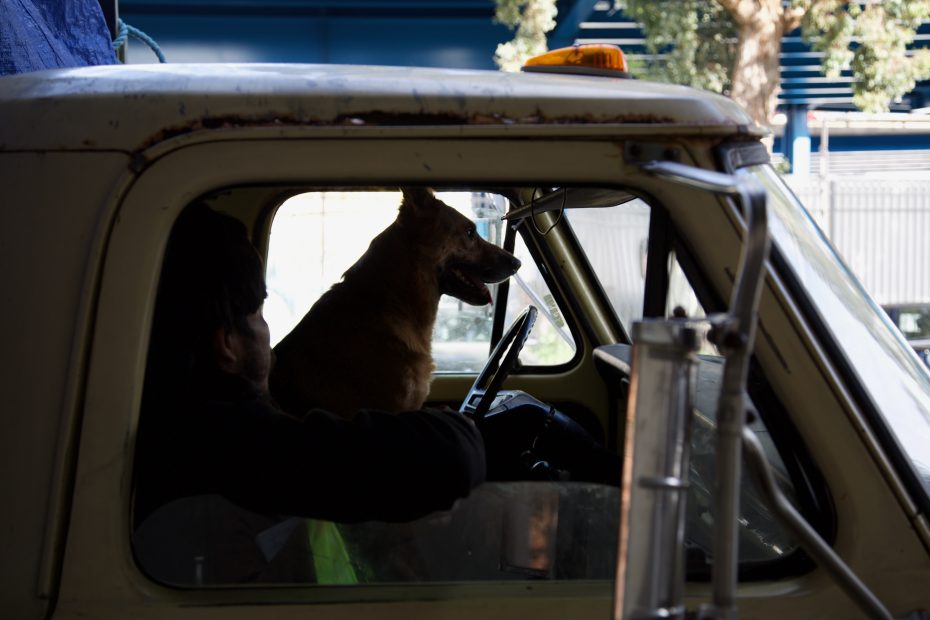
Alan Brooks, 70, recently went on a walking tour of an apartment, and will likely move there in the coming weeks. Brooks is on parole after serving nearly 50 years in San Quentin prison, and is thus required to reside in San Francisco.
To meet his parole restrictions, Brooks has been matched with an apartment in the city, though not everyone’s preference to stay in the city will likely be met. According to the large vehicle permit program’s regulations, if an RV resident rejects their housing offer, they will be disenrolled from the program and lose their parking privileges.
‘It’s cold:’ Life on the street for former RV residents
For Oscar, Brandy and Diego, losing their mobile home has turned their lives upside down. For Oscar and Diego, it is the first time they have lived on the street, they said. Both have lived in their RV in San Francisco for nearly a decade.
On Friday, Oscar stooped on the pavement under an overpass in a slightly stained blue T-shirt, petting the two dogs he shares with his girlfriend as she squatted over frozen waffles heating on a hot plate on the sidewalk. The clothes on his back are his only belongings at the moment, he explained.
The morning after the first night he slept in a tent, his possessions were confiscated by the Department of Public Works, including his clothing and his phone. He doesn’t know how to get his belongings back, he said, or why they were taken.
Diego, who called Mission Local on his friend’s phone, he said, also no longer owns a phone since his RV was towed in February.
The move has come at a cost to his pets as well — since he was towed, his dog, wandering under the overpass, was hit by a car and broke its leg. Oscar’s girlfriend quickly ordered him to put the dog back in its leg brace as it still eagerly limped toward a rubber bumblebee toy.
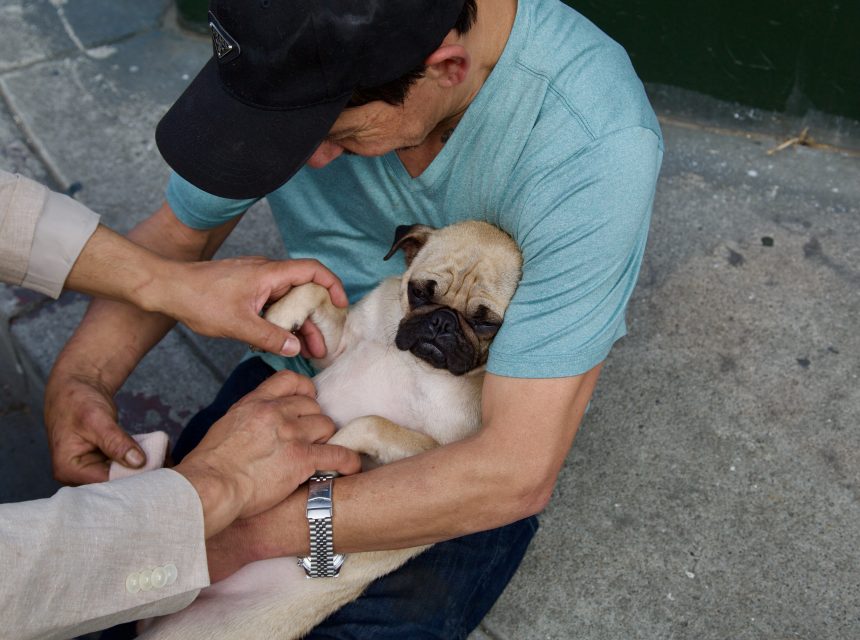
They’ve relied on neighbors still parked in nearby RVs for help with necessities and transportation. Soon, though, there likely won’t be many RVs left in what was once a popular parking spot, they mused.
Diego, too, has set up his tent near friends who live in an RV to sleep under a roof when it rains, or to use the generator to plug in a heater. He doesn’t know how much longer he will live in a tent, and has tried to find shelter, with no luck. It’s the first time he’s been homeless.
“It’s been hard,” he said, over the phone. “I sleep close to my friend’s RV, he keeps an eye out for me,” he said. “But I want a place. I want a nice warm place. It’s cold.”
I bet housing is way easier without four dogs.
Can’t place a bandaid 🩹 on a bleeding artery. Housing !!!?????
Why can every one get permanent housing. There is so many vacant buildings in SF
someone should think in how to make them into studios. The homeless don’t need much. Make sure you provide garbage dumps and bathroom with showers. What they done with the homeless is inhumane. Everyone is only one pay check from being homeless. Think about it !
After I lived in a truck for ten years (no problem) I moved into my sister’s apartment. The first thing I noticed was that many formerly homeless stayed there. I loved them but they had no respect for others. They were loud and had mental issues that made it more difficult to live indoors. People who think there are enough vacant apartments in San Francisco buildings should answer the question: can they live next door to you? We need to respect those who have a roof as well as those who don’t. I have suggested such in another posted comment on this issue. Most so far, disagree with me. Of those who disagree with me, have you been homeless for more than a year at a time?
After being homeless for more than half of my life and now I’m also working for a nonprofit homeless shelter. I agree with you 110%. There are so many different multiple reasons while one is homeless and even in a homeless shelter or let’s say transitional housing there are numerous amounts of support staff from case managers to resident assistance, etc. that are just there to provide basic support and even in that situation. There are fights, thefts and
Deaths. The other main issue that’s there is there’s no training on how to act once one gets housing outside of the system.
Defying all measure of common sense (as well as the facts presented to them) three female immigrant SF supervisors voted for this program, which only serves to increase income inequality!
I read this cry me a river story and compared it to my personal experience of being homeless for ten plus years (2009 to 2019-20ish). Short back story: I bought a brand new F-150 in 2008. Never did I think that I would be living in it in less than a year. I LOVED IT!! The key was to navigate clean and lightly. My family members marveled at how clean I always kept my truck. What did it cost the city to house me? Zero dollars and zero cent. That said, I created a solution to this homeless problem that no one in City Hall will touch with a ten year, ten foot bureaucratic pole. Why? Because the city is narrow minded in thinking on the needs of the homeless. Why did I keep myself and truck clean? RESPECT FOR OTHERS AS WELL AS MYSELF. I always voted. I wrote and published a book that is in the SF Main Library. I also wrote a SF ballot measure that received 98,000 yes votes (it lost) during this same period. And for three years I had a weekly public access TV program from 2016 to 2019 called The Angelic Troublemakker to share my point of views. And I briefly was on a city commission committee. I was kicked off by one commissioner who lets say who did what she told me not to do years later. (Long funny story) All of this was done while living in a truck for ten years. Never mind the fact, that I have never been able to walk. Now I know what I was able to do, not all homeless can do. But I am willing to be 90% can do.
San Francisco can save a lot of money in housing while offering privacy, dignity for almost nothing if they embraced homelessness creativity. Yes, homelessness creativity. Ask yourself this one question: if you became homeless, would you rather sleep in a tent or a Lincoln Town Car? I called my idea Kar Keys and I posted it on my Medium page. But if you can only visualize a person sleeping in a car, you missed the WHOLE point of my idea.
Thousands flock to this city every year with the intention of living on the street. Some arrive by vehicle, some with little or nothing more than the clothes on their back. Most eventually move on, but some do not, and it’s this hardcore minority whom we see on sidewalks or in vehicles rotting away. Addiction is the common theme. Pretending this is in any way okay and,or the wealthy are to blame is blithering insane.
You wanna know what’s really “funny?” San Francisco house’s who they choose to house. I’m no angel. But I’m not a filthy-hoarder either. You don’t want your property looking like a dump site, but still choose to let them in and then it costs you that much more to repair the place than his/her rent ever was.
PLEASE STOP the Sanctuary Cities nationwide.
Anyways, I homeless and hopeless at this point. I NEED a clean apt for myself and my Babygirl(cat.)
I’ve got a cleaning problem and refuse to stay or live anywhere that’s dirty.
I also love to cook and just hangout by myself.
I’m also on SSI($1,362 monthly.)
Now I just hope somebody sees this and is encouraged to help me.
I would like to ask all westcoast landlords to lower their rent, for the people because you are the one causing this homeless crises,,and you wonder why you see people on the streets,How about you walk one day ,with no food,no money,no roof,no love, no job, and no fear..Because what you got,won’t last forever,and when you die,Let’s hope your inheritance,has a bigger or even a heart nothing like you.
Marina,
What a cute bunny to open and animal shots throughout to soften the impact some ?
I’ve told the Mayor repeatedly that he should build about 4,000 KOA level Campsites inside the City limits, right quick like a rabbit !!
We could do it (we did it for lots more people in 1906) and give our Street People at least as good a shelter as a Palestinian Refugee Camp.
Noooo, says Lurie.
Let em roam the streets like extras in a Zombie Movie.
I intend to do 100 consecutive pushups for you and my guests at my 82 birthday party !
go Niners !!
h.
This is bullshit. I hate our government
Stole my rv in June of last year. Ever since Miss Luna and I HAVE BEEN homelessness the streets. No help from city no apologie or any direction what to do next. Cant a stand her, can’t go here, 86 from here. Only door i still available on prison but true.
Live and let live.