

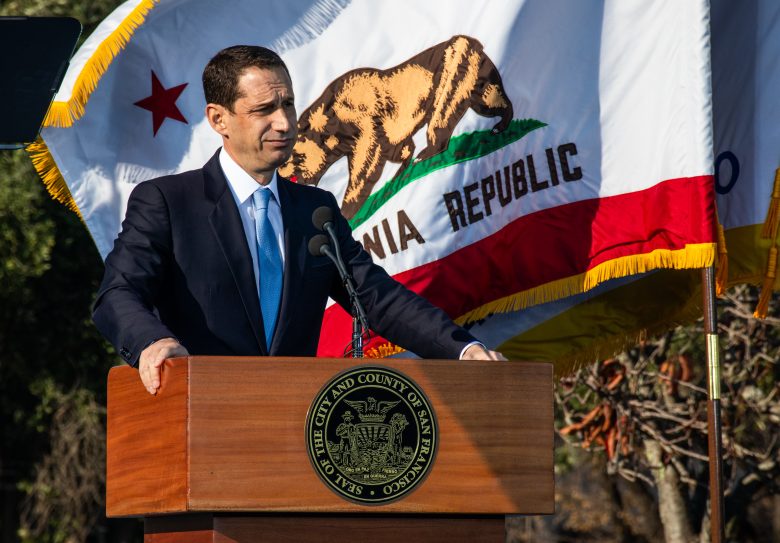
When San Francisco Mayor Daniel Lurie announced a plan to significantly cut taxes paid when real estate is sold for $10 million or more, he blamed the current, voter-approved tax rate for inhibiting housing development and keeping construction workers idle.
“We will create the jobs and build the homes that San Franciscans deserve,” Lurie promised of his legislation.
If the Board of Supervisors approves the tax cut, the tax rate for properties worth more than $10 million will go from 5.75 percent to 2.75 percent and those over $25 million will go from 6 percent to 3 percent.
It effectively repeals Proposition I, a 2020 measure approved by 58 percent of voters and placed on the ballot by Dean Preston, the predecessor of District 5 Supervisor and tax-cut co-sponsor Bilal Mahmood.
But many say that the cuts are too broad, and that the tax could have been more narrowly tailored to boost housing construction even more. That’s because it’s not just a tax cut for new housing, but for almost all real estate.
Tax cut may help housing — or may not be enough
San Francisco, facing a $936 million budget deficit, could forgo tens of millions in tax payments if Lurie and Mahmood’s proposal becomes the law. In return, this tax break is pitched as a means of increasing housing production. Would it?
Maybe, maybe not, developers say. But they agreed: They wanted an even bigger tax cut, which they say would help much more.
“This tax abatement is probably the largest single thing that can be done right now,” housing developer Eric Tao said, estimating that the proposal would reduce costs for large apartment buildings by around $33,000 per unit.
That will directly help housing projects get financed, he said.
When housing investors, such as pension funds, real estate investment firms and insurance companies, decide whether to underwrite construction, one of the key numbers they consider is how much the future building will sell for, since investors only realize their gains after the building is sold.
The sale price has to be sufficiently larger than the investment to justify the risk. Because the transfer tax is paid when the property is sold, lowering that tax increases investor profits.
Corey Smith, the executive director of the Housing Action Coalition, said the market-rate developer members of his group believe that rolling back Prop. I will help more projects get off the ground, though not all of them.
“I am hearing everything between, ‘Yes, we will go if this thing gets signed, it’s that big of a deal,’ to ‘We’ll obviously be closer, but the math still doesn’t quite make sense,’” Smith said.
Financing housing production is still difficult in San Francisco. Rising rents due to the AI boom have made housing development more appealing, but high interest rates and construction costs mean that many projects remain infeasible.
Moreover, in San Francisco, there are other fees that impact housing financing. Housing developer Patrick Kennedy’s reaction to hearing the cuts was, “That’s all? Oh.”
He wants to slash various taxes and fees that San Francisco charges for new development, such as the inclusionary housing, transportation and school impact fees.
Building housing, he said, is “death by a thousand cuts. You add all this stuff together, and pretty soon you’ve got a project that will never get off the ground.”
Kennedy said his firm hasn’t looked at building in San Francisco since 2022, in part because the transfer-tax increase “chilled investor interest” in San Francisco.
Tao agreed that an even lower transfer tax would be better for housing production.
“As a housing developer, knowing we’re in a housing crisis, I would say zero percent transfer tax for new construction for a number of years to stimulate production,” Tao said.
But proposal includes the sale of all buildings, even offices
Cutting the tax rate for new housing development to zero could actually be done for a lower price tag to the city than the current proposal on the table.
That’s because the tax cut isn’t just for new development. It’s also for old apartment buildings and office buildings — everything other than single family homes.
Office buildings, in fact, provide the largest portion of the city’s transfer tax revenue. In the 2024-2025 fiscal year, for instance, over a third of transfer tax revenue — about $106 million — came from the sale of commercial buildings worth more than $10 million.
Apartment buildings worth over $10 million, in contrast, brought in about $44 million for the city, and that number includes existing buildings, not just new construction.
The current tax cut proposal, in other words, would’ve cost the city about $78 million last year in lost revenue. Cutting just the entire apartment-building tax would’ve cost $44 million.
Mahmood and Lurie have promised to ensure that the tax cut is revenue-neutral by putting a measure on the November ballot to remove the transfer tax exemption for foreclosed properties, which high-value commercial properties are increasingly claiming.
But, tenant and affordable housing advocates said, it is unclear how lost revenue from one portion of the transfer tax can be directly offset by taxing a different kind of property. Plus, the foreclosure tax measure will have to be passed by a majority of voters, whereas just the Board of Supervisors is needed to pass the proposed cut — and they are likely to vote before the results of November election are known.
“It’s not revenue neutral as it stands right now,” said Kyle Smeallie, the San Francisco Community Land Trust’s policy director.
So, why does the tax cut include office buildings?
Mahmood said that it was partially due to the Building Trades Council, a coalition of building and trade unions, which is supporting the tax cut.
“If you talk to any of the trade unions, the majority of their work comes from tenant-improvement work they do when offices trade hands,” he said.
But Building Trades Council secretary-treasurer Rudy Gonzalez said that tenant improvement work is not the primary reason why he is supporting the cut, because that is “naturally coming back.”
Instead, Gonzalez says, his focus is to get large projects, such as the plan to redevelop Hunters Point and Treasure Island, off the ground. Those large projects include plans to build thousands of housing units, and require hiring union labor.
“It’s the big, hearty, meaty, complex ones that have affordability, community benefits, union jobs, infrastructure, pension investments, all the good stuff,” Gonzalez said.
The mayor’s office said that the transfer tax was never just about getting stalled housing construction going.
Though most of the statements and press releases have focused on the impacts to housing, the press release also briefly mentioned “downtown transactions that drive the city’s economic recovery.” These transactions, the mayor’s office said, encourage investment, renovations, and new businesses.
Nevertheless, there’s skepticism about the scope of the cut.
Board President Rafael Mandelman said that, while he’s in favor of some form of transfer tax cut, he has questions about the current proposal.
“You have a building, it’s worth a lot, and then you transfer it and we haven’t gotten a housing project out of it. Why did we provide that relief?” Mandelman asked.
He would also like a sunset date added to the tax cut, so that higher taxes could be reinstated if the economics of housing production gets easier.
Tenant and affordable housing advocates are also upset that the tax applies to office buildings.
“They’re not cutting transfer taxes on new development,” said Shanti Singh, the legislation and communications director at Tenants Together, a renters’ rights organization. “They’re just straight up cutting transfer taxes.”
That office building owners will profit, she said, is not right.
“Trump owns skyscrapers downtown that are older than Daniel Lurie,” Singh said. “They’re going to get a tax cut. A lot of corporate landlords who own large multi-family buildings and are flipping them, they are going to get a tax cut.”
In President Donald Trump’s “Big Beautiful Bill,” real-estate investors have already gotten tax cuts, Singh added.
The transfer-tax cut has also upset affordable-housing advocates, because they see that transfer-tax money as theirs.
Although transfer-tax revenue legally could not be dedicated to any particular cause, proponents of Prop. I campaigned for it as revenue for housing in 2020.
And at first, some Prop. I funding did flow to housing. Some $200 million was spent on projects like updating elevators in SROs and providing rent relief during the pandemic.
Money also went to land trusts, which buy land with the promise that the housing on it will become permanently affordable.
“We’ve been able to preserve hundreds of homes with Prop I. money, including two that are in our portfolio,” said Smeallie.
But in 2022, then-Mayor London Breed decided to stop allocating that money to housing. Facing a billion-dollar deficit, Lurie has also chosen to use Prop. I funds for other purposes.
As part of the legislative package, Mahmood and Lurie have said that they are putting together a task force that will, within the next three months, “identify a more effective source of funding for affordable housing.”
“We are fully aligned with the intent of Prop. I,” Mahmood said. But creating a dedicated source of funding for affordable housing was “never actually done by the original author.”
But Smeallie said simply replacing the lost revenue from Prop. I for affordable housing is not enough.
“We have so many needs in the affordable-housing sector,” he said. “This should not be an either-or. It should be a yes-and.”
The big companies and builder that will benefit from this override of Prop I, passed in 2020 is ill-conceived and proves yet again that real-estate runs San Francisco. The time is to demand affordable housing not these big developments that only create high priced condo and apartments for the wealthy. If they want a tax break make them build 50% affordable units in every district. The give aways have to stop. Listen to the voters not the corporations.
Might be truer to the measure’s intent to excempt only the first sale of a new appartment building. Why reward flippers who are not building anything?
No one in this article stated any evidence to support repealing the tax on existing buildings—even the Building Trades Council doesn’t seem focused on it. Write your Supervisor to ask them to reject the “BUILD” Act as it’s currently written: https://sfsocialhousing.org/letter?source=missionlocal
Sounds to me like a giveaway to the developers so they can continue to make profits in a city that seems to caters to the wealthy while we cut public services for the poor and working class. Guess it was to be expected from a millionaire heir to the Levi fortune. perhaps we do need a general strike before too long.
Any link between Mayor Lurie’s push for a transfer tax cut that primarily benefits office building owners (potentially including Trump) and the mayor’s recent success talking the Trump admin out of an ICE surge in SF? Maybe not. But it’s not a good look.
What is the evidence that transfer taxes actually kill housing development? If anything, the cost of the tax will be absorbed as a lower sales price of land for development. This is borne out by peer-reviewed research on the topic: https://www.sciencedirect.com/science/article/abs/pii/S0094119024000871
That’s a great study. Shows that even if this repeal weren’t incredibly overbroad from the perspective of new housing, it would still be looking in the wrong place for a solution.
The “problem” that they are “solving” is “low” profits for builders.
What’s the problem? Is it that we don’t have enough expensive apartments for rich people or is it that we don’t have housing regular people can afford?
The “market” won’t build affordable housing. Meanwhile the free marketeers are telling us if we build lots of units of unaffordable housing the prices will eventually decrease.
But all the latest data show that it would take tens of thousands of new units and decades to build that much market rare housing and prices would only go down a couple hundred bucks a month.
market based solutions are a farce to juice developer profit. And this is a cash grab by the real estate industry.
Wow, it’s almost like his goal is to trick the populace into supporting tax cuts for his uber-wealthy friends.
Oh, right, that’s his ONLY GOAL. More socialism for the rich and more austerity for the poor. I’m sure quadrupling down on everything wrong with the city won’t backfire at all, ever.
Huh? He’s already going around having his goons assault random unhoused people?
Who would have ever thought that a nepo-billionaire wouldn’t empathize with the citizens he was elected to serve? Oh, literally everyone who gave it a second of critical thought?
Don’t worry, it’s not like he’s friends with Noem and Trump behind the scenes or anything. Wow, THAT TOO, huh?
Don’t worry guys, he’s totally not just pretending everything is all fixed just like his role model in the White House. No rampant corruption taking place right in our faces with every “Nonprofit” in the city, nope, not our guy.
“Why”? Because denim dan is an oligarch who hates regular working people. He was a wolf in sheep’s clothing in 2024. We are in big trouble with him in room 200.
We need to tax not only 10m transactions but 1m transactions more . This tax system discriminates against the gays and minorities . Government needs to protect the most vulnerable … SF has gone crazy controlled by the millionaire class . Safer to be gay in Iran then SF
The prime directive of the current San Francisco government is to reduce costs on real estate speculation.
In addition to repealing the transfer tax increase, which will add value to real estate, Scott Wiener’s posture towards transit funding likewise soaks working people to subsidize a transit system that is aligned to bring people into downtown San Francisco where the jobs used to be.
There is no evidence that the office economy will ever “recover” to the point that it requires such an office footprint. Not only WFH but AI is decimating the kind of shit work that transpires in cubicles.
Yet conservative Democrats would defer transfer tax revenues to benefit real estate and increase regressive taxes to subsidize real estate.
“Housing” is a neoliberal coding for “real estate.”
If this passes and they repeal Prop I and the wealthy real estate transfer tax, Blame Saikat Charkabarti. He donated big to help Bilal defeat Dean Preston. Saikat is a snake don’t trust him.
Here’s 2 taxes who’s time has come. First, place a payroll tax on work here, but don’t live here, like the cities of,New York, and Chicago do. Second place a tax or have people who ride bicycles,have a license like they do in europe.
This artcle makes this petition, which is presumably weeks or longer old, look hilarious: https://actionnetwork.org/petitions/fund-san-francisco-social-housing-petition
What’s hilarious, exactly? Just that hundreds of people asked the mayor to spend the Prop I money on social housing, and he ignored them and is trying to repeal it instead? I mean, it’s frustrating, but it’s not really “ha-ha” funny.
Anything that encourages development, construction and liquidity in the local property market has to be good for the city. And for future property tax revenues and the revitalization of downtown.
Yeah man, more support for the Billionaires hollowing out our entire society will totally become a magical solution to all the problems caused by supporting Billionaires. Just like in the middle ages when Monarchs led perfect utopian nations all across the world.