

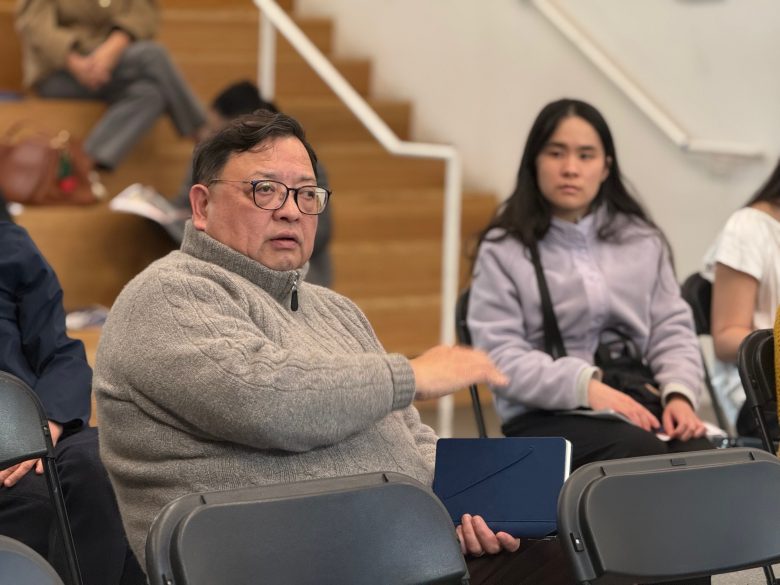
Edward Siu estimates he’s made over 50 complaints over the years by email, in person or in meetings — and that’s just about homelessness in Chinatown.
There are many more, about many other things. So many that, in corners of San Francisco City Hall, he’s now known as “The Complaint Guy.”
Siu, however, doesn’t just complain. His grievances yield results.
Siu’s griping has helped drive down the number of unhoused people in Chinatown, thwart a former mayor’s plans for a sober-living facility, and secure tens of thousands of dollars in compensation for small businesses, among many other things.
“He’s been very vocal on all fronts about Chinatown, from small things like curbside color issues to parking spaces to road closures,” said Thomas Li, president of the Edwin M. Lee Asian Pacific Democratic Club.
“People know him as a complaint guy because he’s been so vocal about other people’s complaints, not just his.”
For those at City Hall on the receiving end of Siu’s complaints, he’s a hassle. They frequently meet with Siu to chat about problems, but also just to appease him. He’s a real-life squeaky wheel.
“If I was the one that Ed’s complaining to, I’d feel like you’re giving me a headache,” Li said.
Siu’s in-your-face approach nicely complements the more diplomatic advocacy efforts usually conducted by the Chinese Chamber of Commerce or neighborhood nonprofits. Those weighty groups have to preserve their leverage for larger negotiations; securing funding and shaping long-term policy with City Hall, for example.
Siu, however, can dispense with the niceties and make sure smaller day-to-day frustrations don’t get ignored. Both draw their power from the growing value of Asian voters to elected officials in San Francisco.
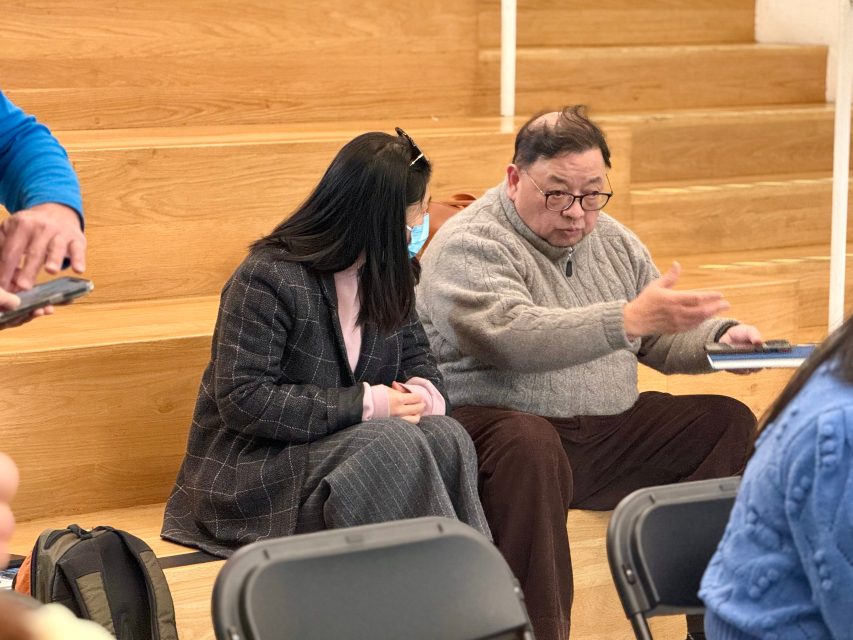
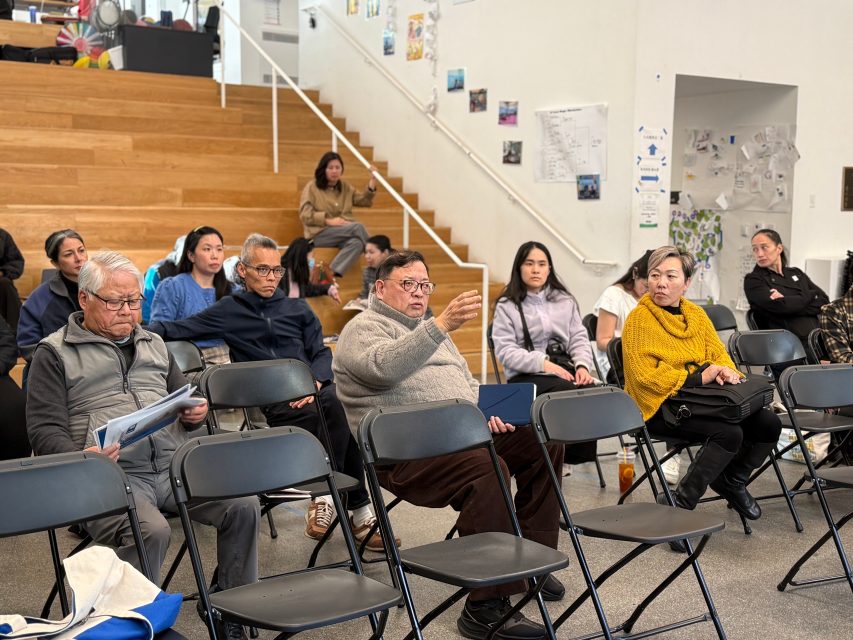
Crystal Liang, Mayor Daniel Lurie’s API liaison, chats with Edward Siu after an SFMTA community meeting in Chinatown on Jan. 29, 2026. Photo by Yujie Zhou. 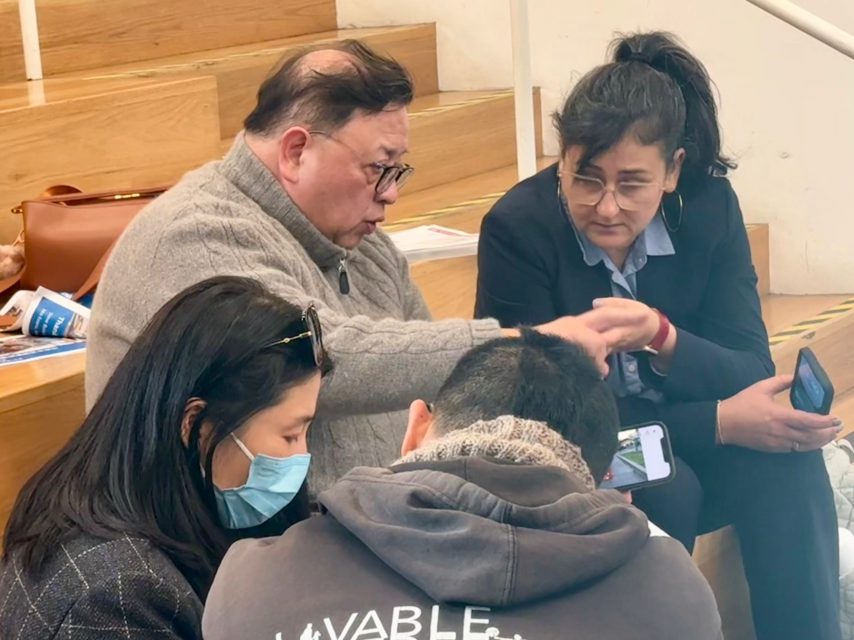
Viktoriya Wise, SFMTA’s streets division director, chats with Edward Siu after an SFMTA community meeting in Chinatown on Jan. 29, 2026. Photo by Yujie Zhou.
“If you want Chinatown to get better, you have to point out what is wrong. Don’t just kiss ass [or] say, ‘Everything is good,’” Siu, 65, said in a recent interview.
He has been in Chinatown since the 1980s, and describes his neighborhood as a big, but flawed, shopping mall for people from different countries and cultures.
“I’ve seen Chinatown going up, down, up and down.”
Siu runs his own Chinatown travel business, and is the volunteer president of the Chinatown Merchants United Association, a group founded in 2020 that is now arguably the largest in Chinatown: It boasts more than 170 Chinatown members and more than 50 in the Sunset, according to Siu.
While all merchant groups vent to the city, Siu stands out as the “Complaint Guy” because of the sheer volume of grievances and his effectiveness in organizing his members.
Now many call him by his nickname, first coined by Sing Tao Daily’s Chinatown reporter David Huang during a phone call (投訴者), as a badge of honor. He has become the voice for the non-English-speaking merchants who know little about City Hall advocacy and who, after some fruitless attempts, tend to give up.
“No ‘Complaint Guy,’ call him a hero,” said David Au, a member of Siu’s organization and the owner of Wai Hing Imports on Grant Avenue.
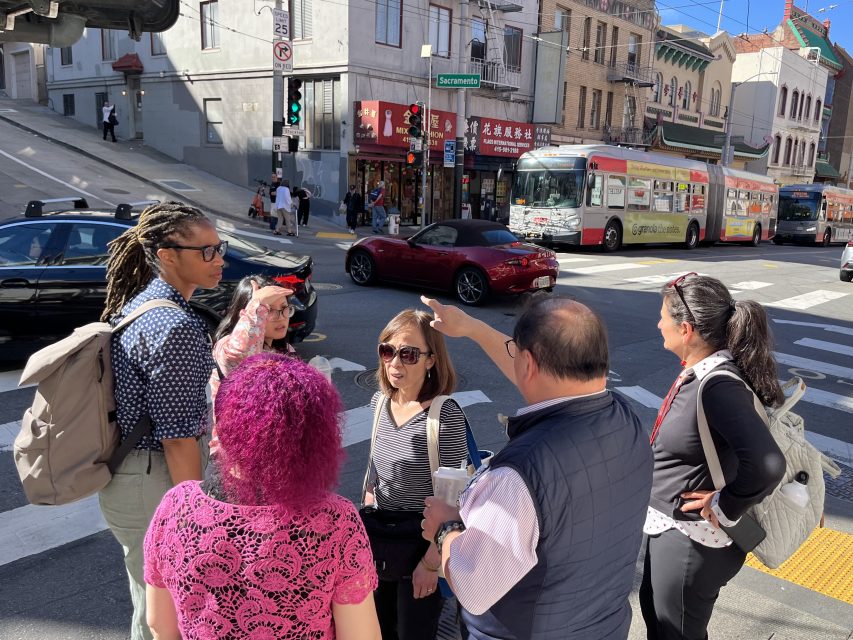
Siu’s latest result was on homelessness — a thorny issue.
In November, a Chinatown merchant arrived at her storefront to find a new group of homeless people had lit fires at her doorstep to keep warm. It was the third time in several weeks, and the shopkeeper had had enough. She wrote a formal letter of complaint to Siu and other community leaders.
What happened next was a group effort, but Siu played a key role.
He forwarded the letter to every city office he believed could influence the situation, and contacted Huang at Sing Tao Daily. Within days, city officials had conducted merchant walks and held a press conference, and Huang had written several stories.
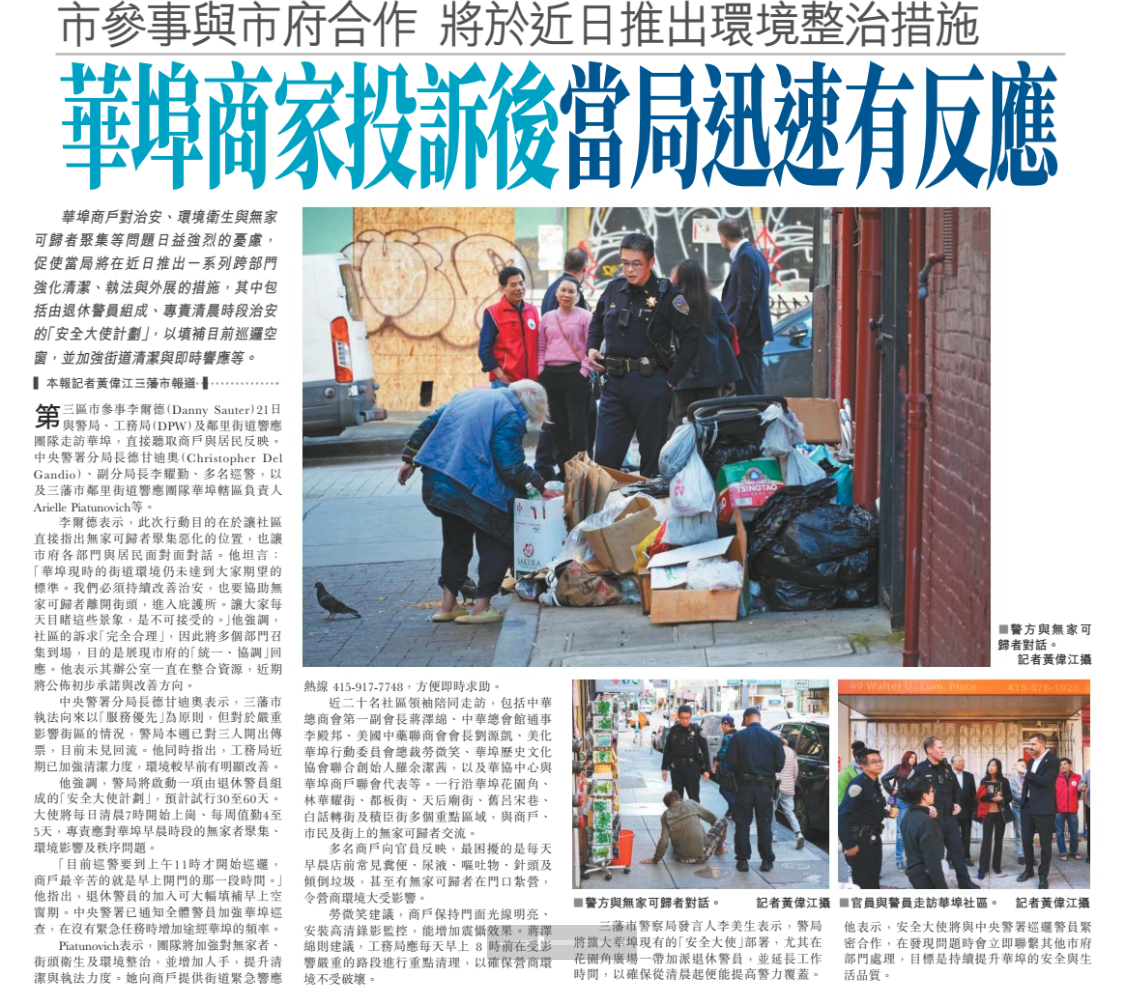
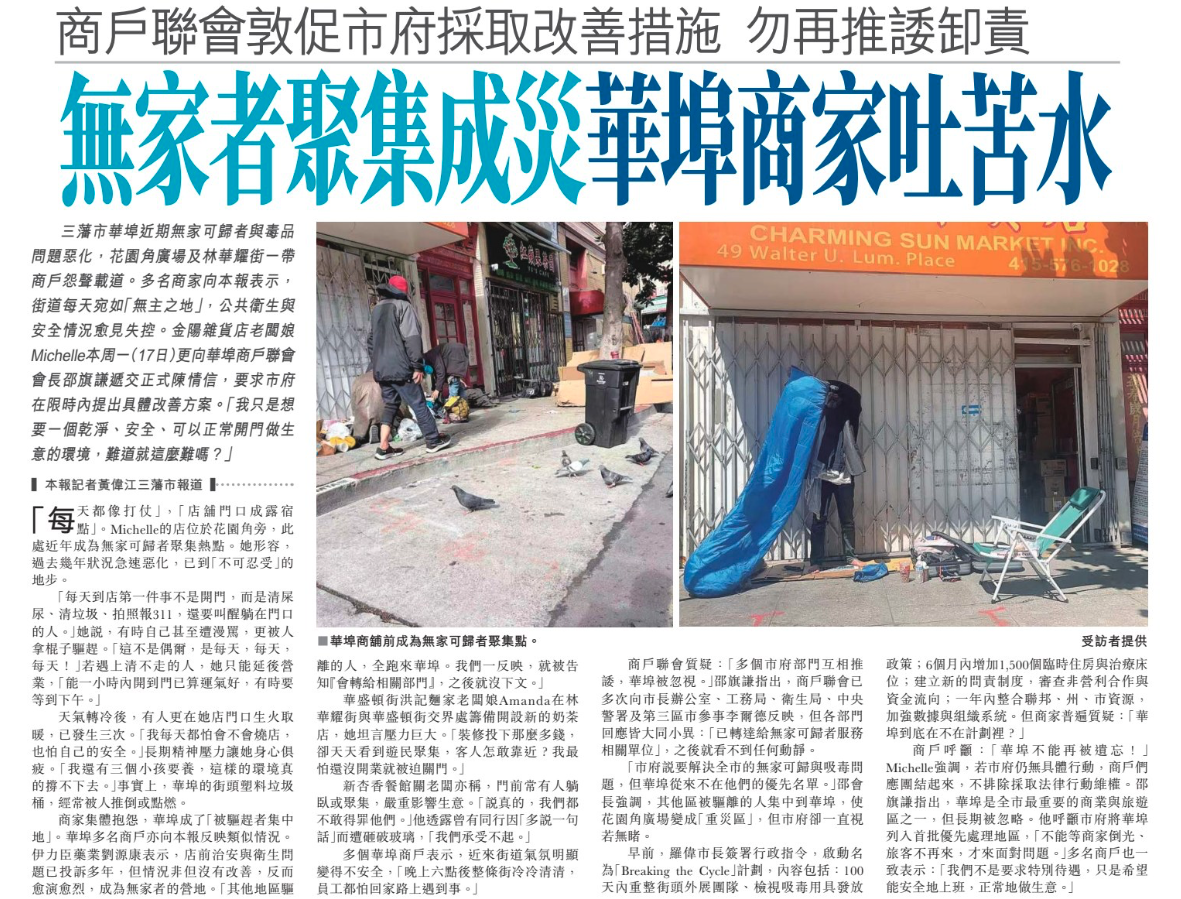
By the end of last year, the group that was setting fires had mostly moved out of Chinatown — likely relocating to an adjacent neighborhood — after more frequent visits from beat cops, according to Siu. Chinatown’s homeless population fell to between eight and 10 familiar faces, according to the police department’s Central Station.
“He knows how to generate buzz and get media attention, because that’s what moves things in today’s society,” said Jeremy Lee, president of the Rose Pak Asian American Club.
Working quietly behind the scenes isn’t Siu’s style.
“You got to voice up, then they will listen. Then you have to be reasonable,” he said.
“Voicing up” means using language like “we strongly protest” and “demand immediate and decisive action.” A January email was titled “Strong protest statement on illegal street vending enforcement failures.”
When officials say, “Oh, we are working on it,” Siu’s response is a friendlier version of “What the hell? How long can that take?” He relentlessly follows up on the issue, even after the community has stopped talking about it.
“We often experience delays or explanations that appear to excuse mistakes rather than address the problems directly,” Siu wrote in a recent email to Han Zou, Mayor Daniel Lurie’s head of communications, to express disappointment with a city department.
The head of that department was copied in the email, as well as a group of Chinatown leaders, merchants, and some relevant employees of other city departments.
That email was a continuation of a January 2023 email chain.
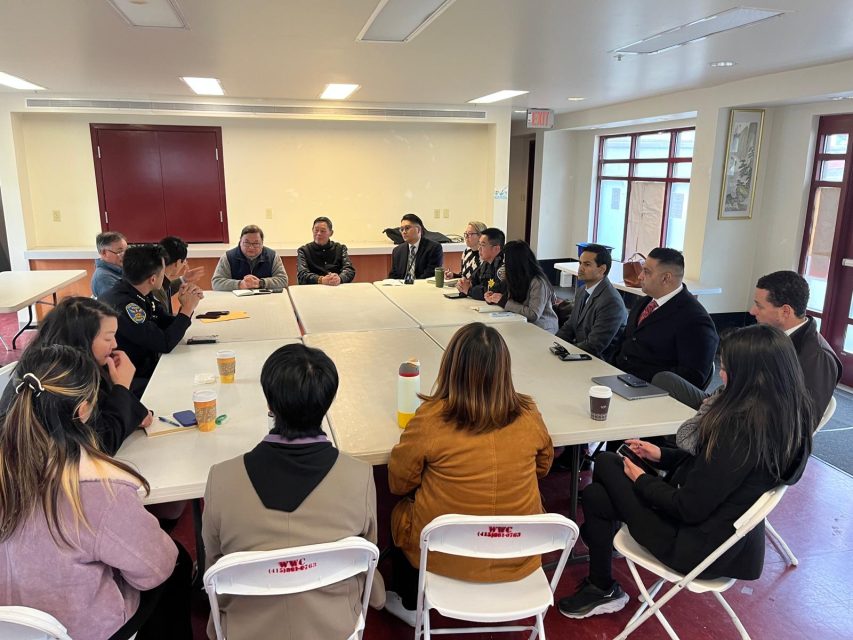
Lee, of the Rose Pak club, describes Siu’s advocacy as “exhausting” but also necessary for an ethnic minority.
“If he was white, it would be so much easier for him to talk to all sorts of different people in government,” Lee said. “But he’s Chinese,” so he has to “milk [his connections] as best as he can.”
While Siu claims that some politicians who sought his support to win Chinatown votes avoid him now — City Hall priorities often don’t align with community priorities — city staffers have learned to keep him informed about plans that could affect the neighborhood, whether it’s a road closure or a shortened bus route.
Some department heads even make time to meet Siu in-person, sometimes several times a year, according to sources.
Making changes in Chinatown without Siu’s buy-in can have consequences.
It could mean a contentious public meeting, or a complaining email to supervisors. Elected officials may lose votes in Chinatown, or the department’s reputation could spiral downwards. In a largely monolingual neighborhood, reputational damage can spread quickly and be hard to repair.
Siu began his career as a complainer a decade ago when he rallied Chinatown merchants to testify at Board of Supervisors meetings about the effect of the Central Subway’s construction on their businesses.
The city ultimately created a construction mitigation fund to support Chinatown merchants affected by the subway project, offering grants of $5,000 to $10,000 per business.
“Had he not been so vocal, I don’t think they would have gotten the resources,” said Li, adding that that was when Siu built a strong following of small-business owners.
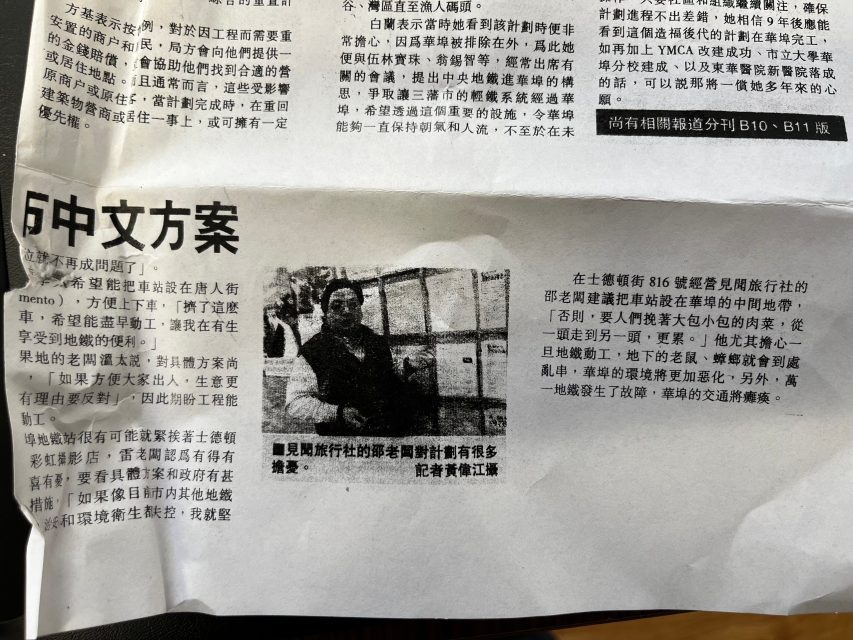
Siu again became the local hero in February 2024, when he crashed a press conference by then-Mayor London Breed, who announced a plan for a sober-living facility in the Chinatown area without consulting Chinatown.
“Why didn’t you consult with us before the press conference?” Siu asked Breed after her remarks.
“Breed admitted to Siu that it was a mistake and she would arrange to meet with him privately on the project,” Wind Newspaper’s Portia Li wrote then.
After the press conference, Siu called the family association elders, Chinese Chamber of Commerce and other community figures, who later collectively met with Breed.
Within two weeks, the proposal was shelved.
Without Siu, the proposal might have gone unnoticed, as it coincided with Lunar New Year, and few members of the Chinatown community were invited to the press conference, said Lee of the Rose Pak Asia American Club.
“Ed essentially turned the event into a spectacle and leaned into a familiar narrative: City Hall is again trying to dictate what happens in Chinatown without community input from the Chinese community,” Lee said.
The sober-hotel debacle also contributed to Breed’s declining popularity in the Asian community nine months before her failed reelection effort. And it sent a signal to all candidates who ran to represent Chinatown as well as to would-be San Francisco mayors: A sober-living facility proposal is off-limits.
Siu speaks favorably of Mayor Lurie’s office (and often copies Zou and Crystal Liang, the mayor’s Asian-Pacific Islander liaison, on every email). Siu has known Liang since she was a local reporter at Skylink TV before the pandemic.
Now, after receiving Siu’s emails, Liang usually calls Siu back, trying to find solutions or directing him to the right city department or contact.
Zou also occasionally calls Siu back to ask about the problems, according to Siu. During Breed’s era, her spokesperson Mason Lee also knew and dealt with Siu. “When he called, I’d pick up or call him back,” said Lee. “We had a good working relationship.”
Nonetheless, Siu sends out even more complaining emails now, “because they listen,” he said — though, he admits, most times Lurie’s people couldn’t really solve the issues.
Siu has learned that a lot of technicalities can get in the way of fixing things, but he persists. “Sometimes he’s right, sometimes unjustly he just complains,” said Li of the Ed Lee Democratic Club.
Currently, he’s busy drafting emails about illegal vending on the sidewalk of Stockton Street, which is filled every day with Chinese vendors selling raw fish and meat without permits. They divert business from storefronts, raise food safety concerns and could cause the elderly to trip, complains Siu.
It’s a longstanding issue. Siu proposes that all the relevant departments should clamp down on illegal vendors. Until that happens, it’s likely that the city will be hearing from Siu.
It must be hard for the city government to be reminded they work for the people.
I 311 stuff, bad scooter parking from Lime or Spin, go on their app and report.
As Graveyard Security 311 never worked for me.
Chinatown is just pissed because the gazillion dollar Rose Pak subway was a mega boondoggle and didn’t fix anything. I suggest extending the F line up Broadway, through the tunnel, down polk to connect to fishermans wharf and make it a tourist loop. The F line has great ridership and brings tons of people.
Frankly this city has too many people like this. You’re proud you prevented a sober living facility? Awful awful awful.
It’s just a short term outlook from people who don’t care about anyone but themselves.
Following Daisy’s point..the media often just talk to the merchants whenever they cover Chinatown, hardly the thousands of people who live and work there. Do the workers like the merchants? I read news about a labor group fighting for workers in Chinatown. I have seen articles about tenants fighting landlords. I think most of the merchants don’t live in Chinatown unless they own the building, or are less well to do. There are supposed to be at least 800 small businesses. Siu gets interviewed a lot in the news. I guess his complaint letters campaign get the media’s attention. But a quick search shows several merchant groups. *Arguably larger* sounds right, because the Chinese Commerce Chamber is the oldest and gets mentioned more. Found several articles about this guy and his group fighting with other businesses and community people in that one paper named in this article and others. (One can read the Chinese language news article with Google translate. Some even give you an option to translate into English.) But in-fighting is common for any community. The media should talk to the community groups, residents and workers more. But I guess it has more to do with tourism for the city.
Where does Mr. Siu live? What does he do (career)? Does he really know Chinatown? What’s he doing for all Sub-Chinatown busi nesses?
He’s Chinatown’s Dirty Harry!