


Many years ago, a wilderness survival expert visited our Boy Scout troop. “What’s the worst thing you can do,” he asked theatrically, “if you’re lost alone in the woods?”
Greg, the smartest of us, raised his hand: “Die.”
Well, he wasn’t wrong. No lies detected. Greg’s a priest now.
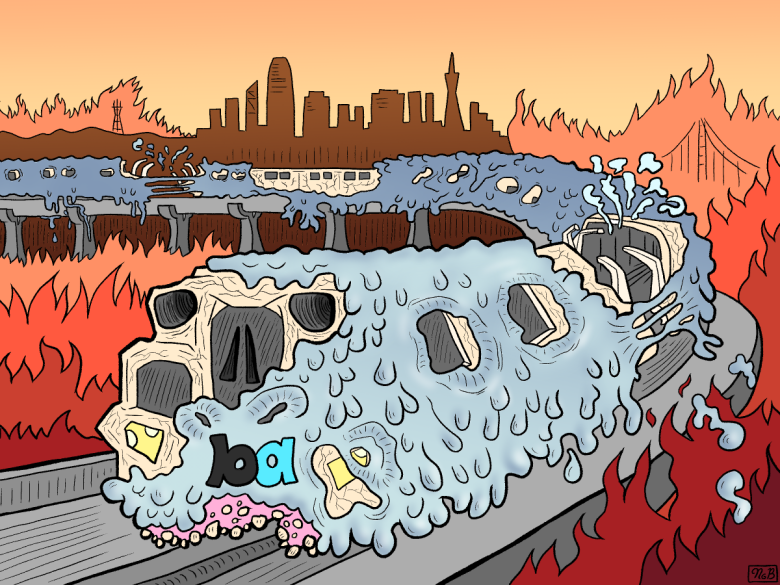
This 40-year-old exchange feels relevant because of all the stories you’re reading about BART — which, in a fiscal sense, is lost alone in the woods with a looming $376 million deficit.
You can tell things are bad, because you’re reading about them in the New York Times and Washington Post. Our nation’s flagship newspapers don’t cover BART unless the system’s finances are having a Bear Stearns moment (or if a transit cop kills an unarmed passenger). Either way, something has to go very wrong.
And it has. The one-two punch of the pandemic cratering ridership and the rapid ascent of working from home has crippled the transit agency — and led to a ruinous fiscal shortfall.
Assuming signature-gatherers are successful in getting a measure onto the November ballot, a bare majority of voters across five Bay Area counties will have the opportunity to vote themselves a sales tax increase and, for now, save BART.
The estimated revenue generated, some $310 million, would only cover the lion’s share of BART’s deficit. The rest would have to come with efficiencies and austerity.
We live in sad and diminished times: A multicounty all-hands effort (and regressive sales tax) is necessary to mitigate most of a transit system’s structural operating deficit. The best possible scenario here isn’t even a better transit system, but one that doesn’t get much worse.
The worst-case scenarios posited in lengthy articles are horrifying, replete with massive service cuts, layoffs and huge fare hikes.
But, in truth, these aren’t really worst-case scenarios. I regret to inform you that, in reality, it could be worse.
Even among knowledgeable and well-informed transit people, there seems to be a less than perfect understanding of the painful details of BART’s “Alternative Service Plan” — the anodyne title for the extreme privations the system will adopt if spurned by voters in November.
If voters pass the November measure, BART and its riders will enjoy a dour version of the status quo — yay, winning. But if the measure fails, enter the “Alternative Service Plan.” Within BART these are referred to as the “measure fails” scenarios. They’re bloody awful.
There’s a lot of focus on “Phase One” of the Alternative Service Plan, which is understandable because of its rotten details: A 63 percent reduction in service hours, 9 p.m. station closures, 30 minutes between trains and 30-percent fare hikes for this jankier, spottier, dirtier service.
What the general public, and even transit nerds, may not know is that Phase One is the equivalent of tossing cargo out of a sinking ship — which, by design, doesn’t do anything to patch the hole.
Phase One, also by design, doesn’t attempt to run BART on a balanced budget: The system’s bean-counters, we’re told, have determined that any attempt to immediately balance the budget would induce BART to rapidly collapse.
It would be akin to McDonald’s immediately shifting from serving burgers to serving dirt. They would be closed on Day Two and so, very nearly, would BART.
The general public also may not know that Phase One — by design and immutably — is intended to be followed by Phase Two. Phase Two is designed to balance the budget. It calls for heavy layoffs of support staff: Station agents, janitors, cops, people who run payroll, etc. It would lead to the potential closure of up to 15 stations and even more fare hikes — to a cumulative 50 percent.
There has been a great deal of focus on those station closures. That’s understandable. But it also feels like, if you were lost alone in the woods, missing the forest for the trees.
That’s because, while Phase Two has been posited as the worst-case scenario in the event of voters swatting the November measure, it’s really not.
It may be the best-case scenario: It assumes that BART is able to continue offering a sustainable and viable service on a balanced budget without additional revenue. It assumes enough people will continue riding a slower, dirtier, more erratic and more poorly maintained service — and pay a lot more for it.
It assumes BART continues to exist.
And that’s a hell of an assumption. Because there is the specter of Phase Three, which is the full shutdown of the BART system, with its remaining revenue going toward securing its assets.
If voters reject the November measure and BART sets down this path, the decision to shut down the system could come at any time. Like a dodgy bar or a minor-league hockey franchise, you could show up one day and find a padlock on the door.
So that’s your worst-case scenario. That, and dying in the woods.
Oh, by the way, it gets even worse. The five-county measure voters will decide in November would fund more transit agencies than just BART.
And if they don’t get additional funds, their services will suffer too — and lead to a not-insignificant number of paying riders no longer transferring onto BART.
Transit funding is beastly complicated but, for many years, BART’s was largely less so. People paid money to ride on the train. The end.
Until the pandemic, BART was able to cover around 70 percent or more of its costs from rider fares — better than four times the national average. That was better than the New York subway system and virtually everyone else.
BART’s farebox recovery dropped to 12 percent during the pandemic, and registered at 29 percent in fiscal 2024. That’s … much less. But 29 percent is still nearly double the national average.
BART is in a pickle because the pandemic didn’t just obliterate ridership, it also permanently altered Bay Area residents’ work and leisure patterns.
BART is a system that was, literally, created to carry people from the outer suburbs to Downtown San Francisco to work and shop. So this is an existential situation for both BART and Downtown San Francisco; the two entities are intertwined.
You might be surprised to learn that, in February, just over 60 percent of all BART trips either started or concluded at the four downtown BART stations.
Downtown San Francisco is still the Steph Curry of Team BART, but the overall numbers are proportionately lower. A lot lower: Scott from Moraga is still riding the train, but he’s only going to the office one or two days a week, not five. For a farebox-heavy service like BART, that’s a death knell.
BART’s ability to make up a supermajority of its costs via farebox recovery basically enabled state and regional government to direct transit subsidy dollars elsewhere; you could argue that BART was The Giving Tree of commuter services.
Now BART isn’t making nearly enough back from the farebox to operate the service. Five minutes of research could inform you that there is no way BART can cut its way out of this problem. And, even if it theoretically could, no service ever gained much-needed users by making itself crappier, costlier and less viable.
But, along comes the overtly libertarian Washington Post op-ed page with its elbow on the pulse of the Bay Area’s transit crisis to say — maybe it could?
There’s a lot here to boggle the mind. The WaPo notes that ridership isn’t coming back, when BART’s numbers grew 12 percent year over year.
It seems confused by the elementary notion that fixed-rail systems have huge fixed costs — and can’t simply scale up and down with ridership. Finally, Jeff Bezos’ op-ed page posits that the solution to this problem is automation. Of course it did!
Is automation a bigger part of BART’s future? Quite possibly! That would go a long way toward running shorter trains at all hours as would befit a post-pandemic transit agency.
But there isn’t an on/off “automate” switch to pull here. Automation would be an expensive, yearslong process. Meanwhile, BART is facing a massive deficit now. Of BART’s 4,599 full-time-equivalent employees, 489 are full-time drivers and 23 are part-time. You could cut them all and not even come close to mitigating BART’s deficit.
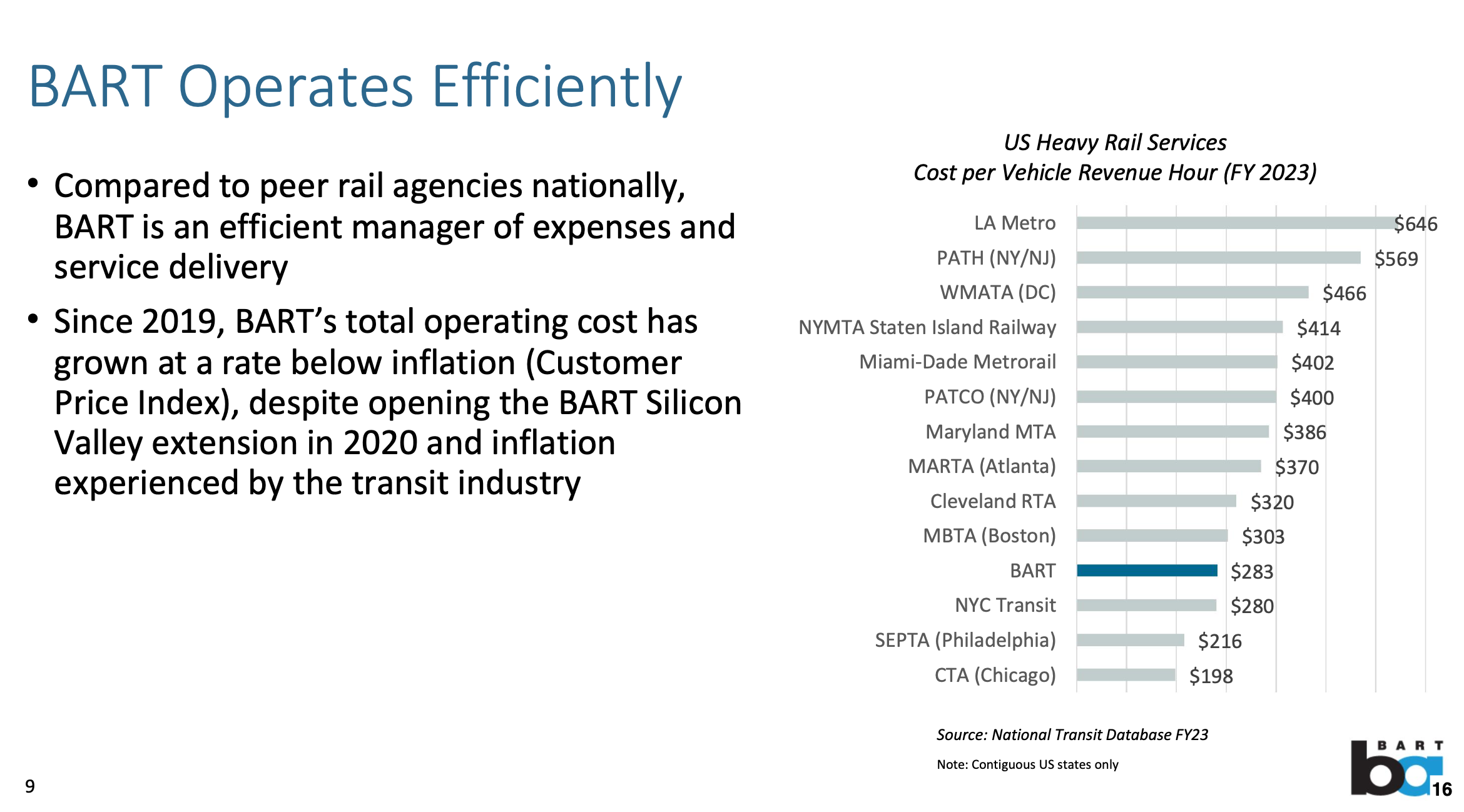
Of note, data from fiscal year 2023 indicates that BART’s “cost per vehicle per revenue hour” is $283. The same metric for D.C.’s Washington Metropolitan Area Transit Authority is $466.
Does a five-county BART bailout have a chance? Actually, it does: Recent polling puts it at 56 percent, and there will be no big-dollar opposition.
Signature-gathering enables a majority vote instead of a two-thirds vote, and signature-gatherers are acting as advance troops pushing the pro-BART vote. It’s no slam dunk, but it’s also not a Hail Mary.
That’s in large part because this is not the UN Security Council. One or more counties cannot veto the will of the others.
If San Francisco and Alameda counties vote overwhelmingly for this — and Alameda County has twice the population of San Francisco — you only need to avoid getting swamped in Santa Clara, San Mateo and Contra Costa. Plenty of Richmond-area Contra Costa voters figure to be favorable as well.
It’s news every time BART conks out or someone misbehaves — or worse — on a train. The system is still karmically suffering from its 1970s decision to put carpeting on its trains.
But BART’s actual riders appear willing to be forgiving. Customer satisfaction is presently at 89 percent. On-time performance is at 93 percent. Violent crime is down 36 percent and property crime is down 49 percent.
There are, indeed, ways forward when you’re lost alone in the woods. Provided, of course, you don’t do the worst thing you could do.
The neo-liberal belief that natural-monopoly social services should “make a profit” needs to be strangled, crushed, drowned, and killed with fire.
Everyone gets that services like police and fire departments that protect the value of private property don’t need to be “profitable”. Property owners pay taxes for these services so that their property values are protected.
Likewise, public transportation protects the value of city real estate. Getting workers to their office jobs in the city protects the value of downtown skyscrapers. Getting people into and around the city to get to shopping, hospitality, and tourist destinations protects the value of the respective commercial real estate. Getting security, janitorial, and facilities workers to their jobs in city buildings protects the valueof those buildings. Having regional mass public transit makes it easier for people to get to many different area locations affordably and quickly and helps mitigate traffic and pollution, making it desirable to live here, protecting the value of residential and commercial real estate. Low-wage workers who cannot afford to live in city commute from distant locations to their jobs caring for otherwise helpless billionaire families on Pac Heights, making it desirable for the rich to live here, thereby protecting the value of high-ticket residential real estate.
The people who benefit the most from regional mass public transit – commercial and residential property owners – should pay for the social services that protect their property.
Moreover, making regional mass public transit free at the point of service would make living in the Bay Area so desirable that business and property owners would get far more back than they put in. Unfortunately, the prevailing neo-liberal dispensation infecting the minds of the ruling class is based on usurious privatized extraction, obviating public investment, so the race to the bottom will continue.
Right, and nobody understood this more than the Gilded Age monopolists who used to own the private streetcar lines that ran in every US town from the late 1800’s to the end of WW2. Most of the historic private streetcar lines from this era didn’t turn a profit. They were run as loss leaders, because the monopolists who owned the streetcar lines also owned the real estate that the streetcars rode by, utility companies, railroads, and other assets that wouldn’t have been nearly as valuable without a functioning public transit system to move workers and consumers around town.
Um…no. Streetcar companies were almost always legally obliged to charge a certain fare for a ride. Usually 5¢ – an amount which went nearly unchanged from the last 1880’s until the 1940s or even 50’s. It’s about impossible to turn a profit when you can’t reasonably charge more for a service after 50 or 60 years. This you get the deferred maintenance that led to the systems collapsing.
When I was on the Western SOMA Citizens Planning Task Force I asked Muni to commit to running loss leader transit to provide a gradient to newcomers taking transit. Muni said they could not afford that.
Now Muni is running loss leader transit to the financial district to boost office valuations.
“making regional mass public transit free at the point of service” = hotel BART, no thank you.
A nominal charge will keep the lumpen underclasses out of your line of sight, lest your beautiful mind be offended.
It is more the odor of the body and the fentanyl in the confined space of a BART car that puts people off. It is worse on Muni when it is raining.
A perceptive column with many good points. I will quibble with one: the repeated point that it’s “better” for BART to have, pre-Covid, gotten 70% of its revenue from fares, a much higher percentage than other systems. That’s worse. That was BART putting all its fiscal eggs in one basket. That’s why BART lacked resilience. And that’s why BART fares are sky-high, the highest of any peer system in North America, which keeps would-be riders in cars because unless you’re going to congested downtown San Francisco, and sometimes even then, the marginal cost of driving your car is often cheaper.
Until the Reagan era, the federal government used to provide operating funds for urban public transit. BART’s $400m deficit is peanuts at the federal (or state) level. Public transit isn’t here to make a profit, and a lower-fare system with diversified revenue would be a healthier system.
Scott, it is simply not true that public transit cannot be self-sustaining. Various cities in Asia have close to a 100% farebox recovery rate. London’s private/public transportation system gets over 90% of its revenues from fares. And so on.
I suspect that BART between the airports and downtown SF, Oakland and Berkeley is close to self-sustaining. It is those long extensions to Antioch, Dublin and (under construction) San Jose that are killing BART. You cannot compete with cars in the further-out suburbs.
Edit earlier post: Some *say* labor contracts can’t be changed, but they are wrong
Indeed the carpeting was emblematic of BART design–not one of those dirty (but far more functional!) East Coast subways. Original plans did call for automation, but BART bought computer control which was less reliable and functional than existing pre-computer systems in service on older subways.
One of the other built-in un-needed expenses was overly deep stations. Think of 16th, 24th. The mostly empty mezzanine, center platform design requires 3 escalators and two elevators. A shallow cut and cover station as were the style of early NYC subways with side platforms a short flight from the sidewalk, would have one fewer escalator, and those needed would have been shorter (cheaper to install, operate, maintain) and get riders to/from trains to sidewalk sooner.
I cite this because BART did this all over and is planning the same mistake in San Jose.
As to the ‘county vote’ issue, the original referendum authorizing BART lost in CC, but combining the majority votes in SF and Alameda brought the 60.2 % win. A recent editorial from a news site out on the Blue Line urged BART to save more money rather than be given more funding.
There are minor tweaks which can save BART money, but we should remember that planet wide urban mass transit is not self sustaining. The issue is notsubsidy, but how much subsidy.
The crux is BART’s DNA and (hello cinema nerds) how he came into the world: As a make-work project for idle aerospace engineers. This means everything ended up being proprietary, needlessly needing to be light weight equipment. Which of course at the time translated into more work for the army of people tasked with building BART. Talk about backwards incentives.
For perspective, contrast that with Stockholm: Ride their subway, and it feels weirdly familiar. That’s because it is a carbon copy of the New York subway. The saying goes, you could take a New York subway train and it would run in Stockholm. Probably not quite the case, but nonetheless, most of the upfront cost of buying equipment for maintaining and upgrading their small-ish system is riding on the coattails of NYC, where they benefit from New York’s economies of scale. BART? Cough, cough, complete opposite.
We hear about finances (with assumptions), but how deep in the hole BART actually is, we don’t know. The way I look at this: Everybody involved, BART directors on down, have a strong interest in keeping BART on life support, so they keep kicking the can down the road. It would be interesting to learn what it would take to actually keep BART running long term, simply from the perspective of technical feasibility. It stands to reason that at one point, after years of fixes-upon-fixes, they might be painted into a corner to the point where BART might need a total shutdown for months anyhow? What have we gained if that’s the case?
A note on the automation bit: BART was originally designed to run automatically. No operators needed. Then labor stepped in to claim “theirs”. Which gave us the familiar sight of operators leaning out of the window at the station. Automation, or lack of it, seems the least of BART’s problems. Aside how that runs up against labor, today, it might be nigh impossible to try implement anyways.
Man, so many lies.
1. You’ve mixed the aerospace transit failure with BART, you’re actually referring to MUNI’s Boeing SLRV. BART actually had real engineers that fix problems.
2. Lightweightness led to energy cost savings and less wear on the tracks, a testament to decades of service despite local and state leaders failures to heed a call to actually invest in upgrading and maintaining the system over the last HALF CENTURY. From inception to Measure RR in 2016. BART is not in this position because of fraud, but sheer ineptitude to maintain the system by political leaders until 2016.
3. BART had one of the first ATC in operation at that time. And despite being a mostly enclosed system there wasn’t funding to do it, nor the technology back then.
re 1: There’s a fairly long history of public transportation being used as overflow for the military industrial complex, to mixed results. The ole Boeing cars, yes. Then there’s BART and WMATA. There’s more examples.
re 2: Given the extraordinarily tight weight constraints, paired with a collection of modern requirements, has us admire the fleet of new BART cars as a modern miracle, actually. Flipside, a very pricey one. You are right about the lackluster support over time, we live in a country where the ribbon-cutting is everything.
re 3: As opposed to a standard signaling system that can be upgraded over time, under vendor support. With a system like BART’s ATC, you got a one-off homebrew innovation. How we’re liking TTL? And when time comes to expand or replace it, you find that everyone who knows how it works, has left to pursue other interests and paychecks. And just like so, you find yourself totally painted into a corner.
Thanks. Only in ML–thorough and concise article about a big local matter followed by informative comments. PS: BART director Radulovich had suggested downsizing to standard gauge for the San Jose extension–don’t expand a costly system and allow potential tie-in with Caltrain. Naw, too inconvenient. In hindsight, the transfer to standard gauge beyond Antioch works fine. The giant tunnel in San Jose is turning out expensive.
“..MUNI’s Boeing SLRV.” Good catch. The ill-fated light rail cars that had to be junked. Gave rise to the ‘vintage’ (retired) rail cars from other cities that are so colorful; they are perfect for a theme park.
They did away with the automation because of some very spectacular crashes where, very fortunately, nobody was seriously hurt. The automation was not working.
The reality is that BART has not dealt with, or acknowledged it’s original sin. “We need to be unique”. We need our own gage rail. We need one off escalators. We need to spend millions and millions of dollars on an elevator at Powell Station that was a one off and had a service life of 8 years. This makes everything more expensive and gives BART employees an excuse for not maintaining the system. (We need to order parts). A whole lot of money has been spent chasing expansion while never maitaining the core system. Contrast this with where Caltrain is now. Standard gage. Steady improvements to the system over it’s whole life (Grade separation, continuous welded track, putting in concrete ties, and finally electrification). What did Caltrain do with its old fleet? Sold it to Peru. What did Bart do with it’s old fleet?
1. Indian gauge is not the problem. https://www.bart.gov/news/articles/2022/news20220708-2
2. The escalators are from the GOD DAMN 1970s where it all began. Because political leaders DID NOT FUND maintaining the system until 2016 with Measure RR. They aren’t a one off, we’ve been using them for so long that parts don’t exist for them anymore. And that money is to replace the existing ones with easier to maintain models.
3. Blame political leaders who chase new stations for political brownie points.
4. Caltrain and CALMOD’s history is also not as simple and easy as you think it was either. Of which was delayed for 20 years with its own problems with funding for the past 20 years of operation.
Have you ever ridden the subway in Washington, DC, or in Atlanta? Those systems were built around the same time as BART, and each one is a dead ringer for it. (Or was up to a few years ago, when BART got its new trains and new fare gates.) It’s pretty uncanny when you’ve ridden one of these three and then see another for the first time.
So although I don’t know all the history of how BART was designed, I do know that one thing they weren’t going for was “unique”.
@Greg – Yes, DC built WMATA around the same time and had the same rolling stock from Rohr Industries. Rohr got out of the business in the 1970s but others came along to make compatible-looking cars. Atlanta’s MARTA started off with these.
I have a friend that works at Bart and explains a lot of the downfall can be traced to the huge salaries of the management. Along with that Bart is more a real-estate company than a train service.
Carl —
Management everywhere could probably afford to take a haircut, but that’s budget dust in this case.
Best,
JE
“There’s a lot here to boggle the mind. The WaPo notes that ridership isn’t coming back, when BART’s numbers grew 12 percent year over year.”
===
Yes, but it’s still a fair point that there has been a permanent change, or at least a long-term change. According to the Examiner, the office vacancy rate peaked at 36.9% in the third quarter of 2024. It was 35.3% in the third quarter of 2025. That’s 1.6% per year, so it would take almost 20 years to bring the vacancy rate down to 5%.
Also, the Examiner notes, the decrease has been almost entirely an effect of the Artificial Intelligence boom. When that balloon pops…
We’re in a bit of a nosedive;
I hope we can rise back up…
This is ridiculous. Did you read this part?
“Phase One, also by design, doesn’t attempt to run BART on a balanced budget: The system’s bean-counters, we’re told, have determined that any attempt to immediately balance the budget would induce BART to rapidly collapse.”
So, if we bail out a failing system, they won’t attempt to fix the problem of losing money. Just keep begging for more money.
I’ll try that with my budget.
Sir or madam —
The question here is did *you* read that part? I don’t think a halfway intelligent person would have trouble conceiving that attempts to immediately mitigate a $376M deficit will result in such a jolt to riders and the system alike that it essentially ruptures. As noted, this is a stabilization period preceding a deep budget-cutting. This was all in black-and-white in the story.
As for *your* budget, when you provide a transit service for millions of riders then, yes, you can reasonably ask for a public subsidy and the voters might provide you with one.
JE
Did anyone think of taxing the plethora of shared ride, scooter, ebikes, etc. that also have impacted the decline in numbers.
Thanks, Joe, for the reporting. Do you have a sense of how the current situation is/was influenced by Bechtel, and Parsons Brinckerhoff and Tudor Engineering (PBTB) ala Burton H. Wolfe’s reporting circa 1974?
https://www.foundsf.org/BART:_Bechtel%27s_Baby
Look, I’m not saying the old carpet was clean. I’m not even saying it was a good idea. But I liked it, okay? I liked it!
I don’t traffic in conspiracy theories, but the one I have long held is that whenever BART wants/needs money, as it does from time to time, service suffers. Breakdowns, outages, “see?! this is what happens if we don’t get more!” It has happened enough that I have a boy-who-cried-wolf response. I understand; the numbers are what the numbers are, but still, there have – again – been a lot of systemwide problems the past few months.
That aside, there are some fantastic comments here. I had no idea about the “bespoke” impulse driving the system.
@Transbay Tunnel – Probably the main issue with this conspiracy theory is that BART has recently mostly improved, and regained ridership. The recent high-profile outages (I was caught in one) are nothing compared to weekly shutdowns I had to grapple with 10 years ago.
(Most interesting man in the world voice): “I don’t always traffic in conspiracy theories. But when I do, I traffic in this one.”
Best,
JE
I don’t agree with the article about the pandemic being the result. Mostly it’s the result of the service cuts by Trump when he foolishly shut down the government. The BART, like the USPS relies heavily on funds by the federal government since most of the funds by taxpayers are not enough to cover the expense of providing funds to support the transit system. BART is incredibly expensive to maintain and the added tariff has took a toll on the BART program designed to help people use BART while seemingly to favor people using cars. But with the gas prices rising, it makes more sense to use Bart more and to use cars less. Trump’s destructive methods of oil drilling will do nothing to reduce global consumption of gas and oil, it will make oil consumption more expensive and difficult to come by because of geographic differences in distribution and the cost of making reckless demands on a supply so limited and damaging to the ocean including the environment. We are already running out of time because offshore drilling is just as dangerous and expensive as coal mining. There’s a risk of damaging the health of our ecosystem and bringing us consequences for abusing our planet’s resources to in order to supplement America’s reliance on automobiles.
The words Debt Service and Allocations appear nowhere in this article but that is a huge part of the problem – paying debt on capital improvements that go unused – the train to Antioch, warm springs station, etc.
Cutting service after 9pm on all but the Richmond line makes complete sense
Here’s an easy thing to do:
Make a circle, and cut it up like a pie, where public transit, traffic, sewers, cops, garbage men to collect from public trash bins, health inspectors, etc… All the services you can think of, and make them slices of this pie, but put them in sizes that are relative to what you think we should be spending money on “as a city”. Not because we want to house homeless, but because we want a city without homelesspeople dying on the street. not because we care about public transit, but because good transit makes the city better to live in and brings in more people/revenue.
Once you get the pie chart done of “where you personally believe the city should be putting money”, then go to the budget and check out how different it is from what you think it should be.
Budgets are both a zero sum solution, but also an investment. So, do you invest in a better rail system that will be a long term gain, or do you cut funding or increase pricing and reduce usage?
There are very few services a city can provide with **OBVIOUS** investment value, but better public transit is one of them. ESPECIALLY in a city internationally renown for having a parking problem.
Now…. using some kind of automation… As someone who works in that field, I’d seriously avoid it for at least 10yrs. A human, even, dare I say the word…. a union employee… is far far cheaper than putting in automation when AI is currently at the most expensive it will ever be, and probably be utterly outdated in 5 yrs.
but… in this city, it seems to be rich “moderates” who make all the decisions with the help of millions of dollars from outside PACs funded by republicans and rich dems.
This simply is not accurate. More PR messaging to sway the public. Best case scenario? Financial crunch forces BART into a court proceeding where their existing labor contracts get tossed out. This issue is specifically the cause of BART fiscal problems. Some labor contracts can’t be changed, but they are wrong.
Santa Clara county apparently thinks BART is worthwhile. They are planning on a $12 billion BART tunnel under San Jose to Santa Clara.
BART MUST File Bankruptcy ASAP!!
By doing so,
BART will be allowed to remove one of it’s largest budget line item problems,
if not it’s largest line item problem,
HR Costs,
Wages,
Paid Benefits,
And,
Paid Retirement Plans,
All of which are outrageously expensive and not at all in line w/private sector HR costs.
After Bankruptcy,
Privatize BART.
Also ASAP!!
That would be the quickest and most sensible solution to BART’s disastrous fiscal problems.
I’m amazed by how desperate people who come from the private sector are to turn public sector services into some private sector hellscape. I work in the public sector (not SFMTA), and we regularly receive comments about how much more helpful we are than people in the private sector.
“HR Costs,
Wages,
Paid Benefits,
And,
Paid Retirement Plans”
stabilize employees and incentivize people to remain in their jobs for a long time, which improves institutional knowledge and overall service quality.
100k/year Station Agents,
+ benefits,
200k/year Janitors,
+ benefits.
The private sector can provide cheerful, helpful,
extremely competent
employees at less than half that cost.
Of course those who are in the public sector would disagree.
The bottom line is that public sector unions political influence
w/public sector agencies,
had become an extremely expensive burden upon society.
The work can, and should, be contracted to the private sector ASAP!!
What happens if so-called progressives won’t take a stand against regressive taxes? Find another way!
@Vote NO – We definitely need an overhaul of funding that isn’t a regressive burden, but bear in mind “fiscal cliff” has become an acute problem all over the country thanks to Sean Duffy, not your “so-called progressives” bugaboo.
The state’s regional transportation funding body made a change for the worse in 2008 (during the Shrub-prompted Great Recession) and public transit has had to cobble funds from diverse sources ever since. A real overhaul would at least restore state priorities from before that time, and of course it would be good to have a Transportation Secretary with better qualifications than “former reality teevee personality.”
Scott Wiener made transit the centerpiece of his political life once he took office in 2011, yet here we are with not just BART, but Muni and Caltrain all facing fiscal crises.
All three of these systems are aligned to deliver office workers to job sites in downtown San Francisco and the Peninsula where people used to work.
A dutiful servant of real estate, Wiener wants to regressively tax working people through parcel taxes and increased sales taxes to subsidize transit service to ghost office buildings in order to sustain the market valuations of these empty structures in the hopes that in the face of WFH and AI, office jobs might one day return.
And Wiener is about to get a promotion for this record of failure.
“A dutiful servant of real estate,”
LOL.
When I take a long BART ride, I don’t feel comfortable and in fact I’m afraid that it’s bouncing around and vibrating so much it might plunge off the rails and crash 50 or more feet below onto the street.
Al —
The train is not going to fall off the elevated tracks. You need to focus on more realistic problems.
JE