

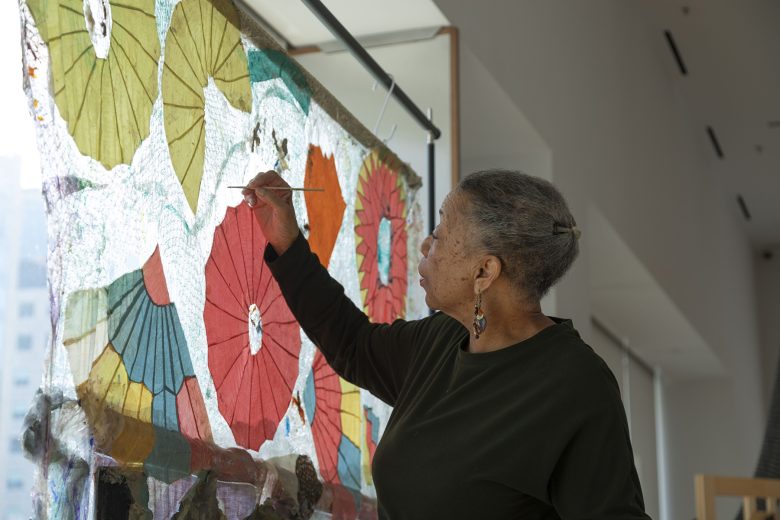
At the press preview for “What Is Love,” SFMOMA’s six-decade retrospective of her art, Suzanne Jackson said, “This is my city. I’ve done more things in the arts here than anywhere.”
“What Is Love” is a celebration of Jackson’s visual art and the occasion of her self-declared San Francisco “homecoming.” But it also presents a fascinating record of those “more things,” including her early career as a dancer and model, her work as a theater designer, and her life-long advocacy for other artists.
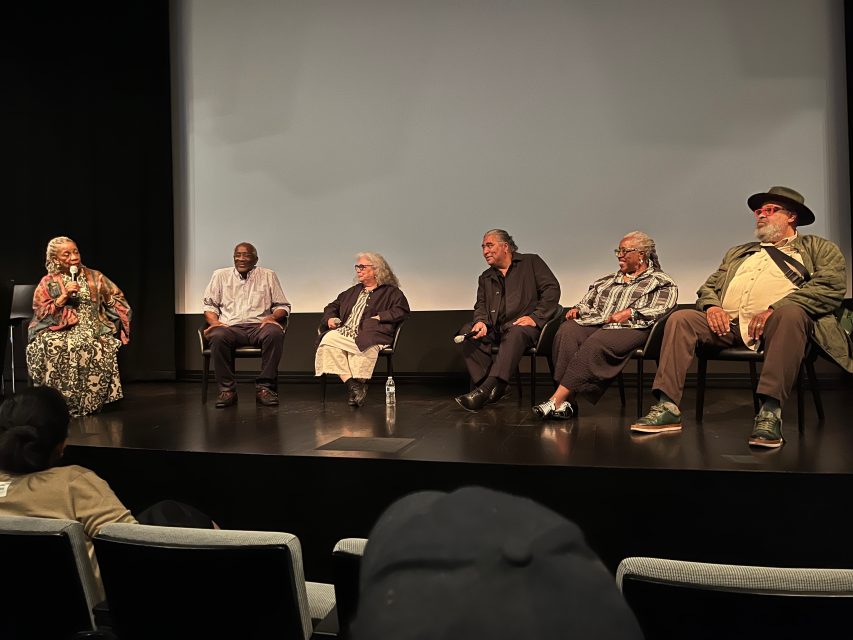
SFMOMA launched “What Is Love” Sept. 27 with a press preview and a pair of public talks, including a conversation between Jackson and modern art historian Professor Kellie Jones; and a panel, “Suzanne Jackson and Friends,” with celebrated artists Mildred Howard and Alison Saar.
Unless otherwise noted, quotes in this story come from these events.
Howard, whose own family and creative history parallels Jackson’s in some ways, offered the most generous and incisive instance of game recognizing game: “To me, what sets [Suzanne’s] work apart is the use of materials, and the influences of her background in theater, dance, poetry, bookmaking.
“As you step into Suzanne’s world, take time to explore the many layers of visual information in her work. To me, these layers are like poetry or pages from a Toni Morrison novel, where I keep rereading, looking and thinking beyond the norm. Each time new information comes to light.”
Wearing a fuchsia off-the-shoulder cocktail dress, Jackson led journalists, critics and admirers on a walk-through of the exhibition, her first major museum retrospective.
At 81, she still has the posture and enviably toned arms and shoulders of a former professional dancer. Vitrines around the galleries and the excellent exhibition catalog document nearly every stage of Jackson’s amazing story.
“The whole sort of Bay Area funk school has not left me,” Jackson said.
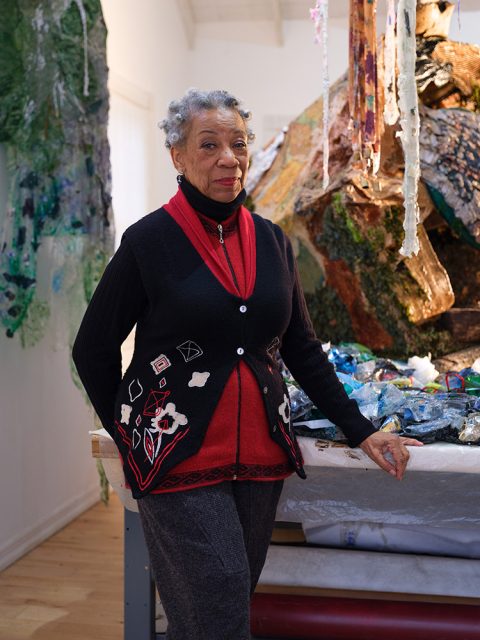
Between her arrival in San Francisco in 1944 from St. Louis as a 9-month-old, when her family joined the World War II phase of the Black Great Migration, and the current exhibition, Jackson has returned to San Francisco many times: From a girlhood largely spent in the Alaska Territory; from Los Angeles, where she was a central figure in the Black arts scene; from Yale University, where she was the first Black woman to earn an MFA in theatre design; and from Savannah, Georgia, where she has lived since 1996, when she moved there to teach at the Savannah College of Art and Design.
Consistent throughout work spanning more than 60 years is her commitment to the beauty of connections: Between people, species and the natural world.
“Art is everything. There is no art. There is life. There is no separation,” she said.
In their first years in San Francisco, Jackson’s father, Roy, drove for Muni, and her mother, Ann Marie, sewed for Koret; they also ran their own barbecue restaurant. In 1951, her father moved to Fairbanks in the Alaska Territory to work on the Alaska Highway.
Speaking with Jones, Jackson reminisced about what she and her mother found when they followed him a year later.
“My father rented a cabin that had two outhouses. Our refrigerator was a hole in the permafrost. And my mother cooked on what I learned in Girls Scouts was a reflector oven.”
Still, in Alaska, she started teaching herself to paint, and took dance classes, becoming a good enough ballerina to be a featured performer with a local professional company. After nearly a decade there, they returned to San Francisco and Jackson enrolled at San Francisco State University.
Jackson’s parents encouraged her creativity while also instilling a sense of community service and entrepreneurship. The exhibition catalog has wonderful photos of the family after they resettled in San Francisco.
One, captioned “President Jackson’s Street Fair,” shows Roy, who in the 1970s was president of the Ocean-Merced-Ingleside Neighborhood Association, surrounded by a diverse group of neighbors, including a couple of smiling, uniformed police officers.
Others show Ann Marie and Suzanne outside Mrs. J’s Sweet Shop and the mural Suzanne painted on the back wall. Roy, who started his own real estate business in Alaska, worked to help underserved Bay Area residents find stable homes.
SFMOMA devotes a large gallery to Studio 32, the Los Angeles exhibition space Jackson ran from 1968 to 1970. It includes works, first shown at Studio 32, by Betye Saar, David Hammons, Emory Douglas, Senga Nengudi, Timothy Washington and others.
Only 24 when she launched the self-funded project, Jackson became the first Black woman to open such a space in Los Angeles. Teaching and dancing to pay the bills, Jackson created Studio 32 for diverse artists to come together for exhibitions and conversations.
In 1970, Studio 32 presented “Sapphire Show: You’ve Come a Long Way, Baby,” a five-day showcase for six Black women artists, including Saar and Nengudi.
At the time, “the gallery scene was still developing and, whether out of ignorance or outright exclusion, Black artists were largely invisible until artists began creating their own spaces to show the work,” said Alison Saar, Betye’s daughter.
Jackson closed Studio 32 with a final event: Her flower-child wedding to Pete Mhunzi, father of her only child, Rafiki.
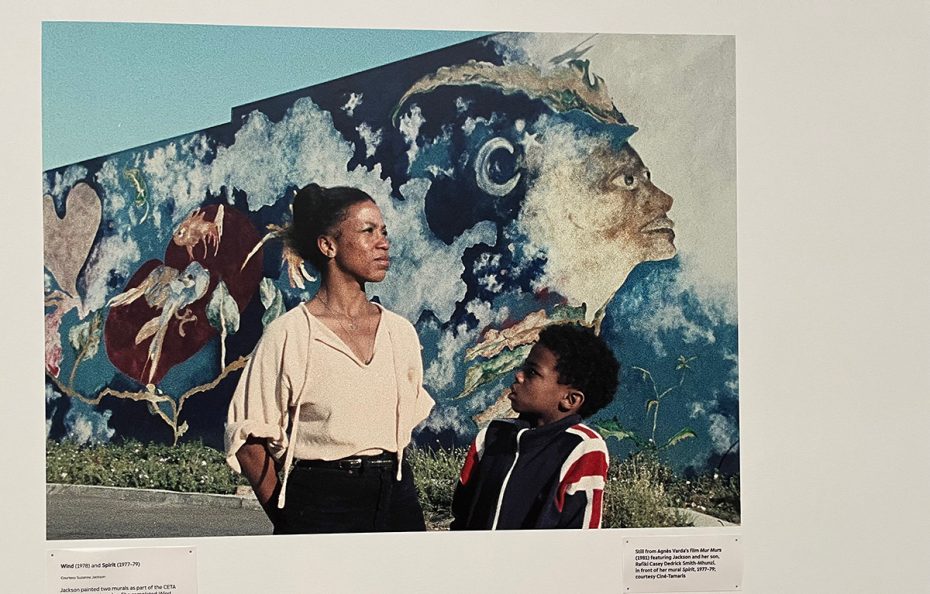
In her 1981 documentary “Mur Murs,” about muralists, French filmmaker Agnes Varda featured Jackson, with little Rafiki, speaking in front of “Spirit,” the massive 1979 Los Angeles mural Jackson made with federal arts funding.
Rafiki Smith, who grew up to be an actor and producer, died from a heart attack in 2016 while registering voters in Georgia. He was 45 years old. Jackson, who has said that the birth and death of her son led to the two most creative periods of her life, has created many of her most magnificent works in the last decade.
Jackson has long advocated for artists’ rights and promoted their work. In 1972, she curated Black Quake, a Black cultural exposition that drew more than 100,000 visitors to San Francisco’s Civic Center.
Jackson was in charge of curating the visual arts, bringing in the work of dozens of artists, from collagist Romare Bearden and sculptor Selma Burke to school children. In 1975, Jackson was appointed to the California Arts Council, where she served with artist Ruth Asawa, actor Peter Coyote and poet Gary Snyder.
Most recently, she established the Suzanne Fitzallen Jackson Foundation in 2023 to support emerging and mid-career artists, “particularly underrepresented artists from the South, where fewer opportunities exist for residencies.”
Two artists in the 2025 inaugural class are receiving a year-long, fully funded residency, including studio and living space in Jackson’s huge Victorian home and gardens in historic Savannah.
Jackson, who also has a home and studio in a restored schoolhouse in St. Remy, New York, plans to eventually offer residencies there, too. It’s a practice she’s observed and followed throughout her life.
“All of the places I’ve lived, Alaska, San Francisco, St. Louis, people share and work with one another to make things happen,” Jackson said.
Great reporting on the artist pioneer Suzanne Jackson. Really looking forward to viewing her retrospective at SF MOMA. Sorry I wasn’t present for the panel discussion. Hope that MOMA will post it on You Tube. Art is life!