

Not long ago, the unscientific practice of compelling LGBTQ+ youth into “conversion therapy,” intended to force them into heterosexuality, seemed headed toward a much-needed extinction.
As of this year, 24 states have banned conversion therapy for minors, and another five states have restricted it in various ways. However, a challenge to one of those bans will go before the U.S. Supreme Court later this year, and possibly reverse all those good strides.
These current events could have made “limp wrist on the lever,” a satire set at a conversion camp, freshly relevant.
Instead, the play, which had its world premiere at the Potrero Stage this month, feels like a throwback to an era when the stakes for queer youth at least seemed much lower.
The script, by openly queer playwright Preston Choi, seems to exhibit a Bill Maher-esque glee in mocking wokeness.
By Choi’s own telling in press materials, he intended the play to be less about living in a world of anti-queer bigotry, and more about holding leftists to task with how they respond to that bigotry. That’s fine, but the answer he comes up with is both poorly thought-out and badly timed.
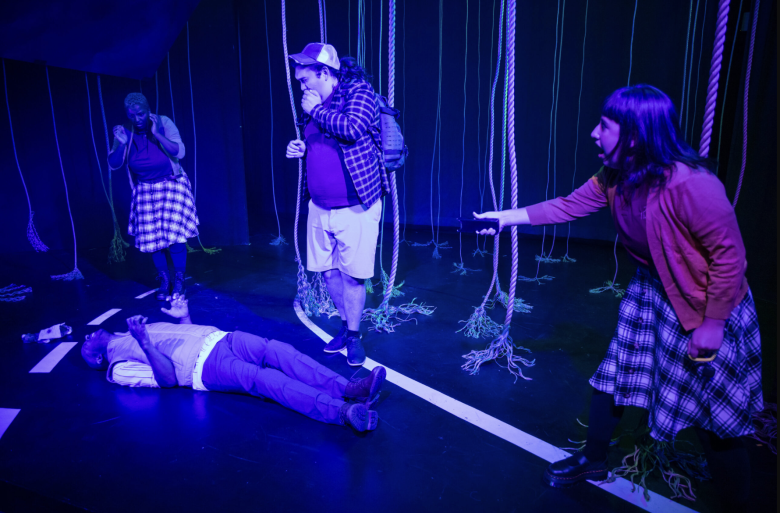
The story opens with three queer teens — Anita (Ashley Jaye), Charli (River Bermudez Sanders), and Zo (linda maria girón) — trying to escape a conversion therapy camp.
When the trio is caught by camp director Thomas (Kenny Scott), Zo uses Thomas’ own stun gun against him, and announces a new plan: Instead of escaping, they should take Thomas and the other counselors hostage, “deprogram” them, and liberate the camp.
Anita and Charli reluctantly go along, but Zo’s “by any means necessary” approach to deprogramming the counselors quickly makes them a caricature of the stereotypical “radical leftist.”
Charli, clearly meant to be a parody of an inactive pacifist, speaks in talking points rather than human dialogue, asks everyone for permission to approach them, and acknowledges everyone’s feelings as if they were filling out a form at the DMV.
As Zo’s actions grow more and more brutal, it seems as though Choi wants us to condemn not only the character’s violence, but also the righteous anger behind it. It’s akin to blaming protesters for provoking the police when, in fact, the protesters are often in danger from those police.
Performance-wise, the main trio do what they can with the paper-thin caricatures they’ve been given.
It helps to think of them as the Freudian model of the human psyche: Non-violent Charli is the superego; Zo is the raging id; and in-betweener Anita is the ego. They do their best to find the hearts of the hormonal teens who just want to live without fear.
Unfortunately, Kenny Scott’s performance as Thomas never connects. Whether by choice or direction, Thomas is consistently smug and insufferable, even in moments when he’s supposed to appear vulnerable.
The play’s choice of setting is never fully conveyed. With a main cast of only four (plus Landyn Endo and Annie Fraser as a rainbow-flagged ghost), there’s no sense as to how the actions of these three renegade teens affect their fellow campers and hostage counselors.
We only get stray lines of dialogue about what’s happening off-stage.
The premise of overtaking a conversion camp is one ripe with potential. Yet, “limp wrist on the lever“ never captures the scope of the main trio’s actions, nor does it make any of its characters into real people.
As a satire, Choi seems to have written a play where the punchline is how foolish an oppressed person is to think they could or should fight back against that oppression. But the script’s “We are the problem” attitude is horribly defeatist in a fighting time of history.
The world premiere of “limp wrist on the lever” runs through Oct. 4 at the Potrero Stage, 1695 18th St. Tickets are $0 to $100.
Women’s and men’s wants and needs are so different and fraught with conflict today. I’m surprised there are not heterosexual conversion camps… My life experience is that men on the down low are very numerous, they just want to have their needs met in private, because they just don’t have the self confidence to break the religious nut case strangle hold on sexual satisfaction. Religions are portals for misery, as anyone truly happy in their life does not need dumb religious dogma to create a performative veneer of happiness and their worthless IOU, for ‘a better place’ after you die, that never will be paid.
Now I’d be interested in someone’s opinion that favors ‘conversion therapy’. If they’re offended too, I’d say Choi crushed it…
It’s not conversion therapy, it’s conversion torture, brought to you by Republican culture warriors.