

Attorneys for three mayoral opponents say that candidate Mark Farrell has unambiguously violated campaign laws with his latest mailer, which ostensibly urges voters to support a charter reform measure, Proposition D, but prominently features Farrell touting unrelated accomplishments as mayor and accusing his successor of failure.
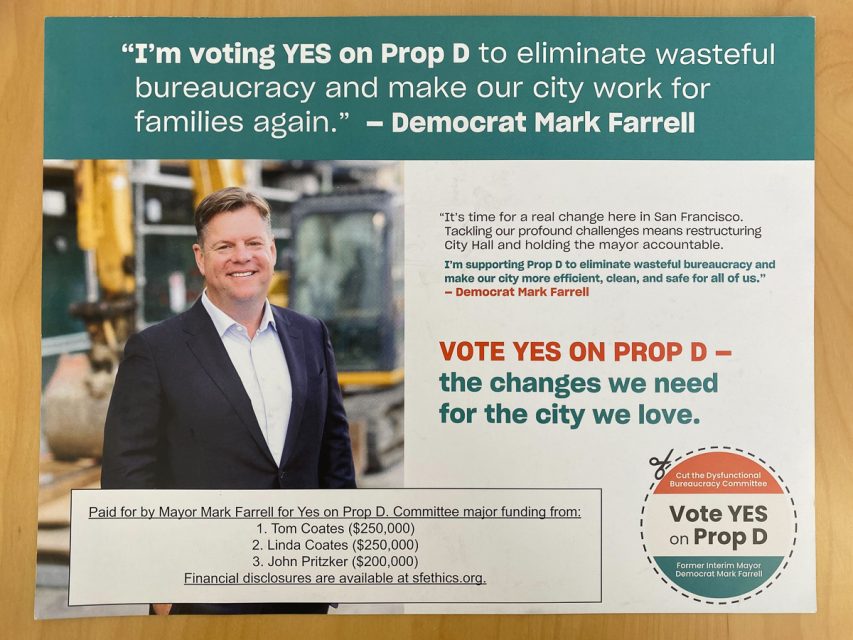
One side of the eight-by-11-inch placard, which was mailed to voters’ homes last week, features a smiling Farrell with his top button undone, urging a yes vote on the TogetherSF ballot measure. The mailer was paid for by Farrell’s candidate-controlled committee backing the measure: Mayor Mark Farrell for Yes on Prop. D.
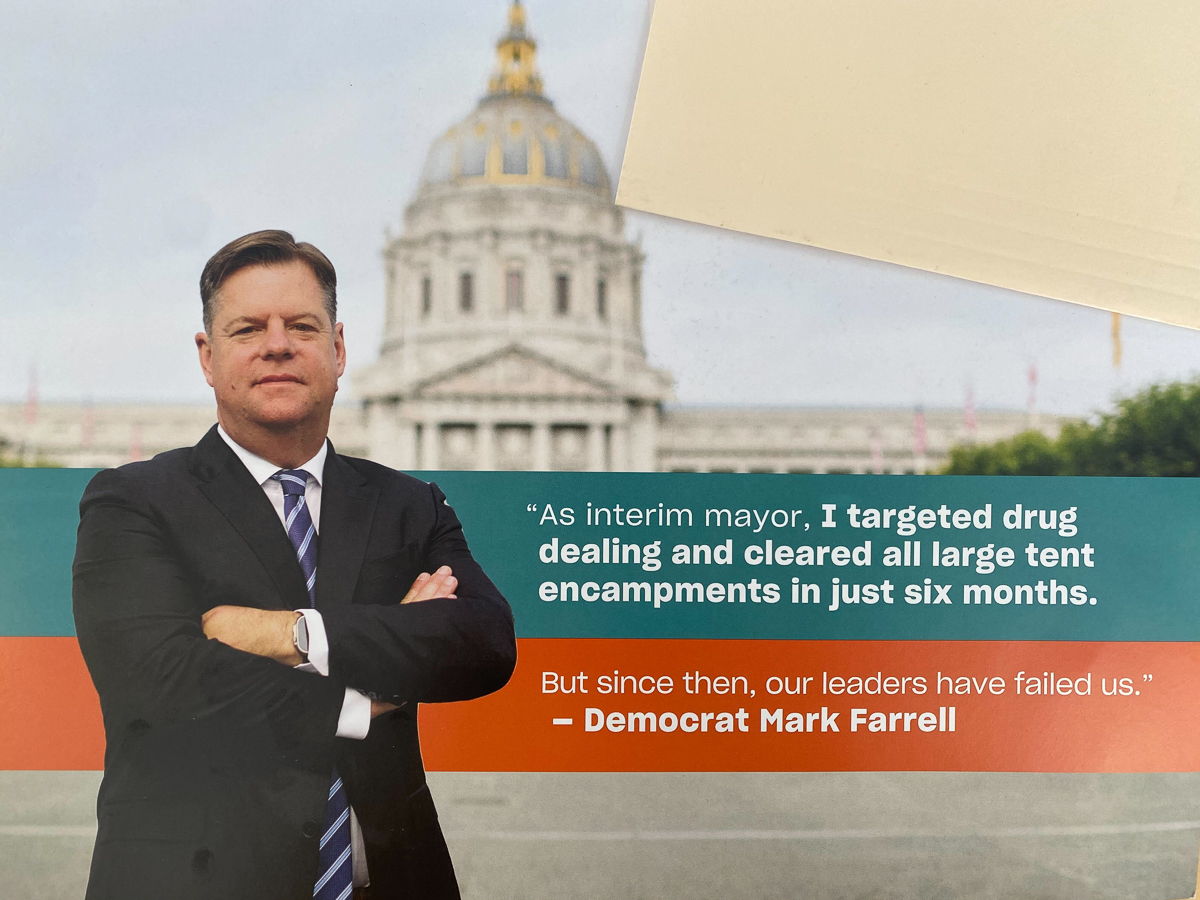
On the flipside, however, is a wholly different ad: A stern Farrell in a full suit and tie gazes at the viewer alongside the text: “As interim mayor, I targeted drug dealing and cleared all large tent encampments in just six months. But since then, our leaders have failed us.”
This statement is attributed to “Democrat Mark Farrell.” Farrell is superimposed in front of City Hall and Prop. D is not mentioned.
Prop. D would reduce city commissions from perhaps 130 to 65 and give the mayor more appointment power to remaining bodies; it is unstated how Farrell’s focus on drug-dealing and tents while interim mayor in 2018 are relevant to Prop. D.
Following last week’s mailer, Farrell’s Prop. D campaign released a very similar video ad.
On Tuesday morning, Mission Local submitted these detailed, written questions. Farrell offered the following response on Thursday evening:
“Every paid communication we share with voters is vetted and approved by counsel. We follow all laws — period.”
The attorneys advising his opponents’ campaigns, however, would beg to differ.
“It is perfectly legal for candidates to control ballot measures committees and take positions on ballot measures. That happens all the time,” says Jim Sutton, the campaign attorney for Daniel Lurie’s mayoral campaign. “But the communications have to actually be about the ballot measure. Not their qualifications for office and not a public policy issue — drug-dealing and tent encampments — which have nothing to do with the underlying measure.”
This sentiment was echoed by Tom Willis, the campaign attorney for Mayor London Breed: “If it had been a mailer about Prop. D completely, and didn’t have the stuff about his qualifications for office, that’d be okay. But that’s obviously not what it’s about. It talks about being interim mayor, being a Democrat, all those things. It replicates his campaign messaging.”
While the mail piece makes no attempt to connect Farrell’s purported achievements as interim mayor to Prop. D, the video ad does. Its voice-over states Farrell’s claims of targeting drug-dealing and removing tent encampments while interim mayor; states that his successor has failed, and then pivots to: “That’s why Mark is now supporting Prop. D to eliminate bureaucracy and unnecessary commissions.”
Bureaucracy and unnecessary commissions, however, would not constrain a mayor from targeting dealers or encampments — and, by Farrell’s own recollection, did not prevent him from doing so when he was mayor. This language was not sufficient, in Sutton’s opinion, to render the video ad compliant with the law.
“Judges aren’t stupid,” Sutton says. “Any judge will see this is a not-that-thinly veiled attempt to use over-the-limit corporate contributions to promote his mayoral candidacy.”
Whether this matter ever finds its way before a judge, however, remains to be seen. None of the rival campaigns would discuss whether or if a complaint had been filed with the Ethics Commission or California Fair Political Practices Commission. Neither Ethics nor the FPPC can comment on active complaints nor can either offer extemporaneous legal advice regarding campaign ads.
Barring unusual circumstances, any complaint leveled in the present or near future will not be addressed before November’s election. Ethics Commission enforcement actions often come years after the violations. Assessed fines can reach five digits, but these sums are a mere cost of doing business for the city’s major donors.
A fundraising juggernaut
A candidate for office tossing a measure on the ballot and using it as a publicity generator not only happens all the time; it’s happening multiple times on November’s ballot. Breed put Prop. O (supporting reproductive rights) on the ballot, and Board of Supervisors President Aaron Peskin did so with Prop. C (establishment of an inspector general). These can highlight subjects a candidate would want to talk about: Reproductive rights, in Breed’s case; cracking down on municipal corruption in Peskin’s.
They can also serve as indirect fundraising vehicles. San Francisco campaign laws cap individual contributions to a candidate at $500. But donors can contribute unlimited funds to a ballot measure committee — and they have. Thus far, Farrell’s Prop. D committee has brought in $2,117,028; the listed top donors on the mailer are real estate investor Tom Coates with $250,000; Coates’ wife, Linda, with $250,000 and billionaire hotelier John Pritzker with $200,000.
Other donors to the committee include Michael Moritz, venture capitalist and lead investor of TogetherSF, with $500,000, and William Oberndorf, a Republican mega-donor, with $195,000.
By sending out what they characterized as an overt mayoral campaign ad under the aegis of his Prop. D campaign, Farrell’s opponents accuse him of making a mockery of the $500 contribution limit.
They pointed, specifically, to California Government Code 82025, which holds that ads by a candidate for office for an ostensibly unrelated measure like Prop. D must “not take a position on the character, qualifications, or fitness for office of a candidate or officeholder … ”
The text and voice-overs for the recent Farrell ads both tout his qualifications and question those of his unnamed successor, Breed.
This, says Amber Maltbie, the campaign attorney for the Peskin campaign, runs afoul of Fair Political Practices Commission Regulation 18521.5. That’s “because it is biographical about Farrell, and not about the ballot measure.” Willis notes that, under FPPC regulation 18215, all or part of the cost of this citywide mailer should be treated as if it was a donation to Farrell’s mayoral campaign many times greater than the $500 limit.
“The city could and, in my opinion, should investigate, penalize and maybe even enjoin this conduct before the election,” Willis says. “This would restore some integrity to the campaign.”
Commingled funds
Farrell’s commingling of funds for his campaign promoting Prop. D and his own mayoral bid have drawn prior scrutiny. Campaign filings report that, between June 1 and July 15, $116,292 from the ballot campaign has been used to pay for workers on the mayoral campaign, as well as $11,650 more for shared office and insurance expenses — leading to accusations that Farrell is using the uncapped donations flowing into his Prop. D committee as a stalking horse to subsidize his mayoral run.
This charge got legs when Chronicle columnist Emily Hoeven last month visited the supposed joint headquarters of Farrell’s Prop. D committee and the Farrell mayoral campaign. She found, however, nary a hint of Prop. D material. When asked if there was any ballot measure material on site, Farrell’s mayoral campaign manager, Jade Tu, purportedly responded, “What ballot measure?”
Within the incorporating document of the Farrell committee pushing Prop. D, the principal officer is listed as Jade Tu.
Additional reporting by Kelly Waldron.



“When asked if there was any ballot measure material on site, Farrell’s mayoral campaign manager, Jade Tu, purportedly responded, “What ballot measure?”
Within the incorporating document of the Farrell committee pushing Prop. D, the principal officer is listed as Jade Tu.”
The perfect ending
Farrell and Breed are both ethically challenged and have no business being mayor of our beautiful city.