
This is the fourth installment of 43 Questions, a weekly column leading up to the 2016 supervisorial elections in which Mission Local asks a question a week of the four candidates for District 9.
In the midst of the homeless sweeps controversy last week, we asked candidates about their views on homelessness and how to adequately address the issue. Those responses can be viewed here.
We wanted to know more and decided to get more specific into the plans laid out by each candidate. We asked each of the four to elaborate on what they would do to address homelessness, from beefing up job services to finding sources of funding. Here are their answers.
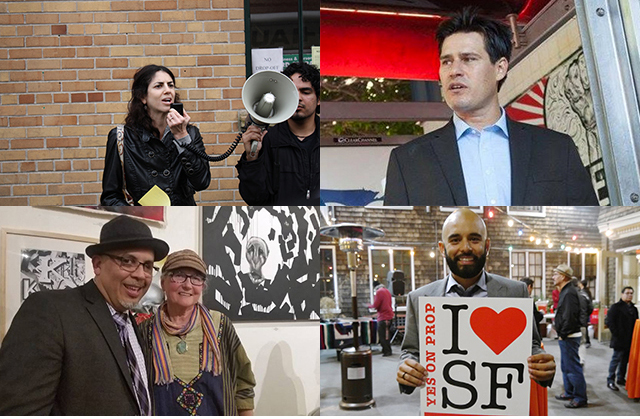
Edwin Lindo, Vice-President of External Affairs at the Latino Democratic Club
Question: You mentioned the Navigation Center in your previous response. Given that it only houses 75 people at a time, the city might need dozens of Navigation Centers to transition the 6,700 homeless people — and 3,500 unsheltered ones — in the city. How would you pay for this approach?
Answer: San Francisco currently spends $241 million a year on homelessness. This is enough to build 550 permanent housing units for our homeless population, each year! It’s not about decreasing the budget on homelessness, it’s about being innovative in our approach to leverage more funding from our budget and increase revenue through taxes on luxury goods and the business revenues of the many thriving businesses that have been entering the city. These new city revenues should be dedicated to a housing fund that increases services for tenant protections, homelessness, and permanent housing — ensuring we aren’t displacing more residents onto the streets.
Hillary Ronen, Chief of Staff for Supervisor David Campos
Question: You mentioned the Navigation Center, micro-housing, and increased mental health access in your previous response. Given that there are some 6,700 homeless people in the city — 3,500 unsheltered every night — the city may need dozens of Navigation Centers, thousands more units, and dramatically increased mental health capacity. How would you pay for improving these services?
Answer: San Francisco is the second wealthiest city in the country with an annual budget of $9 billion. It’s outrageous to tell San Franciscans that we don’t have the funds to invest in real solutions to homelessness. If we can afford tax breaks for billion dollar companies, and can foot the bill for the Super Bowl and America’s Cup we can afford homeless services. City Hall needs to come together to streamline and track existing services, pass homelessness bonds, and tax corporations to raise funds. It’s not acceptable to ask our residents to bear the brunt of this public health crisis any longer.
Joshua Arce, civil rights attorney and Community Liaison for Laborers Local 261
Question: You mentioned vacant public housing units. Are there enough vacant units in San Francisco for the 6,700 homeless in the city, and how would the city pay for retrofitting these units and moving people into them?
Answer: No, there aren’t enough vacant units but public housing is an essential piece of the puzzle for low-income or homeless families. We need increased investment to make more available, but we also need to be smarter with the money we already spend.
The Mission Navigation Center is an excellent example of how to get things right through coordination, but to end the cycle of homelessness we must provide more opportunity and treat people with dignity [and] respect.
We need a robust toolbox of opportunities – public and affordable housing, rental subsidies, eviction prevention assistance, supportive housing, better services and more career opportunities.
Iswari España, Training Officer with the San Francisco Human Services Agency
Question: You mentioned employment for the homeless — how would you improve job-finding services and what are some barriers to employment specific to the homeless that you would address?
Answer: I have 16 years of experience in the job creation environment. The city has services; however, these do not trickle down. Their system operates on the assumption that individuals will walk into a center and self-disclose. I propose the creation of an outreach team to meet people onsite. I would focus on the creation of on-the-job training and temporary/long-term employment. We will incentivize employers that hire this population.
Homeless are faced the inability to produce right to work documentation, no current job history, a phone line and mental health support, and a system that criminalizes their situation, which is inhumane and detrimental to their employability.
We hope our weekly column will also remind people to vote. San Francisco turnouts are notoriously low, and if you have recently moved or have not yet registered to vote, here is the page you will need to update your registration or to register for the first time.
If you have your own questions to ask the candidates, please send them to info@missionlocal.com with the subject line “One Question.”
35 years, 6 mayors later… $50M per year 1996, $241M per year 2016
“I lived in the city all my life, and I’d never seen anyone eating out of a garbage can before,” mayor d. feinstein – 1982
“We can end sleeping on the streets as a commonplace occurrence as we see it today, and we can do that this year.” mayor art agnos – 1990
“Rarely has San Francisco been so plagued by a problem as it presently is by homelessness.”
– sf chron – 1996
“I don’t have an answer . . . the problem may not be solvable,” – mayor w. brown – 1996
“This is a dramatic shift,” as he unveiled his “Ten Year Plan to Abolish Chronic Homelessness.” mayor g. newsom – 2004
“I’m not going to be so bold, like a politician might, as to say I am ending homelessness,”
mayor ed lee – 2015
It is not like homelessness just popped onto the radar for the Super Bowl.
The candidates and their associates have real records on dealing with or not dealing with these issues in the past on their watch.
The truth is that there will never be sufficient local resources to build affordable housing to deal with displacement and that there will never be sufficient local resources to house the homeless. Folks need to stop claiming that their 5% intervention will solve 100% of the problem.
So it does not make sense to cut deals for funding for those projects that end up empowering the same forces that are creating these problems because that only makes the problem worse.
Yet the declared candidates are focused exclusively on those interests who have a percentage in contracting with the government to nibble at the corners of affordable housing and homelessness or which support gentrification completely.
What I think that we’ll see at best are folks elected who will occasionally band together to stop the worst excesses coming out of Room 200 but which will be as cowed as the current crop of supervisors from going proactive on behalf of San Francisco residents.
What we will not see is any dent in homelessness nor in affordability because that would require political risk taking the likes of which we’ve not seen for a decade or more.
The questions I’d ask each of the D9 hopefuls is “What did YOU do for Mission residents during the war?” We must evaluate their answers amidst the wreckage of the Campos era.