

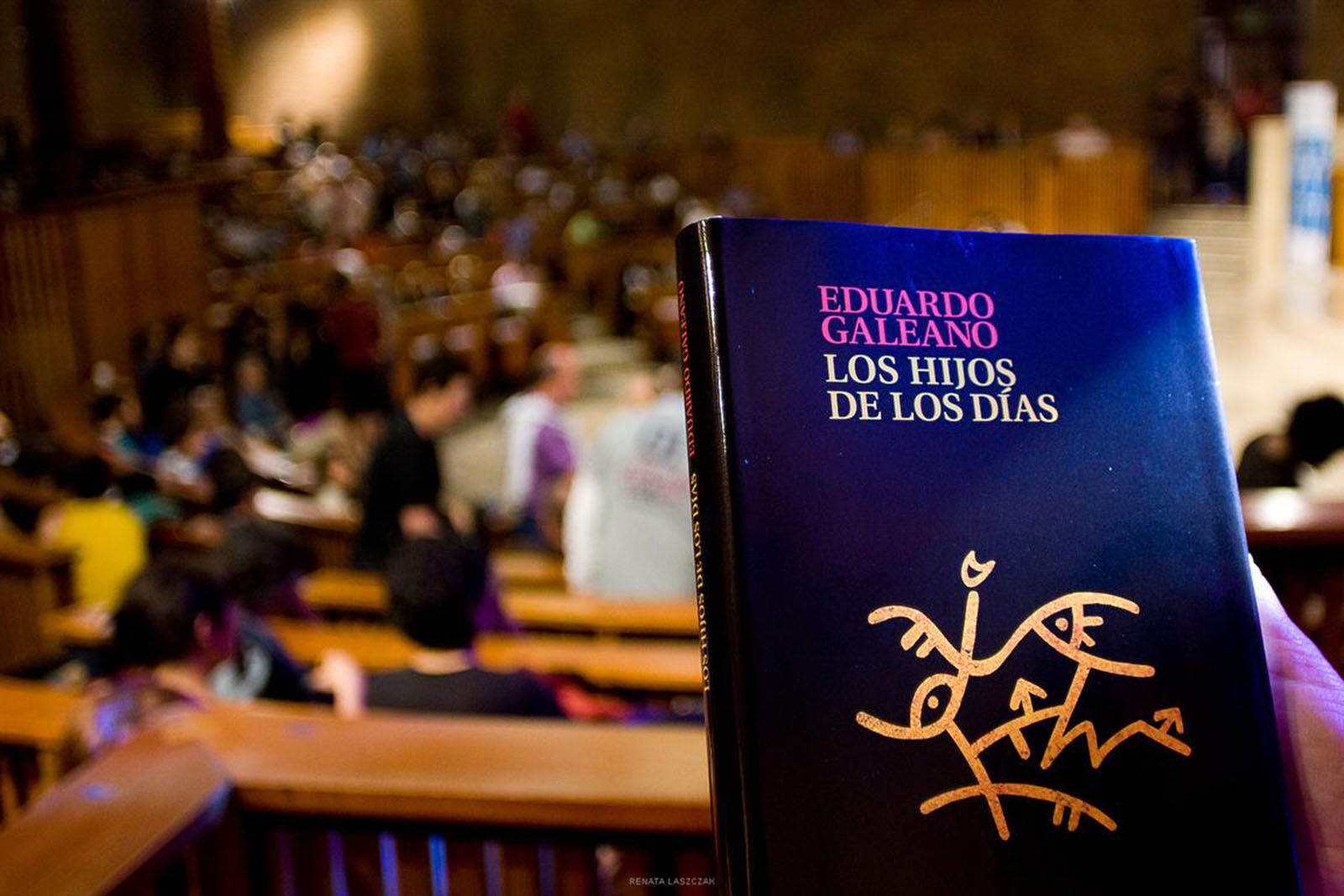
The following is an excerpt from an interview with Uruguayan poet and novelist Eduardo Galeano, one of Latin America’s most renowned storytellers. Galeano was recently in the Bay Area as part of a national tour promoting his most recent book “The Children of the Days: A Calendar of Human History” (2013).
The author was born in Uruguay in 1940, and lived in exile in Argentina and Spain for many years, returning to his homeland in 1985.
Each chapter of his new book describes historical events that took place on each day of the year. The UK Guardian calls the book a “dizzying collection of reminders of man’s inhumanity to man.” KPOO and Radio Bilingüe host Chelis López recently sat down to speak with him about his new book.
—
Chelis López: You are in San Francisco to read from your most recent book “The Children of the Days,” and I would like to start with [the chapter for] May 24 and March 23, “The Heretics and the Saint and Why We Massacred the Indians.”
Eduardo Galeano: This is very relevant today. For the first time in the history of Guatemala, an executioner [Efraín Ríos Montt], military murderer, was condemned for genocide. Three women sentenced him to 80 years in prison. Rigoberta Menchú began the suit against the general Efraín Ríos Montt; and the district attorney and the judge.
Until today, [Guatemala] was the paradise for impunity and it is alleged that more than 200,000 Guatemalans were killed by the consecutive dictatorships implanted since 1954, when the CIA placed a dictator instead of the [Jacobo] Árbenz government.
This is the story of all consecutive dictators of Guatemala, [reading from the book] “a year and a half later, president Ríos Montt, pastor of the Verbo Church, with headquarters in California, credited himself with the victory during the holy war that exterminated 440 indigenous communities.” I saw him on TV from Guatemala, him preaching [in California] for his sect Born Again, an American sect, saying the Holy Spirit was the chief of his intelligence service. According to him, the feat wouldn’t have been possible without the help of the Holy Spirit.
The military motto, the one that originated all these sinister adventures was: “We have to eliminate the seed,” meaning the seed that were the indigenous babies. It was a racist war of a white minority against the greater indigenous majority. Mayan and all their culture, a wonderful Mayan culture that is the one that gave the title to this book.
CL: The Catholic Church asked for forgiveness [in the town of Amah Mutsun, California] for the abuse and mistreatment since the 18th century to Native American Indians. Now they apologize, we have yet to see what the whole apology means. What do you think of this?
EG: Simply that asking for an apology, asking for forgiveness is very well. [Bill] Clinton was as well in Guatemala a few years ago and asked for forgiveness, given the American support to the dictatorship that had devastated Guatemala. But, forgiveness doesn’t resuscitate anyone, right? It is a safe-conduct, very comfortable to avoid responsibility. I don’t really believe in forgiveness.
CL: Eduardo, what do you think about objectivity in the media?
EG: It is a big lie. I don’t believe that objectivity is possible, and if in any case it were to be possible, it’s not my thing. I have never been neutral in my life. Never. I always sided with the losers, which sometimes won me harsh beatings. I never knew how, nor do I want to be neutral.
CL: [In your new book,] February 29 is [titled] “Not Gone With the Wind,” in which you refer to modern slavery. I would like you to talk about that.
EG: [On February 29] in 1940, Hollywood gave eight Oscars to a movie called “Gone With the Wind,” which was a long sigh of nostalgia for the good old times of the lost slavery. Twenty-five years earlier, a full-length silent film was the first blockbuster of Hollywood, called “The Birth of a Nation.” It was an anthem of praise to the Ku Klux Klan. The movie ends with Jesus himself blessing the Ku Klux Klan, and this was a big hit in Hollywood during many years.
CL: But you refer to slavery as well, and such nostalgia for the slavery of the good old time. And at that time not just in the United States but in other places.
EG: As of now that movie is a long sigh of nostalgia for the lost slavery and of course we are living the world of our time, in the global era of capitalism. We are living ways of slavery that don’t even have the honesty to call themselves slavery.
Not too long ago, a catastrophe happened in Bangladesh. A building caught on fire and crumbled down, with several sweatshops, where modern slaves earn one dollar per day of work for the big corporations. More than 1,000 people [died]. People burned alive by the fire produced in the overcrowding and dreadful working conditions. In the first place, it is prohibited for workers to unionize. They cannot create a union. If they create a union, they are expelled right away.
CL: OK, moving on to September 15: “Adopt a Banker!” This means, if nature was a bank, it would have already been bailed out.
EG: It is true because the whole world is focused on banks’ bailout. And no alarm goes off there, nor do they appear in the crime section of newspapers. The key to the big crisis unraveled precisely on September 15. And I launched a campaign called Adopt a Banker, making fun of the sympathy that bankers were worthy of. The truth is that the Wall Street magicians were experts in selling castles in the sky stealing millions of houses and jobs, but only one banker went to jail.
CL: You [have] said that the best language is silence. How extraordinary is a language where words do not exist?
EG: I am a man of words, but….every page of mine that starts out with 30 lines ends up having three because I delete all the words that are not better than silence.
I work by crossing out more than I do writing. [Mexican author] Juan Rulfo one day told me he wrote less with the tip of the pencil, than with the butt of the pencil—where the eraser is.
And [Uruguayan author Juan Carlos] Onetti said to me that the only words worthy of existing were the words better than silence. How good would it be that everyone of us who work in media had a huge sign before our eyes saying that the only words worthy of existence are the words that are better than the silence? That fight is not easy because competing with silence is almost impossible. The only perfect language is the language of silence because it is the only one that speaks while silent.
—
This interview was originally broadcast on “Línea Abierta,” a news and talk show based in Oakland and Fresno, as well as on KPOO Radio in San Francisco. This edited excerpt was translated from the Spanish by Andrea Valencia.
