

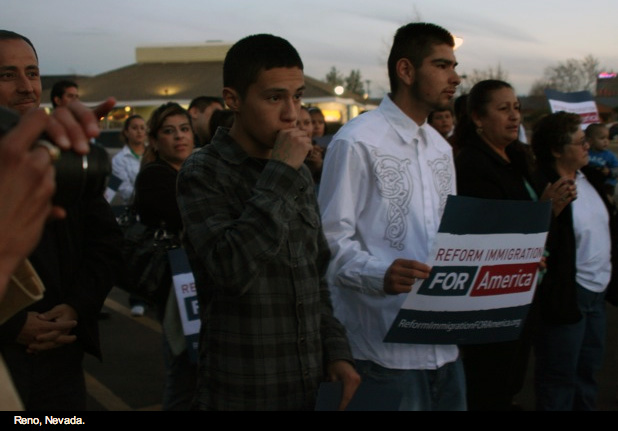
Mission Loc@l reporter Rigoberto Hernandez will be feeding news briefs on the road to the national March For America Campaign. The bus left San Francisco Wednesday and will join others from across the country on March 21 at the National Mall in Washington DC. Their aim is to to ask Congress to pass immigration reform.
Having to watch people’s round-the-clock behavior in a bus headed to Washington D.C. has given me insight into who these immigration activists are, the lives they lead in the Bay Area and their reasons for making this cross-country journey.
Take Esperanza (not her real name) from the Berkeley Organizing Congregations for Actions, who is making phone calls to encourage participation in the in San Francisco marches on March 21 and 24.
She has made 10 calls since she got on the bus Wednesday and 50 since she began organizing three weeks ago. Many were asked to do this but she seems to be only one making progress.
“If I stayed quiet [it would] affect my kids,” she said.
Her approach is working. Her daughter, the first person in her family to go to college, is about to finish her second year at UC Berkeley with a 3.3 GPA.
Even though Esperanza never finished middle school and her husband never made it past elementary school, she said her daughtProxy-Connection: keep-alive
Cache-Control: max-age=0
succeeded because she has always been an involved parent. She started meeting with her daughter’s teachers in kindergarten and kept on through high school.
“I even wanted to meet with her university teachers,” she said. Her daughter refused.
Esperanza and her husband lived by the most fundamental American values: working hard for 25 years, investing in property and giving their two kids everything they lacked growing up. This often meant working more than one job. No matter, they managed.
Then on the first day of her daughter’s senior year of high school, immigration officials arrested her husband at work for being undocumented, she said.
They paid $10,000 to bail him out and have spent more than $30,000 to defend his case in court, she said.
In 2008 the judge ruled in favor of her husband and said, “This country needs more people like him.”
Immigration officials then appealed the case and won, citing that he did not have “extreme or unusual circumstances.”
“Then what do you call this suffering?” she asks with tears in her eyes.
Just last week her husband received his deportation letter. The idea of having to pay off mortgages and raise her 12-year-old son alone is daunting, she says.
At Thursday night’s rally in Denver, Esperanza again shared her story with a crowded audience.
“In the bus they asked me to write up my testimony,” she said. “I don’t have to write it because, sadly, my situation is burned inside my mind and I wish I could forget it.”
Nevertheless she is trying to keep up her family’s spirits up as they, except for her daughter, are riding the bus to Washington D.C. Her daughter will fly there tomorrow night to give her testimony at the National Mall in front of an estimated 100,000 people on Sunday, March 21.
Religion and Immigration Reform
Religion is a big part of this trip. At every city stop, religious figures greet us and give us their blessings. Every few hours people sing Christian songs and pray.
And even though some secular groups are organizing buses to D.C., it is not surprising given that the PICO National Network, which organized the Bay Area bus to Washington, is a faith based organization.
Still, how do religion and immigration reform connect?
I asked Leticia, from Church of the Epiphany in the Excelsior and one of the most religiously active people in the bus.
“It’s very simple,” she said. “The bible tells us that we have to treat everyone the same.”
Soon after this conversation the subject comes up again when Eddy, one of the PICO organizers asks who was Catholic. Half a dozen riders raise their hand.
A passenger, from San Francisco, chimes in.
“I wish we had more people from other religions because that is why I love this organization,” she said.
Javier Torres says religion gives him strength to continue on and is not afraid to show it.
On the drive from Salt Lake City to Denver, he leads a 20-minute prayer, the longest of the trip so far.
When he leads the Spanish-speaking prayer at the rally at Denver, he said he really got into it because only minutes before, he had found a friend he hadn’t seen in more than 20 years.
Coming up tomorrow: Why the seven stops were chosen and the story of Mission District resident Juan Carlos.
andres meza, why don’t you move to Mexico and advocate open borders and see how that type of democracy works?
me encanta que hay personas que no solo suenan de un cambio sino que toman la accion en sus manos y buscan una reforma migratoria justa.estamos ejercitando nuestros derechos a ser felices a traves de la democracia
this is great GOD is in our side psalms 12;5.i get fired up when i see people from diferent back grounds takin action in their hands.this is the real democracy thath america preaches some times with bombs and war mashines to convence the world abouth fredom
While they are there can they protest to legalize robbing banks?
beautiful, la lucha sigue